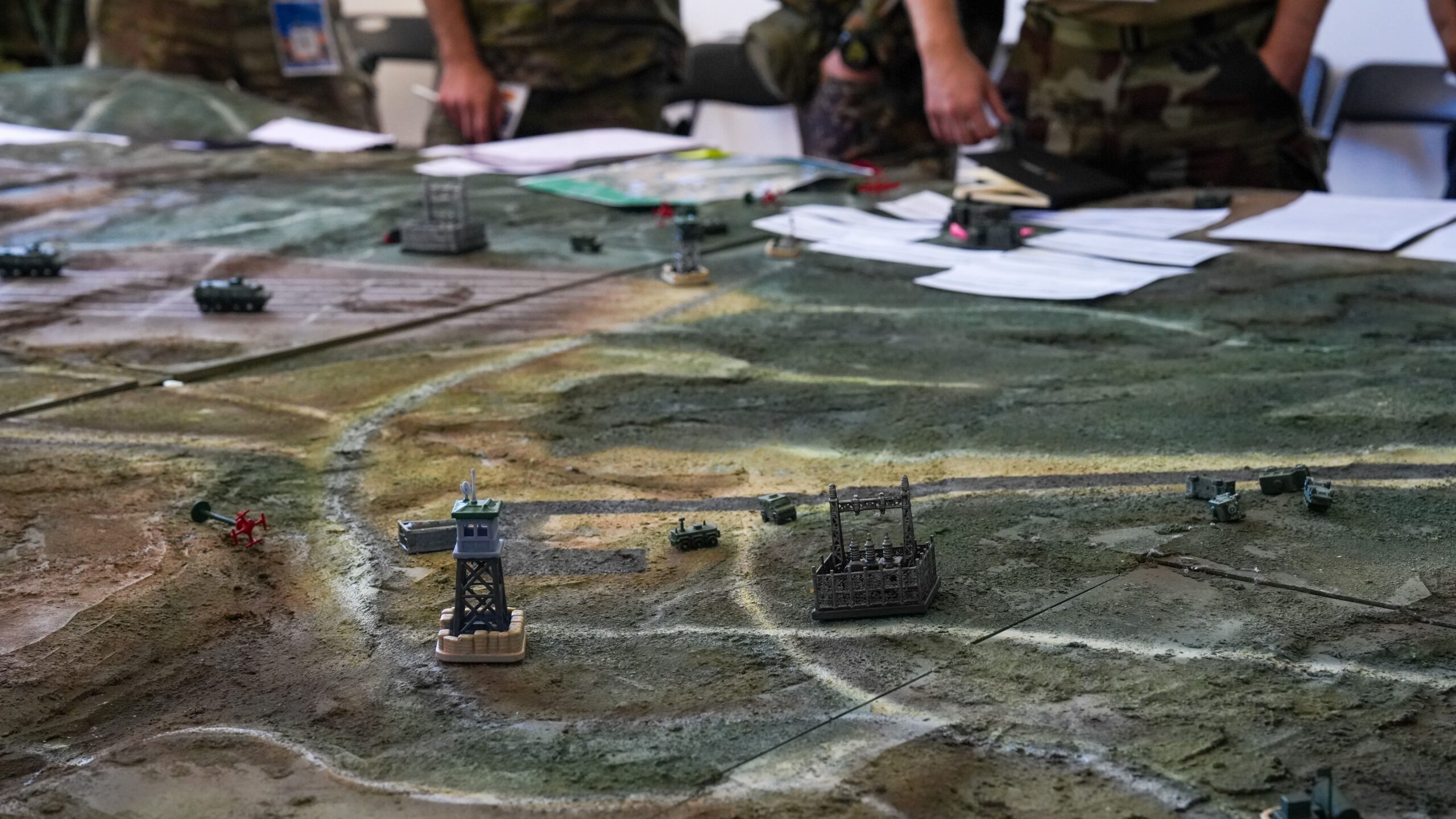
The European Defence Agency (EDA) has tested how European military specialists coordinate the weaponized drone response once a hostile aircraft has been shot down, running a tabletop exercise named European Vigilant Shield at Portugal’s Santa Margarida military camp. Disclosed by the agency on October 7, 2026, the exercise examined render-safe procedures, chemical, biological, radiological and nuclear (CBRN) hazard management and evidence recovery after a drone is neutralized over a military site or critical civilian infrastructure.
Following the September 2025 incursion of Russian drones into Polish airspace and drone sightings that shut airports in Copenhagen and Munich, the European Commission placed the European Drone Defence Initiative among four flagship projects in its Defence Readiness Roadmap 2030, released on October 16, 2025. The roadmap targets initial capacity for the initiative by the end of 2026 and full functionality by the end of 2027, built around a multi-layered architecture to detect, track and neutralize hostile drones. European Vigilant Shield addresses the step that architecture does not cover: what responders face on the ground once the aircraft falls.
Inside the Weaponized Drone Response: Render Safe, CBRN and Evidence
The exercise premise is blunt: neutralizing a drone does not neutralize its payload. According to EDA, an explosive charge can remain active after the airframe is downed, and a device carrying chemical or radioactive material can spill its contents around the impact point. Either outcome converts an air defense engagement into a ground hazard that requires explosive ordnance disposal (EOD) and CBRN teams working in sequence, often under time pressure and close to sensitive infrastructure.
The defeat method shapes that hazard. A drone forced down by electronic attack, such as radio-frequency jamming or satellite navigation spoofing, is more likely to reach the ground with its warhead, fuze and electronics largely intact, which preserves evidence but leaves a live device for responders. A kinetic intercept tends to scatter debris and unexploded components over a wider area. The threat set ranges from commercial quadcopters modified to drop grenade-sized munitions to long-range one-way attack drones; publicly available estimates place the warhead of the Iranian-designed Shahed-136, produced in Russia as the Geran-2, at roughly 40 to 50 kilograms.
Participants worked through scenarios of increasing complexity covering threat assessment, render-safe actions and hazardous material handling. They also rehearsed the safe recovery and analysis of components while preserving the evidence needed to establish responsibility for an incident. That final step, technical exploitation, is where a single downed drone becomes intelligence: flight controllers, navigation modules, datalink hardware and component markings can reveal origin, supply chains and launch profiles, provided they are recovered without contamination or loss.
How NATO Centres of Excellence and UNMAS Shaped Vigilant Shield
EDA assembled expertise across six fields: counter-drone operations, command and control, CBRN defense, EOD, technical exploitation and military legal affairs. National experts worked alongside the United Nations Mine Action Service (UNMAS), NATO’s Counter-Improvised Explosive Devices Centre of Excellence (C-IED COE), the NATO Joint CBRN Defence Capability Development Group and the Joint CBRN Defence Centre of Excellence. The agency lists all 27 of its member states as participants but did not disclose the exercise dates or the number of personnel involved.
The partner mix maps onto the problem. The C-IED COE, based near Madrid, carries NATO’s institutional knowledge of exploiting improvised explosive devices, with exploitation organized in tiers from the incident site to national laboratories. The two CBRN bodies, including the Joint CBRN Defence COE hosted in Vyskov, Czech Republic, bring detection, sampling and decontamination doctrine. UNMAS adds field experience in clearing explosive hazards in conflict and post-conflict environments.
The inclusion of military legal affairs reflects the peacetime reality. A drone downed over an air base or a power plant on EU territory falls into a jurisdiction where police, prosecutors and civil protection authorities typically hold primary responsibility. Chain of custody, rules for handling recovered material and the legal basis for military involvement determine whether exploitation results can support attribution, sanctions or prosecution.
From Tabletop to Field Trials: Vigilant Shield Roadmap to 2028
EDA has set out a three-step program. Virtual wargaming in 2027 will introduce more complex scenarios and test decisions spanning several teams. Live experimentation in 2028 is planned to test the full response under field conditions, from defeating the drone through specialist intervention to analysis of recovered material. Findings from the Portugal tabletop will feed a review of tactics, techniques and procedures and of military doctrine.
The venue places the work alongside Europe’s offensive drone experimentation. Since September 28, Santa Margarida has hosted EU OPEX 2026, the operational experimentation campaign run by EDA’s Hub for European Defence Innovation (HEDI) and the Portuguese Army, with more than 200 participants testing unmanned systems, loitering munitions and electronic communications. EDA frames European Vigilant Shield as a contribution to the Defence Readiness 2030 agenda, converting operational problems into priorities for capability development, experimentation and cooperation.
Analysis: Europe’s counter-drone build-up has been framed largely as a sensor and effector problem, and the European Drone Defence Initiative milestones measure detection and defeat. European Vigilant Shield exposes the downstream gap. Without a common post-intercept chain covering render-safe, CBRN containment and technical exploitation, each member state processes wreckage under its own procedures and legal rules, which slows collective attribution of hybrid incidents and weakens the feedback loop that should inform sensor and interceptor requirements. A standardized exploitation process would turn every downed drone into shared data on adversary hardware.
The near-term marker is the European Drone Defence Initiative’s initial capacity, due by the end of 2026. EDA has not published the exercise findings or identified which procedures it expects to change, and it has not said whether the 2028 live phase will use hazardous material simulants, which member states will host it or how its output will align with NATO counter-drone and counter-IED doctrine. Those answers will determine whether European Vigilant Shield produces common standards or remains a series of experiments.