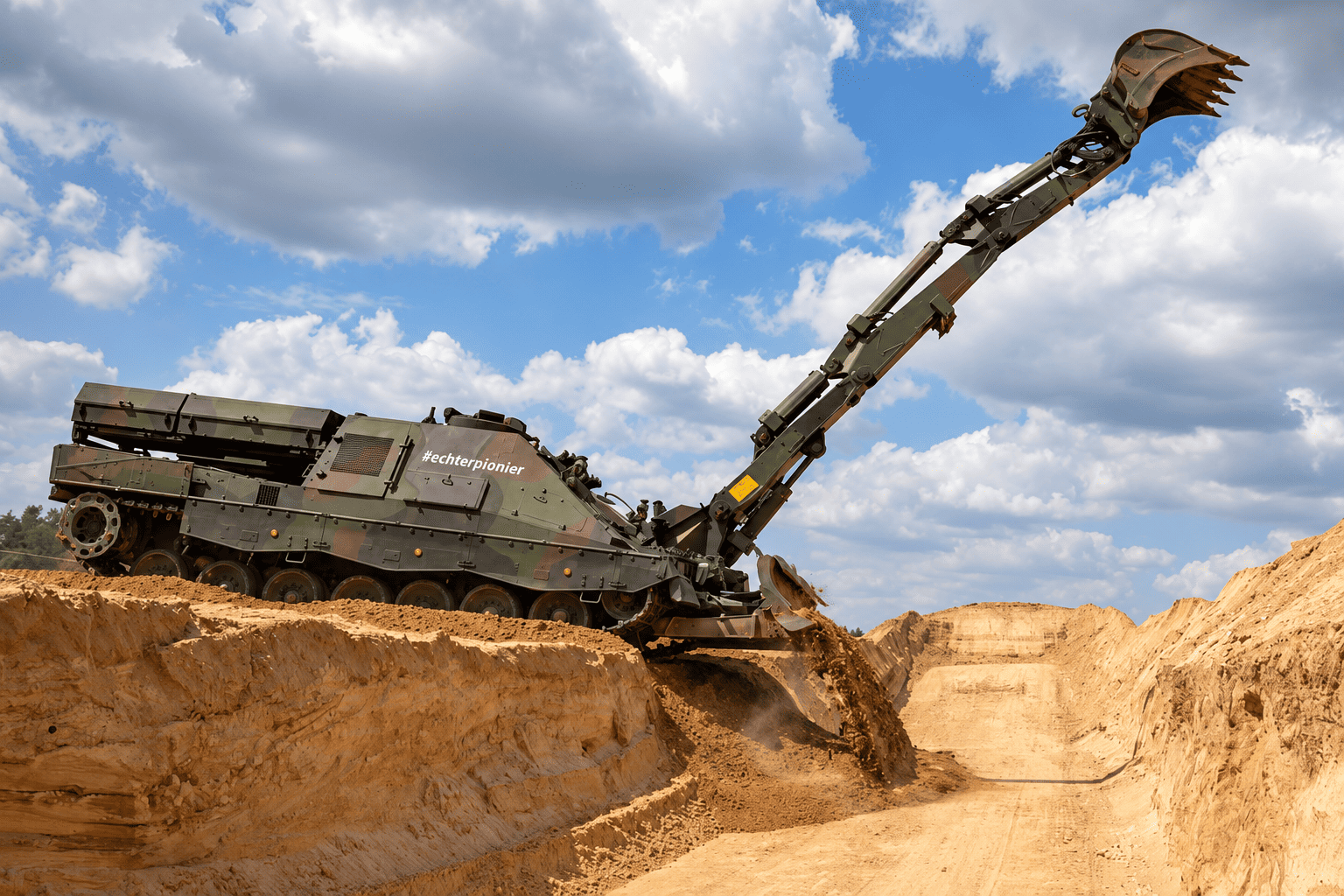
The Bundeswehr has begun official trials of the Kodiak engineer vehicle, Rheinmetall’s Pionierpanzer 3, without the Natter remote weapon station it was planned to carry. Germany’s Federal Office of Bundeswehr Equipment, Information Technology and In-Service Support (BAAINBw) confirmed that Rheinmetall delivered two qualification vehicles at the end of August 2026; both are now in government testing at the Bundeswehr’s technical centers (Wehrtechnische Dienststellen, WTD).
The configuration change hits a program already running about three years late. In May 2021, the BAAINBw awarded Rheinmetall Landsysteme GmbH a contract worth about €295 million for 44 vehicles, built on Leopard 2A4 hulls supplied from Bundeswehr stocks, to replace part of the German Army’s Leopard 1-based Pionierpanzer 2 Dachs fleet. In June 2026, the Federal Ministry of Defence (BMVg) pushed the qualification vehicles, originally due in 2023 and 2024, into the second half of the year, blaming contracted work Rheinmetall had not yet sufficiently delivered.
Natter, FLW 200 or Protector RS4 on the Kodiak Engineer Vehicle
“The statement regarding the weapon station configuration is correct. However, due to ongoing negotiations, no further information can be provided at this time,” a BAAINBw spokesperson said. The office declined to say why testing began without the Natter, whether alternatives are under review, or what extra cost or delay could follow, citing “reasons of military security and contractual requirements.” Rheinmetall also declined to comment, pointing to procurement law.
Publicly available specifications indicate the Natter 7.62, originally designed for trucks, weighs under 100 kilograms, while the Natter 12.7 weighs under 200 kilograms and takes a 12.7×99 mm heavy machine gun or a 40 mm grenade machine gun for armored vehicles. Both use the all-weather FlexEye sensor head mounted coaxially with the weapon. Rheinmetall’s brochure for the Bundeswehr configuration lists the Natter on the Kodiak; which variant the contract specified has not been disclosed.
Observers do not rule out fielding the Kodiak with a station already in German service. KNDS Deutschland’s FLW 200 (Fernbedienbare Leichte Waffenstation 200) weighs about 185 kilograms without weapon and ammunition, carries a cooled thermal imager and is covered by a ten-year Bundeswehr framework contract for more than 500 units; it also equips the Leopard 2A7+ tanks built for Qatar. Kongsberg’s Protector RS4, at 135 to 190 kilograms depending on variant, has been selected for German Boxer and Patria 6×6 programs, and Protector stations are fielded on US Army M1 Abrams tanks. Both accept heavy and grenade machine guns and are proven on heavy tracked hulls.
Leopard 2 Hull, Excavator Arm and Twin Winches: Kodiak Specifications
Rheinmetall developed the Kodiak from 2002 with Swiss partner RUAG against a Swiss Army requirement, and Switzerland (12 vehicles), the Netherlands (10), Sweden (6) and Singapore (14) already operate it. Publicly available specifications indicate it retains the Leopard 2 powerpack, an MTU MB 873 Ka-501 V12 twin-turbo diesel rated at 1,100 kW (about 1,500 hp), with a combat weight around 62 metric tons in Military Load Class (MLC) 70 for earlier vehicles. Rheinmetall lists the German configuration at MLC 80, a heavier rating that bridging and gap-crossing planners must account for. A crew of two or three runs every engineer system under armor.
The design centers on an articulated excavator arm center-mounted at the hull front. According to the manufacturer, it moves about 200 cubic meters of soil per hour and lifts about 3.5 tons at a maximum reach of 9 meters, and tools such as a gripper or concrete crusher can be changed without the crew leaving protection. Two capstan winches rated at 9 tons each can pull more than 60 tons through deflection pulleys. The dozer blade adjusts in cutting and tilt angle, and Dutch vehicles can mount a mine plow instead. Rheinmetall developed the 350-bar hydraulics in-house. Working forward and often stationary while digging, a Kodiak relies on its weapon station for self-protection against infantry and light vehicles.
Pionierpanzer 3 Program Slips Three Years From the 2019 Plan
The BAAINBw opened the competition for 44 armored engineer machines, the Gepanzerte Pioniermaschine program, on November 25, 2019. The original plan called for contract award at the end of 2020, qualification vehicles in 2023, authorization for use by 2025 and first fielding in 2026. Rheinmetall’s modernized Kodiak beat Flensburger Fahrzeugbau Gesellschaft (FFG), which offered its WiSENT 2 in an armored recovery configuration. Including training, initial spares and special tools, the package works out to about €6.7 million per vehicle.
The contracted delivery profile foresaw five vehicles in 2026, 14 in 2027, 17 in 2028 and the final six in 2029. As late as September 2025, the BMVg still expected the qualification vehicles in spring 2026. In June 2026, Rheinmetall said trials would open with mobility and engineering functions, followed by the tactical operational test, and that series deliveries would proceed as contractually agreed.
Analysis: Starting trials without the specified station lets the BAAINBw qualify the Kodiak’s mobility and engineering functions while the armament question is negotiated, but it moves risk downstream. Any substitute station needs its own integration and possibly additional testing, on a program with no schedule margin left. Choosing the FLW 200 or Protector RS4 would give the Bundeswehr commonality with stations already in its training and logistics chain, a real advantage for a fleet of only 44 vehicles. Who pays for that change is for the negotiations to settle. For NATO, the issue is practical: armored engineers set the pace of breaching and obstacle work for Germany’s heavy brigades, and every year of delay keeps the Leopard 1-based Dachs in frontline service longer.
The next milestones are the end of WTD mobility and engineering trials, the tactical operational test, and the authorization for use that must precede series acceptance. Neither the BAAINBw nor Rheinmetall has disclosed a revised date for first troop deliveries, the weapon station production vehicles will carry, or whether the 2029 completion target still holds.