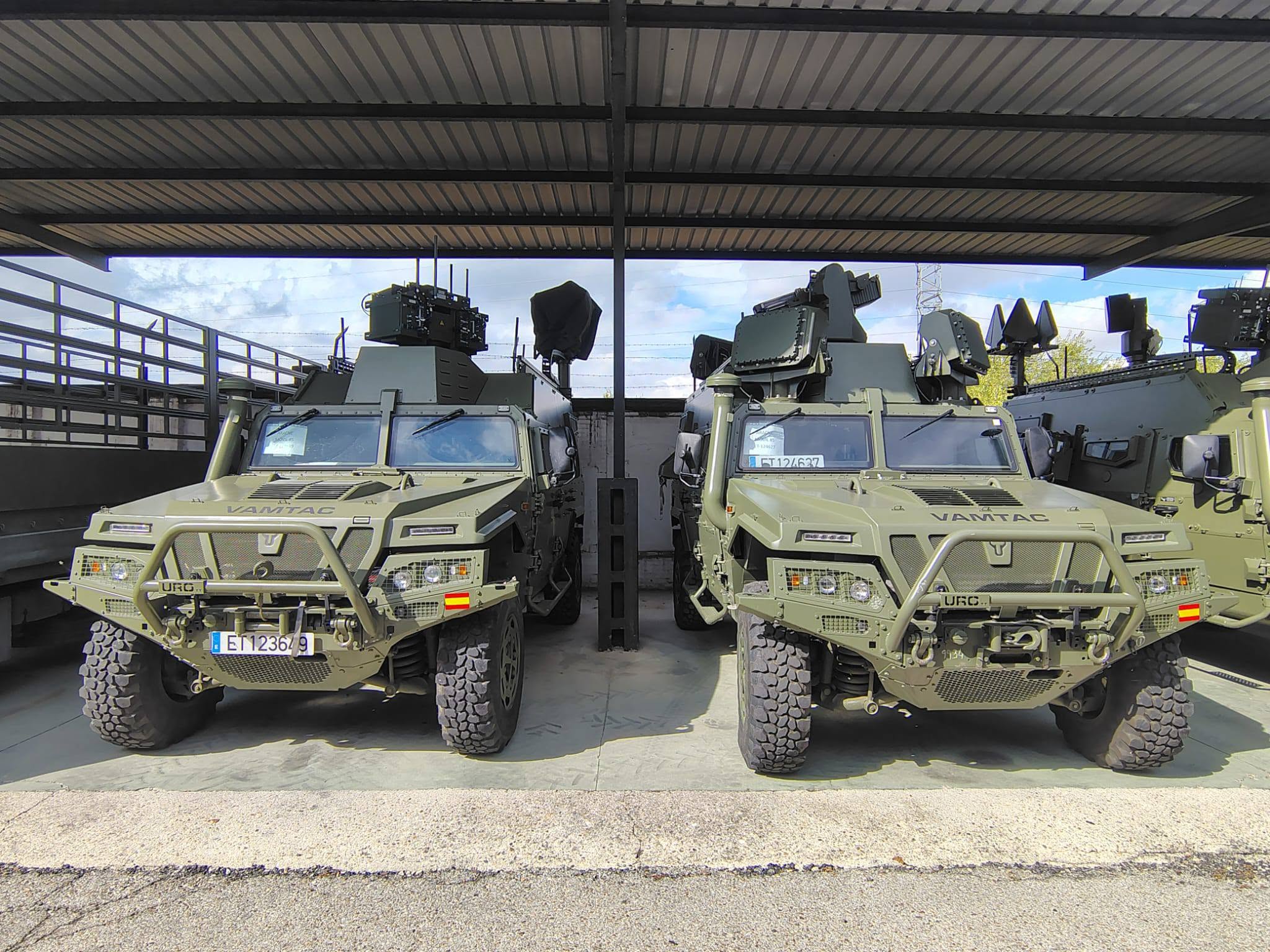
The Spanish Army’s 71st Anti-Aircraft Artillery Regiment (RAAA 71) has taken delivery of its first ARACNE counter-drone systems, the service announced on October 8, 2026. The regiment, the Army’s reference unit for counter-unmanned aircraft systems (C-UAS), has already completed the operational evaluation (EVAO) of ARACNE’s soft-kill, non-destructive mode; hard-kill evaluation follows at the Army’s next ATLAS exercise. The Army did not say how many systems arrived.
ARACNE stems from a contract worth just over €30 million signed in February 2025 between Spain’s Ministry of Defense and a temporary joint venture of Indra and EM&E Group, the country’s first major procurement dedicated solely to counter-drone systems. It covers 14 systems: fixed sets with a shelter-based command post for base protection, and mobile sets on two VAMTAC ST5 tactical vehicles. The Army receives five fixed and five mobile systems plus a simulator, while the Navy and the Air and Space Force each take one of each. According to Indra, the fixed sets were delivered by the end of 2025 and the mobile sets were due in mid-2026.
Inside the ARACNE Counter-Drone System Sensor and Effector Chain
At the core sits an Indra command-and-control (C2) system that fuses radar, radio-frequency (RF) and optical tracks, classifies the target and helps operators choose between jamming, link takeover or a kinetic engagement. The requirement targets low, slow and small (LSS) drones that conventional air defense radars struggle to see.
Primary detection comes from Indra’s Nemus, a compact active electronically scanned array (AESA) radar able to operate on the move. Publicly available specifications indicate 360-degree azimuth coverage, detection of a target with a 1 m² radar cross-section (RCS) at 12 to 15 km, and of 0.01 m² micro-drones at about 4 km. Indra’s 20 kg SmartEar RF sensor passively covers 400 MHz to 6 GHz out to roughly 6 km, picking up control and video-link emissions without radiating. EM&E’s Oteos electro-optical sensor, which pairs an HD day camera with a third-generation thermal imager, is credited with detecting a NATO standard target beyond 14 km by day and up to 23.1 km in infrared, giving crews positive identification before they engage.
Indra’s Brontes/EVO jammer handles non-kinetic defeat, with a published reach of up to 15 km against satellite navigation (GNSS) signals and 5 km against the drone’s command link. This is the mode RAAA 71 has now validated. The hard-kill layer exists because fiber-optic and autonomous drones, a lesson driven home in Ukraine, ignore jamming entirely. It uses EM&E’s Guardian 2.0 remote-controlled weapon station, fitted with a 40 mm Mk 19 automatic grenade launcher and an optimal engagement envelope of 200 to 700 meters. The station also accepts 5.56 mm to 12.7 mm machine guns and cannons up to 30×113 mm, leaving room to upgrade the effector as the threat evolves.
From Cervus to ATLAS: The Road to RAAA 71 Hard-Kill Certification
In the mobile configuration, one VAMTAC ST5 carries the identification and electronic warfare equipment and the other the radar and weapon station, so a section can move with a maneuver unit while splitting detection and engagement across two platforms. The Army has not disclosed whether programmable airburst ammunition, which sharply improves the odds of hitting small drones with 40 mm rounds, is part of the package.
ARACNE builds on the Army’s Cervus program, launched by the 31st Electronic Warfare Regiment to test whether its existing EW equipment could detect small drones early. Cervus I and II were soft-kill only; Cervus III, integrated by TRC, added the Oteos sensor and the Guardian 2.0 station to close the detect-to-defeat chain. Cervus variants have protected Spanish troops on NATO deployments in Latvia and Slovakia, and the Army has since evaluated the mobile ARACNE configuration during NATO trials in Slovakia.
RAAA 71, based at Fuencarral in Madrid under the Army’s Anti-Aircraft Artillery Command, directed ATLAS25 at the Médano del Loro range in Huelva from October 20 to 24, 2025. One of Spain’s largest counter-drone drills, it brought together all three services, the Civil Guard and the National Police, and Indra demonstrated ARACNE there. Separately, an Indra C-UAS system has protected the Air and Space Force’s Vilkas tactical air detachment in Lithuania since December 2025, covering roughly 200 personnel, 11 Hornet fighters and an A400M tanker against incursions by drones and unidentified balloons from the Russian and Belarusian area. Indra says that system continues to evolve within the ARACNE project.
Analysis: ARACNE’s value lies less in any single sensor than in a sovereign C2 layer that Spain controls end to end and can extend to new effectors. Scale is the constraint. Ten Army systems, averaging a little over €2 million per set across the 14-system buy, amount to a pilot fleet for a force with NATO commitments on the eastern flank and bases to defend at home. The 200 to 700 meter hard-kill envelope also makes ARACNE a point-defense tool against LSS drones, not an answer to larger one-way attack drones, which remain a job for short-range air defense missiles.
The next milestone is the hard-kill EVAO at the upcoming ATLAS exercise, for which the Army has given no date. The Ministry of Defense is also preparing a follow-on ARACNE contract with Indra and EM&E under this year’s Special Modernization Programs; its value and scope are undisclosed. Still unknown: how the remaining Army sets will be distributed and which ammunition the Guardian 2.0 stations will carry.