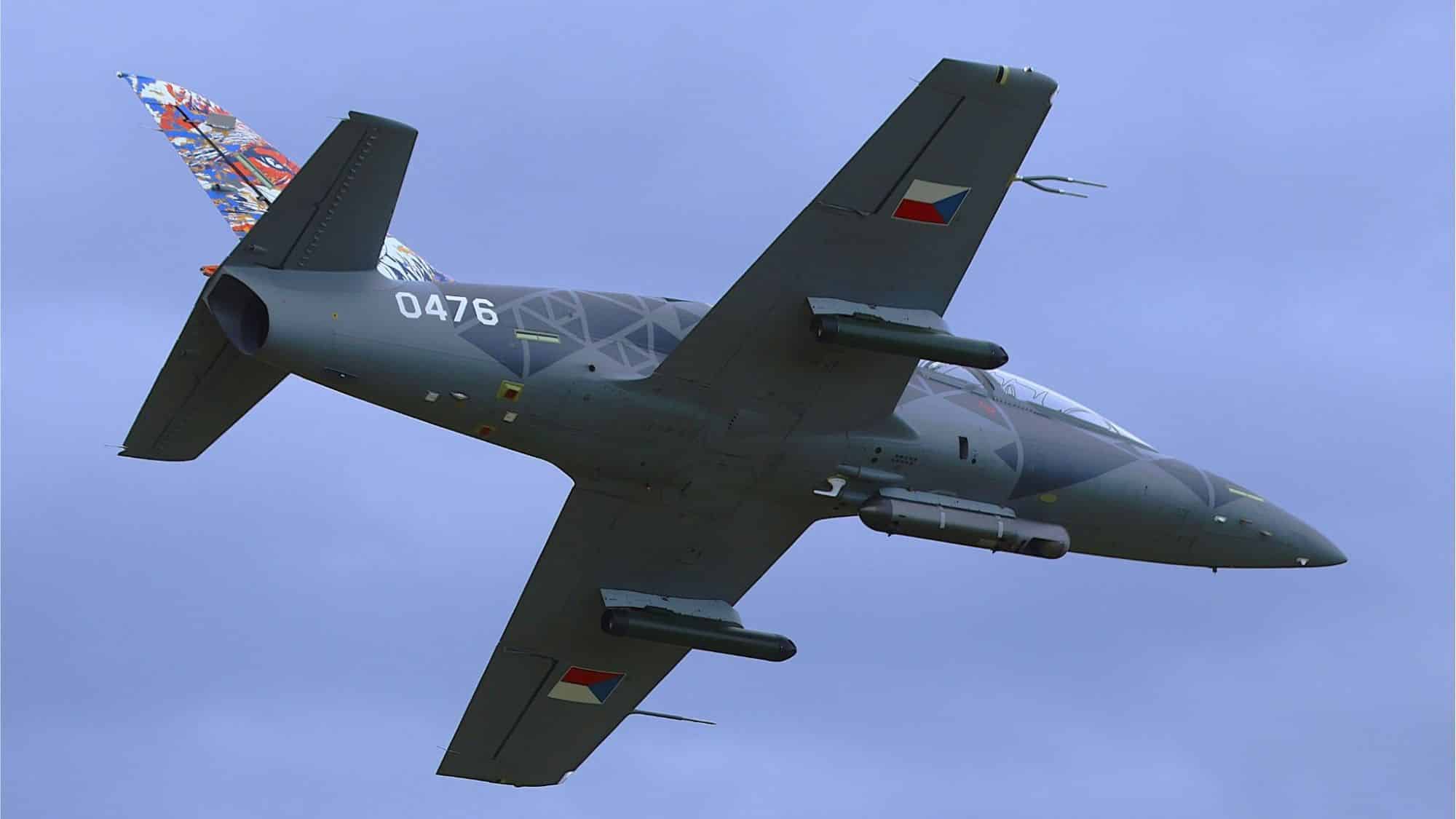
Czech aircraft manufacturer Aero Vodochody and Thales Belgium have signed a Memorandum of Understanding (MoU) to continue integrating and testing Thales Belgium’s 70 mm laser-guided rocket system on the L-39 Skyfox in its Drone Hunter configuration, the companies announced on October 5, 2026. The agreement pairs a two-seat jet trainer with a low-cost guided munition, offering air forces a cheaper interceptor for one-way attack (OWA) drones than frontline fighters firing air-to-air missiles.
The deal follows a year in which NATO’s eastern flank has repeatedly scrambled fighters against inexpensive Russian drones, starting with the September 2025 incursion into Polish airspace. Aero first showed the Skyfox with a counter-drone payload at the Dubai Airshow in November 2025 and gave the Drone Hunter its Czech public debut at NATO Days in Ostrava on September 19, 2026. Thomas Colinet, Managing Director of Thales Belgium, said the MoU centers on the “integration and testing of Thales Belgium’s 70 mm rocket system” on the Skyfox. Neither company disclosed financial terms or a test schedule, although Aero’s reference to “continued” integration suggests work is under way.
Skyfox Drone Hunter Weapons Fit: FZ275 Rockets and FZ800 Launchers
The core munition is the FZ275 LGR, a 70 mm (2.75-inch) semi-active laser (SAL) guided rocket built by Thales Belgium, formerly Forges de Zeebrugge. Manufacturer data lists a length of about 1.8 m, an all-up weight of 12.7 kg with a 4.1 kg warhead, four folding canards, and STANAG 3733 laser coding. The high-explosive warhead uses a pre-fragmented shell with a 9 m lethal radius and an impact fuze. Thales rates the engagement range at 1,500 to 7,000 m with a circular error probable (CEP) below 1 m at 6 km, figures established against ground targets rather than maneuvering drones.
Imagery released with the MoU shows two FZ800 seven-round launchers, a reusable digital pod that identifies rounds, sets laser codes, and enables lock-on before launch (LOBL). The aircraft flown at NATO Days carried LAU-32 seven-tube pods instead, and the FZ275 also fits the U.S. LAU-131A/A. The baseline fit provides 14 ready rounds; Aero is studying a four-launcher arrangement for 28.
The impact fuze demands a direct hit and sustained laser illumination on a small airframe. Thales addressed this at Eurosatory in June 2026 with the LGR275 Proxy, which adds a proximity sensor and a warhead optimized for aerial targets. Skyfox integration has not been announced. Thales Belgium plans to triple guided rocket production between 2026 and 2028.
Airframe, Sensors, and Cueing: How the L-39 Skyfox Hunts Drones
The L-39 Skyfox, designated L-39NG until October 2024, replaces the Albatros’ Soviet-era AI-25TL with a Williams International FJ44-4M turbofan rated at 16.86 kN (3,791 lbf). Publicly available specifications indicate a maximum speed of 907 km/h, a maximum takeoff weight of 5,600 kg, 1,150 kg of internal fuel in a wet wing, a +8/-4 g envelope, and 1,350 kg of external payload across five hardpoints. The cockpit adds a head-up display, multifunction displays, and hands-on-throttle-and-stick controls.
Targeting relies on the SiNAB Phoenix 10, an Australian electro-optical/infrared (EO/IR) pod on the centerline station combining automatic tracking, a laser rangefinder and designator, GPS/inertial navigation, Link 16, a mobile ad hoc network (MANET) radio, and a video downlink. In the tandem cockpit, the rear-seat crew member can hold designation while the pilot flies the intercept.
The Drone Hunter carries no search radar, so ground radars, airborne early warning aircraft, or fighters must cue it toward a predicted intercept point. Aero rates it against targets flying at 150 to 600 km/h and up to 8,000 m, covering Shahed-type drones, jet-powered variants and, per Aero, some cruise missiles. Petr Jinda, Aero’s Chief Technical Officer, has acknowledged that combat use will also require an advanced identification friend or foe (IFF) system and a high-capacity data link.
Cost Per Flight Hour and the NATO Drone-Interception Squadron Case
Aero quotes operating costs of about €2,000 per flight hour against roughly €20,000 for F-16-class fighters, a unit price below $10 million, and a rocket unit cost in the tens of thousands of euros, compared with hundreds of thousands for short-range air defense missiles. These are manufacturer figures with differing cost bases. The kit fits any Skyfox in its two-pylon training configuration and can be removed after a mission; Jinda has said it should be operationally ready by the end of 2026. An Aerem-developed alternative accepts Hydra 70 rockets with BAE Systems’ Advanced Precision Kill Weapon System (APKWS) II guidance.
Aero had sold about 40 Skyfox aircraft by September 2026, including 12 each for Hungary and Vietnam, but no customer has been announced for the Drone Hunter. In September 2026, Royal United Services Institute (RUSI) senior research fellow Justin Bronk proposed a multinational NATO squadron of 16 to 24 armed jet trainers dedicated to drone interception, potentially based in Poland, Romania, and the Baltic states, and named the Skyfox among the strongest candidates after evaluating it in flight against simulated targets at up to 270 knots.
Analysis: The MoU is an industrial step, not a procurement decision, but it assembles a counter-drone kill chain from items already in production: a Czech airframe, a Belgian munition, and an Australian pod. That matters because NATO’s current response to drone incursions burns fighter hours and short-range air-to-air missiles reserved for high-end deterrence. The Drone Hunter depends on external cueing, has not publicly completed air-to-air firing qualification, and with the baseline FZ275 must hold a laser spot on a small, low-signature target until impact, a task degraded by cloud cover. The proximity-fuzed Proxy would close that lethality gap faster than any airframe change.
The next markers are live air-to-air FZ275 firings from the Skyfox, a decision on Proxy integration, and delivery of the conversion kit. The Czech Republic, which trains its military pilots on the Skyfox, is the obvious launch candidate, but no government has committed. NATO’s response to the dedicated squadron concept will decide whether the Drone Hunter remains a demonstrator or becomes a fielded layer of allied air defense.