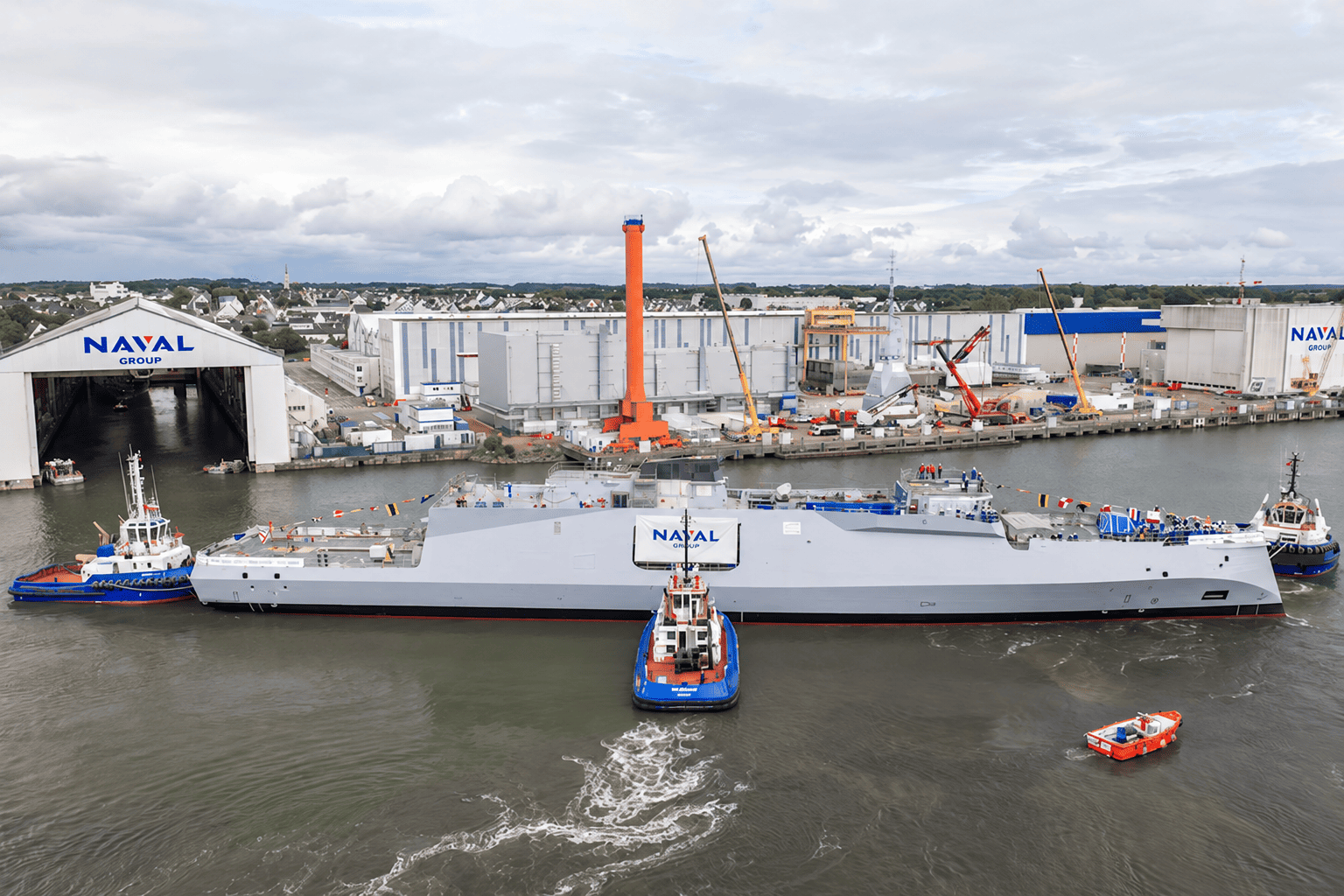
France’s Naval Group is pressing to turn Europe’s naval spending surge into frigate orders, betting that its running production line at Lorient can deliver warships faster than rivals whose programs have stalled. Company executives said European customers outside France now generate 20 to 25 percent of its €4.7 billion ($5.3 billion) in annual revenue, up from zero in 2019, and that the company is preparing a bid for Denmark’s next frigates, a contest that pits it directly against Babcock International.
European governments have expanded naval budgets since Russia’s full-scale invasion of Ukraine in February 2022, with Russian activity at sea, conflict in the Middle East and doubts over US security guarantees adding urgency. Naval Group, roughly 62 percent owned by the French state and 35 percent by Thales, built its European business on four Orka-class submarines for the Royal Netherlands Navy, 12 mine countermeasure vessels shared by the Belgian and Dutch navies, and Defense and Intervention Frigates (Frégates de Défense et d’Intervention, FDI) for Greece and Sweden.
Naval Group FDI Frigate Production Line Sets the Pace at Lorient
Naval Group says Lorient can now complete two FDI frigates per year, cutting delivery to under four years from contract, with a target of about three. The yard holds orders for 13 hulls across three NATO navies: five for France, four for Greece and four for Sweden. Steel was cut on October 1, 2026 for Luleå, lead ship of the four-frigate order that Sweden’s Defence Materiel Administration (FMV) signed on August 31 in a deal valued at about $4 billion. The first Swedish ship is due in 2030 and the last by 2034. The Luleå class will be the largest surface combatants in the Swedish Navy and is expected to triple its air defense capacity. Three Greek hulls are in build or testing alongside two French ships, after HS Kimon was handed to the Hellenic Navy on December 18, 2025.
Publicly available specifications indicate the FDI displaces about 4,500 tonnes on a 122-meter hull, uses combined diesel and diesel (CODAD) propulsion for 27 knots, and carries a crew of about 125. Its core sensor is the Thales Sea Fire fixed-panel active electronically scanned array (AESA) radar, backed by CAPTAS-4 Compact variable-depth and KingKlip Mk2 hull-mounted sonars for anti-submarine warfare. French ships carry 16 Aster 15 and Aster 30 interceptors in Sylver A50 launchers, eight Exocet MM40 Block 3c missiles and MU90 torpedoes; the Greek FDI HN doubles the Aster load to 32 cells. Sweden requires Swedish equipment on board, so Naval Group is integrating Saab systems, though the Luleå-class combat fit has not been publicly detailed.
The record is not flawless. The French lead ship, Amiral Ronarc’h, planned for 2024, was delivered in October 2025, a slip that pushed the second Greek frigate, Nearchos, to mid-2026.
Damen Setbacks and Denmark’s Tender Reshape Europe’s Frigate Market
Frigate program director Jean-Marie Dorbon summed up the pitch: the design “already exists,” backed by a working production line. Guillaume Weisrock, senior vice president for sales and business development in Europe and North America, said speed of delivery and proven systems have become defining requirements for European customers.
That message lands because of trouble elsewhere. Germany scrapped its F126 frigate program with Dutch builder Damen in June 2026, six years after launch, over missed deadlines and budget overruns, and now faces a reported €4.7 billion claim from the shipbuilder. Berlin has turned to TKMS, with a second tranche of four MEKO A-200 frigates worth about €5.6 billion ($6.3 billion) before the Bundestag budget committee, which would bring that program to eight ships valued at €11.6 billion. The joint Belgian-Dutch Anti-Submarine Warfare Frigate (ASWF), also a Damen design, has slipped from 2030 to 2033 for first delivery after design stability problems, and Belgium expects to decide by the end of 2026 whether to stay in the program.
Naval Group does not win everything. It lost Norway’s frigate competition to BAE Systems in 2025, and in Denmark it faces Babcock, which signed an agreement in August with Danish consortium Danske Flådeskibe to build ships locally. German, Spanish and South Korean yards are also reported to be bidding for the air defense frigates meant to replace Denmark’s five current frigates. To meet local content demands, Naval Group partners with domestic industry, including Salamis Shipyards in Greece and Saab in Sweden, whose products it is adding to its catalog of FDI options.
Analysis: Naval Group is selling schedule certainty as much as a warship. With Germany and Belgium reworking programs once meant to deliver around 2030, navies facing a more active Russian fleet in the Baltic and North Sea are weighing proven availability above bespoke design. An in-production frigate with open 2030 delivery slots carries a premium that can outweigh drawbacks such as a larger crew than some competitors. The constraint is capacity: two hulls a year at Lorient caps how many customers can be served on short timelines, and the Amiral Ronarc’h slip shows the yard is not immune to the delays it is exploiting.
The next decision points are the German budget committee’s vote on the second MEKO A-200 tranche, Belgium’s ASWF call before year-end and Denmark’s frigate selection, which reports now place in 2027. At Lorient, handover of the remaining Greek ships, two of them originally scheduled for 2026, will show whether the two-per-year rate holds as Swedish construction ramps up.