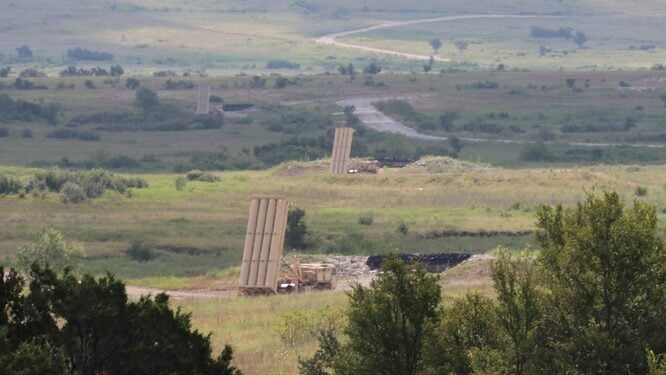
The United States has expended roughly two-thirds of its Patriot interceptor inventory and close to half of its Terminal High Altitude Area Defense stock since coordinated US and Israeli strikes opened the Iran war on February 28, 2026, according to the Center for Strategic and International Studies. Gulf coalition arsenals have drawn down on a similar curve. The interceptor shortage now stands as the central vulnerability in Western and Gulf air defense: guided missiles are fired far faster than they can be built.
The 2026 Iran war, designated Operation Epic Fury by US forces and Operation Roaring Lion by Israel, opened with nearly 900 strikes in its first 12 hours and killed Iranian Supreme Leader Ali Khamenei. Iran answered with sustained missile and drone salvos against Israel and against US bases and partner infrastructure in Bahrain, Kuwait, Qatar, Saudi Arabia, and the United Arab Emirates. A ceasefire took hold in April, though intermittent strikes have continued. The war is the first prolonged stress test of layered ballistic and drone defense at scale, and the results have exposed an economic fault line that predates the fighting.
Interceptor Shortage Exposes the Production-Exchange Gap
CSIS analysts Mark Cancian and Chris Park estimated on July 27, 2026, that US Patriot stocks had fallen from a pre-war level near 2,200 to between 759 and 827 interceptors, a decline of about 65 percent. THAAD inventory dropped from an estimated 452 to between 234 and 278. Some reporting placed THAAD depletion near 80 percent, a figure Defense Secretary Pete Hegseth publicly disputed. The analysts concluded there are no adequate substitutes for Patriot and THAAD in ballistic missile defense, and that rebuilding both stockpiles will take at least three years.
The arithmetic behind the shortage is unforgiving. A Shahed-136 attack drone costs roughly $35,000. The Patriot Advanced Capability 3 Missile Segment Enhancement fired to defeat incoming threats costs about $4 million, and high-value engagements often launch two. Open-source cost-exchange estimates cluster between 100 to 1 and 230 to 1 in the attacker’s favor, and a single THAAD round runs $12 million to $13 million. Production is the deeper problem. PAC-3 output runs near 600 to 650 interceptors a year against a stated Army requirement of 3,203 Patriots for fiscal 2027, while Iran can build hundreds of Shaheds in a week. Gulf batteries consumed more than 1,000 Patriot interceptors in the first 10 days against regional stockpiles estimated at 1,800 to 2,300.
How Gulf Procurement Concentrated Risk in Guided Missiles
The depletion crisis is less an accident than the predictable outcome of a procurement model weighted toward the most expensive and least replenishable tier. For a decade, the wealthiest Gulf states invested tens of billions in Patriot, THAAD, and related architectures while underbuilding cheaper layers such as electronic warfare, gun-based air defense, radar-cued helicopters, and interceptor drones. Reliance on an external security guarantor reduced the incentive to build indigenous, sustainable capacity, and prestige platforms carried a signaling value that hardened infrastructure did not.
The war punished that structure. Iran opened with more than 500 ballistic missiles and over 2,000 drones, most intercepted at severe cost. From the second week, as Gulf forces began rationing interceptors and classifying threats, Iranian launch rates fell by more than 90 percent while hit rates climbed, partly because strikes shifted toward less defended energy and port facilities. Iran also struck billion-dollar early warning radars in Qatar, Jordan, and the UAE, along with an E-3 Sentry and five KC-135 tankers at Prince Sultan Air Base. Thinner sensor coverage forced more interceptors per incoming threat. Analysts increasingly argue that a durable defense must push the bulk of the attritional work down to low-cost systems and reserve exquisite interceptors for the highest-value targets.
Israeli Systems and Indigenous Production Reshape the Gulf Market
Israeli industry has moved into the space Gulf procurement left open. Israeli defense exports reached a record near $19 billion in 2025, with roughly $3 billion going to Abraham Accords states, and air defense sales by Rafael Advanced Defense Systems and Israel Aerospace Industries rose about 25 percent year over year. The UAE has fielded Rafael’s Iron Beam laser and Elbit’s Spectro drone-detection system, took delivery of Iron Dome during the war, and holds a Barak MX order from IAI valued near $600 million. Israeli C-MUSIC self-protection systems reportedly equip Qatari and Saudi F-15 fleets even though neither state maintains diplomatic relations with Israel. Reports in August 2026 indicated Israel suspended covert cooperation and arms exports to Qatar over disputes tied to Hamas funding, underscoring how fragile these indirect channels remain.
Gulf producers are building their own answer. The Emirati EDGE Group, the only Arab firm on the SIPRI top 25 with roughly $4.7 billion in 2024 revenue, unveiled the VORTEX-E kinetic counter-drone interceptor, which reaches 350 kilometers per hour across a 24-kilometer engagement range with a non-explosive kill designed for use near critical infrastructure. Saudi Arabia has crossed $1 billion in annual EDGE orders. Market forecasters put the Gulf counter-drone segment near a 28 percent compound annual growth rate, against a global counter-UAS market projected to rise from about $6.6 billion in 2025 to $20 billion by 2030.
Analysis: The war has clarified that the decisive metric in air and missile defense is no longer the cost-exchange ratio but the production-exchange ratio. A defender can accept firing a $4 million interceptor at a $35,000 drone to protect a refinery; it cannot accept expending in days what industry replaces in years. CSIS judged US replenishment challenging but manageable in this conflict, at an estimated $10 billion using fiscal 2027 unit prices. The sharper risk is not this war but the next contingency in another theater before Patriot and THAAD inventories recover, a window rivals read as clearly as Washington. For the Gulf, the path is harder still, because it sits behind US and Israeli restocking priorities and cannot yet produce high-end interceptors at scale.
The near-term markers are industrial. Lockheed Martin plans to more than triple PAC-3 Missile Segment Enhancement capacity and lift THAAD output from 96 to 400 interceptors a year, backed by a fiscal 2027 THAAD order of 857 rounds. The Pentagon has requested $95 billion for munitions in its fiscal 2027 budget plus a $21 billion supplemental, though deliveries against new orders are not expected before 2029. Whether Gulf states redirect spending toward sustainable lower-tier defenses or repeat the pattern of buying exquisite systems they cannot replenish will shape the regional balance more than any single acquisition. The open variable is Iran’s capacity to reconstitute missile and drone production, which will determine how soon the next round of interceptor accounting begins.