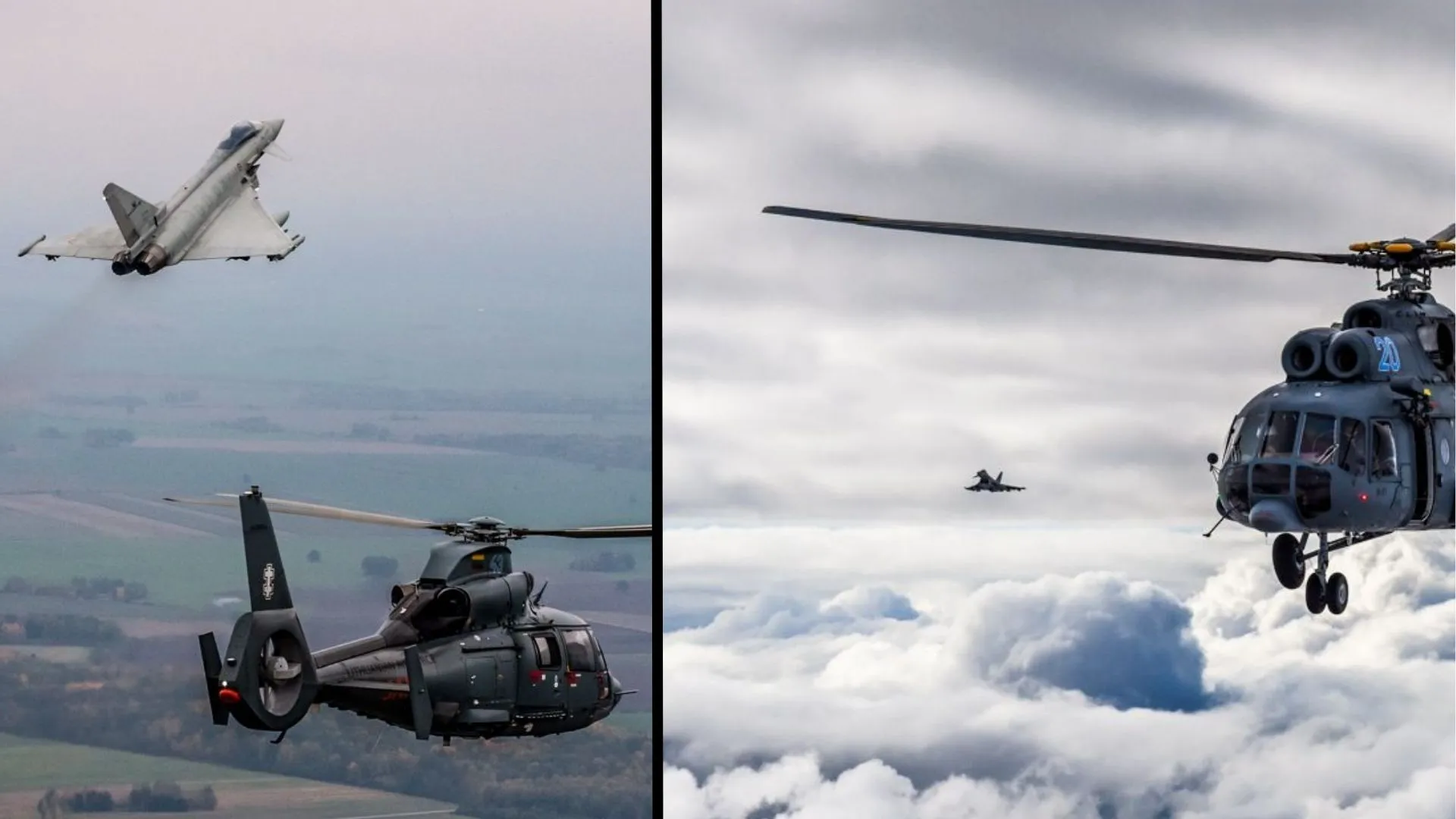
Italian Air Force Eurofighter Typhoons deployed to Šiauliai Air Base, Lithuania, conducted joint Slow Mover Interception (SMI) training with Lithuanian Armed Forces helicopters on October 12 and 13, 2026, according to NATO Allied Air Command (AIRCOM). The command said the drills sharpen coordination, interoperability and readiness to protect Allied airspace against slower-moving aircraft.
The training comes as NATO converts its long-standing Air Policing mission into a broader air defense posture. Allies endorsed the shift at the 2026 Ankara Summit as part of an updated operational plan for Integrated Air and Missile Defense (IAMD), and AIRCOM tied the Lithuanian drills directly to NATO’s new Air Defence Framework, citing common procedures and greater flexibility for commanders facing a wide range of airborne threats. The timing matters: Baltic airspace has seen repeated incursions by drones and Russian military aircraft since the Italian detachment took over on July 31, 2026.
Why Slow Mover Interception Challenges Fast Jet Pilots
Slow Mover Interception covers targets such as helicopters, light aircraft and ultralights that often fly below a fighter’s minimum comfortable speed. Interceptors cannot simply close and formate; they need dedicated procedures to detect the target at low altitude, approach without overshooting, complete a visual identification and, if required, shepherd it out of restricted airspace while maintaining safe separation.
The Italian jets, designated F-2000A in national service, are twin-engine delta-canard multirole fighters built for high-energy air combat. Publicly available specifications indicate a top speed of about Mach 2 and two Eurojet EJ200 turbofans rated at roughly 90 kN each with reheat. Italian Typhoons also carry the PIRATE infrared search and track sensor, according to open-source data, which supports passive detection at short range. Those attributes favor the fast end of the threat spectrum. Matching a rotary-wing target forces pilots into high angle-of-attack flight at low airspeed, close coordination with ground controllers and disciplined geometry around the target.
AIRCOM did not identify the Lithuanian helicopter type involved. The Lithuanian Air Force flies Sikorsky UH-60M Black Hawks, with the first two of four ordered delivered in October 2025, alongside three Airbus AS365 N3+ Dauphin helicopters used mainly for search and rescue. The Italian Air Force already treats SMI as a standing national task, with Eurofighter units supported at home by HH-139 helicopters, so the Šiauliai drills export an established Italian procedure into a host-nation setting.
Baltic Thunder III and NATO’s Shift to Air Defense
The Italian contingent, operating as Task Force Air “Baltic Thunder III,” brought four Eurofighters and about 200 personnel to Šiauliai on July 31, 2026, replacing French Rafale and Romanian F-16 detachments. It is Italy’s sixth deployment to Šiauliai and its 11th to the Baltic states.
The rotation has been busy. The detachment flew its first scramble on August 3, intercepting two Russian military aircraft in international airspace over the Baltic Sea. On August 14, an Italian Typhoon shot down an unidentified drone that had entered Latvian airspace. Shortly after midnight on September 15, Italian jets destroyed a drone near Kaunas, the first such shootdown by NATO aircraft over Lithuanian territory. On September 17, two Eurofighters scrambled after two Russian military aircraft violated Lithuanian airspace.
Under the new posture, NATO says Air Defence covers crewed and uncrewed aircraft and cruise missiles through a multi-layered, 360-degree approach, with ballistic missile defense as a complementary capability. Slow movers sit at the low end of that spectrum but generate much of the daily workload: Lithuanian officials reported 22 smuggling drones in national airspace during the first 13 days of September alone.
Analysis: The SMI drills expose a structural tension in NATO’s eastern flank posture. The alliance is policing low, slow and cheap targets with a four-ship detachment of fighters designed for high-speed air combat. Training with host-nation helicopters builds the shared procedures that let that detachment handle the bottom of the threat spectrum safely, but it does not resolve the cost and capacity mismatch of using Typhoons against drones and light aircraft. The helicopter’s role is the more telling detail: Italy’s national model already pairs fighters with rotary-wing assets for slow-mover identification, a template the Baltic states could adopt as the mission absorbs counter-drone tasks.
AIRCOM has not disclosed the number of sorties flown during the October drills or whether ground-based air defense units took part. The three Baltic presidents called in May for the shift to an air defense mission and for a stronger Allied counter-drone presence. NATO delivered the first at the Ankara Summit; the next rotation will show how far the second shapes the force mix deployed to Šiauliai.