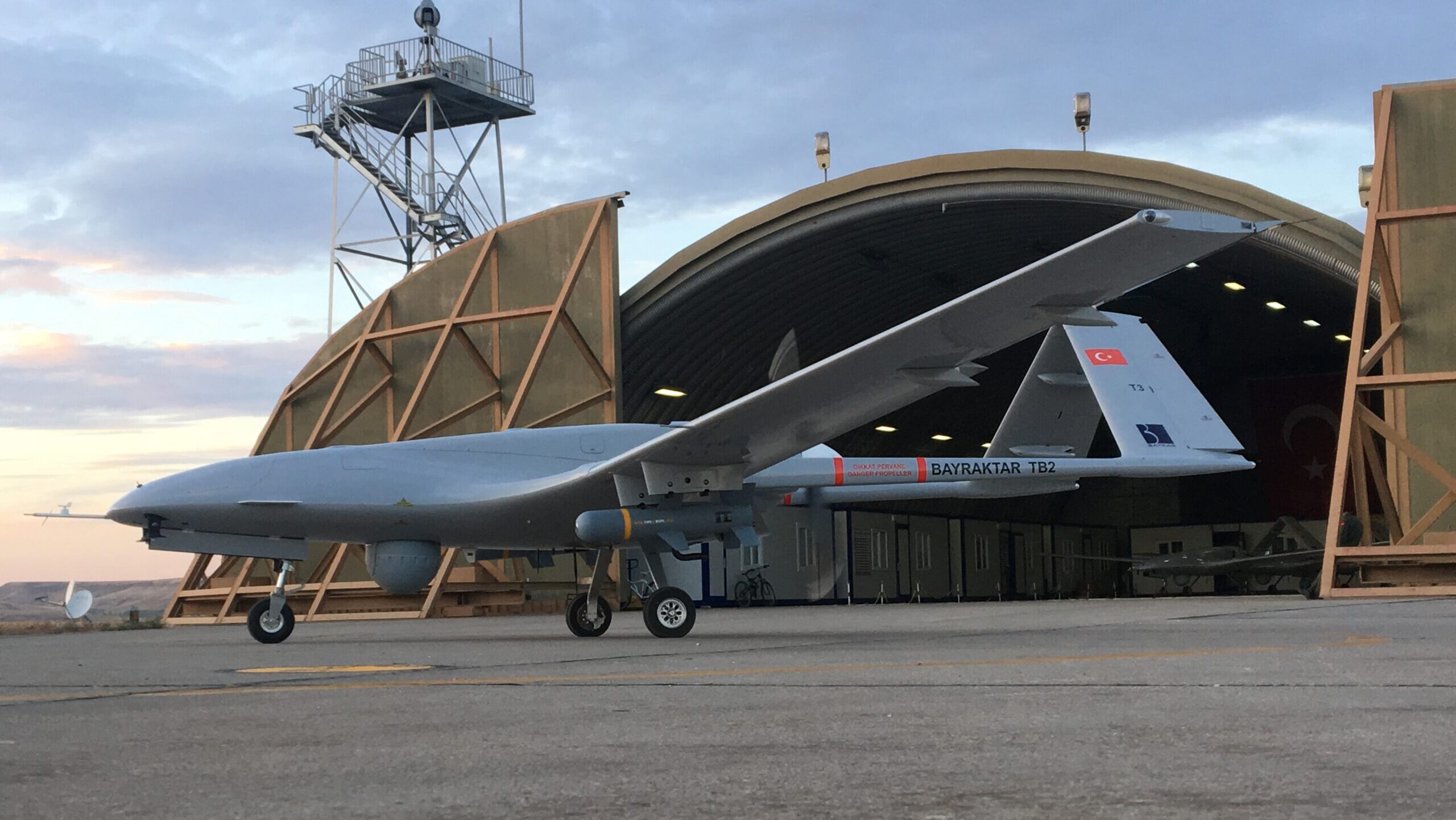
Türkiye’s defense and aerospace exports reached $10.05 billion in 2025, a 48 percent increase over the prior year, according to the Presidency of Defense Industries (SSB). The figure pushed Ankara across a threshold it had pursued for two decades and completed its shift from a target of U.S. sanctions to one of the world’s fastest-growing arms exporters.
The trajectory is steep. Turkish defense and aerospace exports stood at roughly $248 million in 2002 and about $2.3 billion in 2020. Growth has tracked a deliberate model: NATO-standard platforms priced below U.S. or Western European equivalents, increasingly marketed as free of U.S. International Traffic in Arms Regulations (ITAR) controls, and paired with after-sales support and local production. That formula has found buyers across the Global South and, increasingly, inside the alliance. For Washington and its European partners, the question is what Türkiye’s rise exposes: a mid-tier competitor capturing the entry and middle segments that Western primes have deprioritized.
Turkish Arms Exports Reach $10 Billion in 2025
Goods accounted for $9.87 billion of the 2025 total and services for $184 million, per SSB data, with defense and aerospace products representing about 3.7 percent of Türkiye’s overall exports; some accounts place the figure closer to $10.5 billion depending on how services are counted. Weapons and ammunition reached $4.7 billion, and December was a record month above $2.5 billion. New contracts signed during the year totaled $17.8 billion, up from $10 billion in 2024.
The customer base undercuts the assumption that Turkish equipment sells mainly to non-aligned states. About $5.6 billion, or 56 percent of exports, went to the European Union, NATO members, and the United States, with Europe absorbing $4.3 billion; four of the top ten destinations were European and one was the United States. Signed 2025 deals included warships for Portugal, Hurjet trainers for Spain, offshore patrol vessels for Romania, and electronic warfare systems for Poland. Localization now exceeds 80 percent, against roughly 20 percent in the early 2000s. Ankara has set an $11 billion target, the level it judges necessary to enter the top ten global suppliers.
Baykar Drones and the KAAN Fighter Lead the Surge
The gains are concentrated in a few firms. Baykar, maker of the Bayraktar TB2, reported $2.2 billion in exports in 2025 and described itself as the world’s largest exporter of armed drones for a third consecutive year. It posted $2.5 billion in total revenue, 88 percent from exports, and has funded its programs internally since 2003. Baykar has signed export agreements with 36 countries for the TB2 and 16 for the larger Akinci. Its jet-powered Kizilelma combat drone, first flown in December 2022, completed serial production in 2025 and won its first export in May 2026, when Indonesia agreed to 12 units with options for 48 more. The carrier-capable TB3, built to operate from the assault ship TCG Anadolu, is in serial production, and Baykar has moved into Europe through its purchase of Italy’s Piaggio Aerospace and a 2026 sensor partnership with France’s Safran.
The higher-end effort is TUSAS’s KAAN, a twin-engine fifth-generation fighter. Its P0 demonstrator first flew on February 21, 2024, and the first serial-representative airframe began taxi trials on July 31, 2026, ahead of a maiden flight. Publicly available specifications indicate an active electronically scanned array radar, an infrared search and track sensor, a stealth-shaped S-duct intake, and manned-unmanned teaming interfaces. Indonesia became the launch export customer, signing a government-to-government framework in June 2025 and an implementation contract for 48 aircraft in Istanbul on July 26, 2025, in a deal Turkish media valued near $10 billion and paired with two Istif-class frigates. Deliveries span roughly ten years.
The ITAR-Free Pitch Meets Türkiye’s NATO Straddle
The KAAN sale also marks the limit of the sovereignty argument. The aircraft is powered initially by two General Electric F110 engines of U.S. origin, and Jakarta has conditioned its purchase on a fully ITAR-free configuration with an indigenous powerplant. Türkiye’s domestic TF35000 engine, launched by TEI in 2022, is due for testing in 2026 and integration around 2032, with a Turkish-engined KAAN not expected in service before roughly 2036. The platform Ankara sells as an exit from U.S. dependence remains, for now, reliant on a U.S. engine.
The same tension runs through Türkiye’s own buying. While exporting indigenous systems, Ankara signed a formal agreement on October 27, 2025 for 20 new-build Eurofighter Typhoons, valued by the U.K. government at up to $10.7 billion, with deliveries from 2030. It continues to seek readmission to the F-35 program, from which it was removed in July 2019 after acquiring the Russian S-400 air defense system, a step that brought CAATSA sanctions on the SSB in December 2020 and made Türkiye the first NATO member penalized under that law. On July 7, 2026, beside President Recep Tayyip Erdogan in Ankara, President Donald Trump said Washington would lift the CAATSA sanctions and would consider an F-35 sale. As of mid-2026 neither had been approved. A 2020 statute requires a presidential determination that Türkiye no longer operates the S-400 before any transfer, the system remains in place, and congressional resistance is bipartisan, with the Senate Foreign Relations Committee chairman opposed while the S-400 stays.
Analysis: Türkiye’s ascent reads less as a self-contained success story than as a stress test of the West’s grip on the entry and middle tiers of the arms market. Ankara is selling autonomy as much as hardware, and cost-sensitive buyers from Southeast Asia to the Gulf are responding. The bet, however, is unfinished on two fronts. Engine independence for the KAAN is a decade away, leaving its most ambitious export commitments on technology Türkiye does not yet field. And an ambiguous alliance posture, defined by the S-400 and the unresolved F-35 file, caps Ankara’s access to the top-tier Western technology that separates a fifth-generation airframe from a fifth-generation weapon system. For U.S. and European primes the pressure is real but bounded; for mid-tier rivals such as South Korea and Israel, Türkiye is now the benchmark in the thinnest-margin segments.
The near-term markers are concrete. The first KAAN serial airframe must complete its maiden flight, and the TF35000 engine is scheduled for initial tests during 2026. The second and third phases of the Indonesian contract are expected in the same period, with delivery potentially tied to the indigenous engine. On the alliance track, the question is whether Washington issues the determination needed to lift CAATSA and reopen the F-35 line, and whether Ankara moves on the S-400. Eurofighter deliveries are not due until 2030. Until the engine matures and the impasse resolves, Türkiye’s export momentum and its dependencies will advance together.