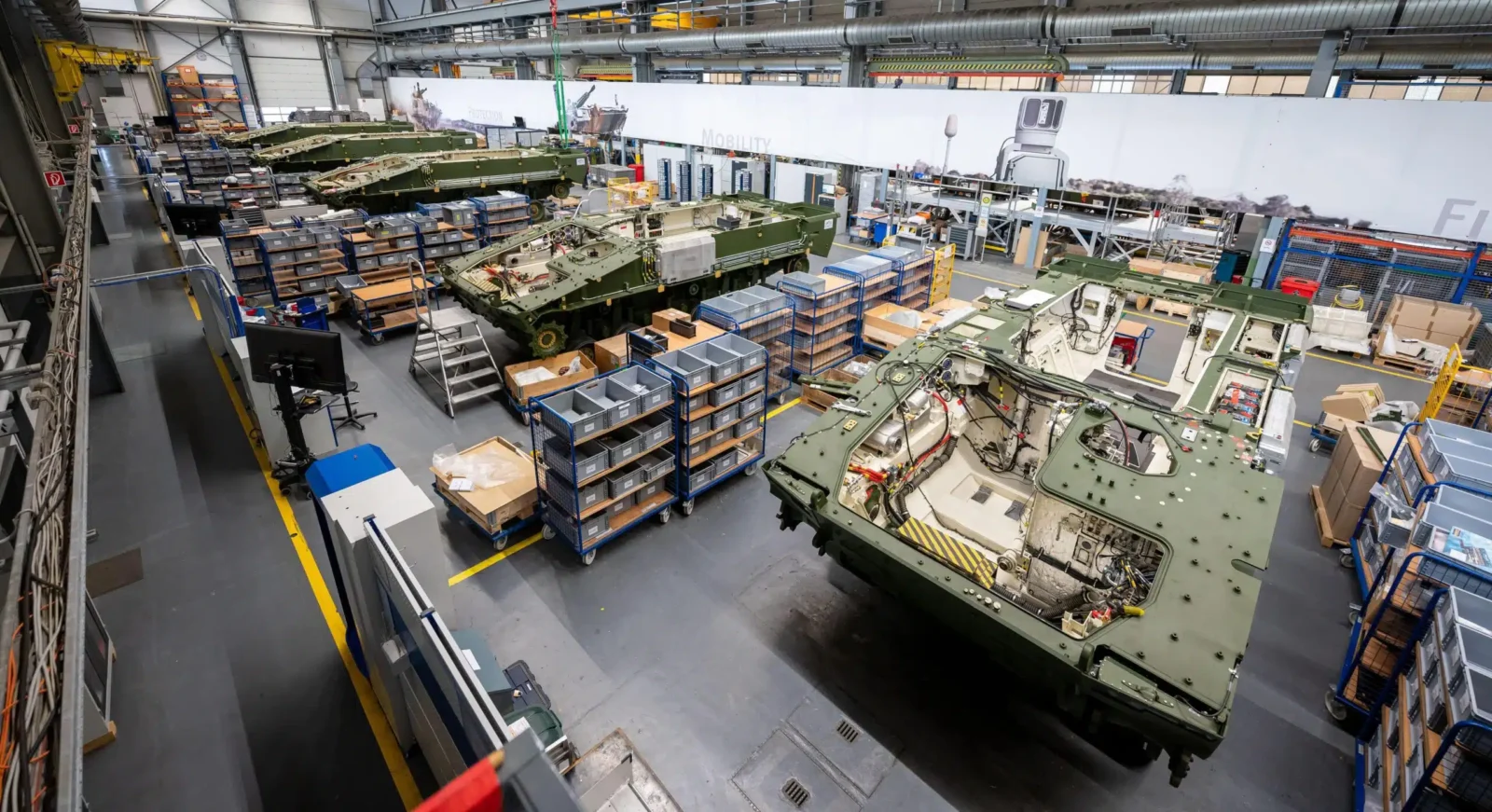
Europe has entered its largest military buildup since the Cold War. The European Union has moved to mobilize up to €800 billion in defense spending by 2030 under its Readiness 2030 plan, while Germany intends to more than double its national defense budget to €162 billion by 2029, a sum that exceeds the current defense budgets of France and the United Kingdom combined.
The drivers are familiar but compounding. Russia’s war against Ukraine has entered its fourth year, with Russian military spending reaching $190 billion in 2025 at 7.5 percent of gross domestic product, and Washington has signaled a reduced appetite for underwriting European security. US military spending fell 7.5 percent in 2025 to $954 billion, largely because Congress approved no new Ukraine aid packages, even as the administration pressed NATO members to carry more of the burden. Against that backdrop, European defense spending rose 14 percent in 2025 to $864 billion, the steepest annual increase in Central and Western Europe since the Cold War ended, according to the Stockholm International Peace Research Institute.
European Rearmament and Germany’s €162 Billion Zeitenwende
Germany sits at the center of the European rearmament effort, both as the region’s largest spender and as the industrial pivot of NATO conventional forces. Berlin’s military expenditure climbed 24 percent in 2025 to $114 billion, exceeding NATO’s 2 percent of GDP guideline for the first time since 1990. To sustain the trajectory, the government exempted defense from constitutional borrowing limits and approved a broad investment framework of roughly €500 billion in March 2025, building on the €100 billion special fund established in 2022.
The procurement ambition is equally large. A German defense ministry planning document sets out roughly €377 billion in desired acquisitions across land, air, sea, space, and cyber domains. About €182 billion of that total is earmarked for German companies, a deliberate bet on recycling defense spending back into the domestic industrial base. Rheinmetall is the primary beneficiary, appearing across 53 planning lines worth more than €88 billion, including 687 Puma infantry fighting vehicles, up to 3,500 Boxer wheeled vehicles, and 561 Skyranger 30 counter-drone systems. Diehl Defence anchors ground-based air defense with €17.3 billion in IRIS-T orders. The same document exposes the execution risk: analysts estimate that roughly 70 percent of German orders carry no published final delivery date, and the ministry lacks automated tracking of what it has actually received.
Europe’s Capability Gaps: Fighters, Deep Strike, and Heavy Lift
Money cannot immediately close the capabilities Europe never built. The continent fields no indigenous fifth-generation fighter. The air forces of the United Kingdom, Italy, the Netherlands, Norway, and Finland rely on the American F-35, while the Eurofighter Typhoon and Dassault Rafale remain fourth-generation-plus platforms. Europe also lacks a mature, mass-produced deep-strike capability. Germany’s own procurement list includes 400 US Tomahawk cruise missiles for long-range fires and Arrow 3 interceptors developed with Israel and the United States, an implicit acknowledgment that no European system fills those roles at scale.
The gaps extend across domains. Europe operates no in-production indigenous heavy-lift helicopter; Germany selected the Boeing CH-47F Chinook for its heavy transport requirement, and British forces fly the same airframe. Precision rocket artillery tells a similar story, as European states from Poland to the Baltic republics have bought the American M142 High Mobility Artillery Rocket System rather than wait for a domestic equivalent. Where the United States cannot supply quickly enough, Europe has turned to Asia. Poland has placed among the largest arms orders in Europe with South Korea, contracting for K2 Black Panther main battle tanks, K9 Thunder self-propelled howitzers, FA-50 light combat aircraft, and Chunmoo rocket artillery, with licensed local production to follow. The pattern underscores a sovereignty paradox at the center of the rearmament drive: Europe is spending to reduce strategic dependence on Washington while importing the very systems that dependence was built on.
FCAS Collapse and the Fragmentation of European Defense
The rearmament wave has not resolved Europe’s structural fragmentation, and in one case it deepened it. In June 2026, Germany withdrew from the Future Combat Air System, the Franco-German-Spanish sixth-generation fighter program, ending nine years of work and roughly €4 billion in spending that produced no flying prototype. The program collapsed over an industrial dispute between France’s Dassault Aviation and Airbus, centered on prime contractorship and control of stealth and radar-signature intellectual property, and compounded by French requirements for nuclear and carrier-capable variants.
The rival Global Combat Air Programme moved in the opposite direction. In July 2026, the United Kingdom, Italy, and Japan signed a contract worth about £4.6 billion with Edgewing, the joint venture uniting BAE Systems, Leonardo, and Japan Aircraft Industrial Enhancement, advancing the aircraft into full-scale design and engineering toward a 2035 in-service target. The program now stands as the only heavy, air-superiority, sixth-generation fighter open to export customers. Cost growth is nonetheless visible, with Italy’s projected contribution rising to €18.6 billion, roughly three times its original estimate. Germany, having exited FCAS, is weighing whether to join the Global Combat Air Programme, launch a new effort with Sweden or Spain, or expand its F-35 fleet. Each path multiplies rather than consolidates European combat air programs, the opposite of what a coordinated €800 billion push was meant to achieve.
Analysis: The binding constraint on European rearmament is no longer political will or funding; it is industrial capacity, delivery discipline, and time. The clearest signal comes from the markets. Even as Rheinmetall reported record 2025 sales and an order backlog of €63.8 billion, its shares fell more than 30 percent through 2026 as investors questioned whether demand for tanks and artillery is durable against a battlefield increasingly shaped by drones and software. Berlin’s decision to trim planned 2027 munitions spending to €9.6 billion, from €11 billion, sharpened that doubt. Capital has flowed into European defense faster than factories, skilled labor, and delivery systems can absorb it, and the distance between committed money and delivered capability is where the rearmament thesis will be tested.
The next markers will show whether commitments convert into hardware. NATO members are working toward the 3.5 percent core-defense spending target that underpins Germany’s 2029 budget, with an additional 1.5 percent allocated to broader security and resilience. Berlin’s ability to translate its €377 billion planning document into contracted, tracked, and delivered systems remains the central variable, as does the disbursement of the EU’s €150 billion Security Action for Europe loan instrument. Germany’s sixth-generation fighter decision, which will shape European combat air for a generation, is the program to watch. The money is committed. Whether Europe’s industrial base can spend it fast enough is not yet settled.