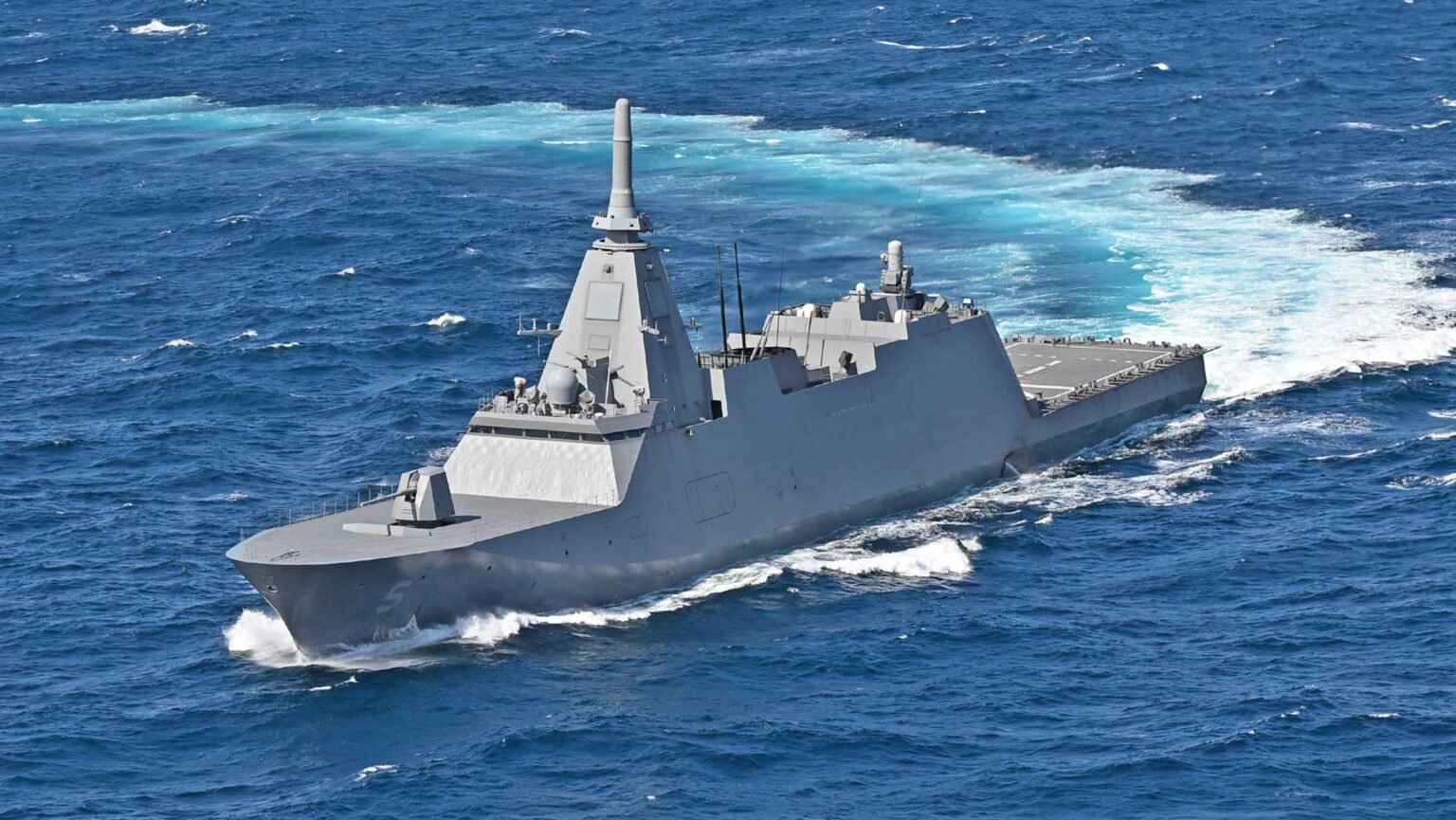
Japan has become the world’s third-largest defense spender and a major arms exporter within roughly two years, a dual shift capped by the April 2026 signing of a contract worth about $7.1 billion to build Mogami-class frigates for Australia, Tokyo’s first export of a complete lethal weapon system since 1945.
The transformation runs on two tracks at once, the fastest Japanese rearmament since the Second World War and the collapse of a postwar taboo on weapons exports. According to Japan’s Ministry of Defense, the Defense Buildup Program covering fiscal years 2023 through 2027 commits ¥43 trillion, roughly $275 billion, toward 2 percent of GDP by fiscal 2027, a threshold Tokyo reached in fiscal 2025, about two years early. China is the primary concern, followed by North Korea, with the war in Ukraine and pressure from the Trump administration reinforcing the case for standoff strike and stockpiles.
Japan Arms Exports Move From License to Finished Systems
For nearly six decades, the Three Principles on defense equipment transfers barred almost all sales; the 1967 prohibition eased in 2014, permitting co-development, then widened. In December 2023, Tokyo allowed exports of licensed-production lethal equipment back to the licensing country, clearing the path for Patriot PAC-3 interceptors to the United States, and in March 2024 it made the GCAP fighter exportable to third countries. The decisive step came in April 2026, when Prime Minister Sanae Takaichi’s cabinet abolished the five categories confining non-lethal transfers, replacing them with a binary weapons and non-weapons test keyed to lethal or destructive capability. Non-weapons became nearly freely exportable. Weapons entered a conditional release limited to roughly 17 partner countries, among them the United States, United Kingdom, Australia, Canada, and major European partners. For the first time, finished defense products, not only joint-development stakes, sit on the export table.
The ban is not fully lifted. Case-by-case screening, controls on third-country transfers, and a prohibition on sales to states in active conflict remain in force, and Takaichi has framed exportable systems as strictly defensive, noting that Japan fields neither strategic bombers nor aircraft carriers. The enabler was electoral. The Liberal Democratic Party won an absolute majority of 316 seats in February 2026, after Komeito, long a brake on defense expansion, left the coalition in late 2025.
Mogami Frigate and GCAP Anchor an Indo-Pacific Arsenal
Two programs turn policy into hardware. Australia’s National Security Committee selected the upgraded Mogami, also designated New FFM, from Mitsubishi Heavy Industries in August 2025, over Germany’s TKMS and its MEKO A-210, for the Project Sea 3000 requirement. The first three ships, signed for aboard the JS Kumano in Melbourne in April 2026, carry a value of about $7.1 billion, or A$10 billion, inside a program that could reach A$20 billion, roughly $14.3 billion, over the decade. Of 11 frigates, three will be built at MHI’s Nagasaki yard, with first delivery due in December 2029, ahead of the type’s entry into Japanese service, and eight at Henderson in Western Australia.
Publicly available specifications indicate the design displaces about 4,800 tonnes, carries a 32-cell vertical launching system, ranges up to 10,000 nautical miles, embarks an MH-60R Seahawk helicopter, and runs with a crew of just 92, easing manning on a stretched navy. The complication is that the upgraded Mogami does not yet exist as a delivered ship; it is a derivative of the baseline design, and MHI has never built a major surface combatant abroad. GCAP is the longer bet. The Global Combat Air Programme, a UK-Italy-Japan effort codified by treaty in December 2023, will replace Japan’s F-2 and the Eurofighter Typhoon, with service targeted around 2035 and a demonstrator due to fly by the end of 2027. The Edgewing joint venture, splitting BAE Systems, Leonardo, and Japan Aircraft Industrial Enhancement Co. evenly, holds design authority, backed by a £686 million bridge contract in April 2026 and a £4.6 billion award, about $6.1 billion, in July 2026.
An Industry Built for Restraint Faces a Scale Test
The harder question is whether Japan’s industrial base can deliver at volume. Analysts note that Japan has no true defense prime, no major manufacturer whose core business is weapons. At MHI, the largest player, defense accounts for roughly 20 percent of revenue, rising but still a minority line that competes for resources against commercial divisions. Decades of small runs, high unit costs, a single domestic customer in the Self-Defense Forces, and thin margins pushed some firms out, including Komatsu and, in part, Sumitomo Heavy Industries, leaving a contracting supply chain.
The direction is reversing. The Stockholm International Peace Research Institute recorded a 40 percent year-on-year rise in the arms revenue of Japan’s largest firms in 2024, with the top five, MHI among them, totaling about $13.3 billion. Export candidates line up behind each champion: MHI with frigates, the GCAP fighter, an improved Type 12 missile, and submarines; Kawasaki Heavy Industries with Soryu and Taigei submarines and the C-2 transport; IHI with GCAP engines; and Mitsubishi Electric with air-defense radars already sold to the Philippines. Tokyo’s aim is to raise volumes, cut unit costs, build surge capacity, and reduce dependence on a United States whose reliability it now hedges. The constraints are structural. The buildup is financed partly by corporate, tobacco, and income tax increases from 2027. A yen down 15 to 20 percent erodes the purchasing power of imports. Demographics tighten the labor pool, and more than 30,000 people protested the export loosening in April 2026.
Analysis: The tempting read, that Japan is returning as a great military power, misses the mechanism. Tokyo has unlocked its political constraints, on exports, on spending, on the interpretation of Article 9, faster than it has repaired its industrial tools. An industry configured for restraint, single customer, low volume, no primes, is now asked to export and mass-produce. The Mogami selection and GCAP prove technological credibility; neither proves scale. For Washington and its allies, the shift cuts two ways: a credible allied production node for the Indo-Pacific and a new export competitor against South Korea and European suppliers.
The near-term milestones are concrete. First delivery of the upgraded Mogami is due in December 2029, and the design must mature on schedule to hold that date. GCAP targets service around 2035, its £4.6 billion tranche funding 18 months of design ahead of prototype work. Budget decisions from 2027, when tax increases begin, will test political durability, and a weak yen will keep pressure on procurement. The measure to watch is not whether Japan can build advanced systems, which it has shown, but whether it can convert that into reliable volume for its own forces and allied customers.