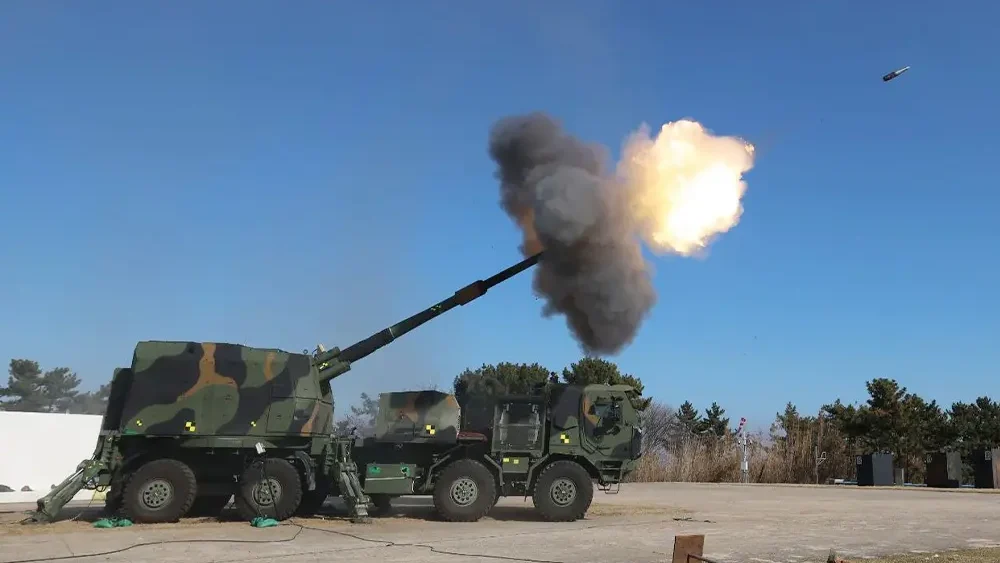
The US Army selected Hanwha Defense USA to build a wheeled 155mm howitzer for its Mobile Tactical Cannon (MTC) program on August 18, 2026, awarding an Other Transaction Agreement (OTA) worth up to $262.9 million and handing a South Korean manufacturer its first major contract with the service. Hanwha identified the winning design as the K9 Mobile Howitzer (K9MH), a wheeled variant of the tracked K9A2, though the Army announcement itself did not name the platform. The award placed Hanwha ahead of every Western prime that competed.
The decision lands as South Korea presses one of the most aggressive export campaigns in the global arms trade. Sales reached a record $17.3 billion in 2022 as European buyers rearmed after Russia’s invasion of Ukraine, according to the Defense Acquisition Program Administration (DAPA). Exports cooled to $13 billion in 2023 and $9.6 billion in 2024 before rebounding above $15 billion in 2025. Seoul now targets $20 billion in annual exports and a place among the world’s four largest suppliers by 2030, a goal President Lee Jae Myung reset from an earlier 2027 target.
How Hanwha’s K9 Beat Western Primes at the MTC
The MTC program replaces part of the Army’s towed M777 fleet with a self-propelled wheeled howitzer offering greater mobility and survivability. Hanwha’s win came against a dense field: Elbit America’s SIGMA, offered with Anduril and Oshkosh; a Leonardo DRS and KNDS pairing built around the Caesar; Rheinmetall’s RCH 155; BAE Systems’ Archer; and General Dynamics Land Systems. Defeating that lineup on the Army’s own ground is the strongest evidence yet that Korean systems compete on capability, not price alone.
The firm-fixed-price agreement, awarded under Title 10 US Code Section 4022, funds an initial $100.3 million for six accelerated prototypes, with an option for twelve more to reach as many as 18 systems over an estimated four-year period. Hanwha expects to field an initial unit in the early fall of 2026. The company runs an integration and test site in Opelika, Alabama, and has proposed a $1.3 billion facility near Pine Bluff Arsenal in Arkansas for energetic materials and modular charges, a direct response to the US 155mm ammunition shortfall the Pentagon inspector general has flagged. The K9’s decisive advantage is scale: more than 2,500 units built or ordered across roughly ten to twelve countries, making it the most widely exported modern self-propelled howitzer in service. For a program built around rapid fielding, that production base and its logistics tail matter as much as any single performance figure.
Poland Drives Korean Defense Exports Across Europe
The American breakthrough rests on a European foundation, and Poland is its cornerstone. A framework agreement signed on July 27, 2022 opened the door to up to 1,000 K2 Black Panther tanks from Hyundai Rotem, K9 howitzers and K239 Chunmoo rocket launchers from Hanwha, and FA-50 light fighters from Korea Aerospace Industries. With the Chunmoo included, the package is valued near $22 billion, and Poland has become NATO’s largest arms importer over the past five years, sourcing roughly 47 percent from South Korea and 44 percent from the United States.
The structure of the K2 deal distinguishes the Korean model. Of the tanks ordered, 180 are built in Korea and 820 K2PL variants are to be produced under license in Poland between 2026 and 2034. A second executive contract signed on August 1, 2025 covers 180 tanks and is valued near $6.5 billion, and the first Polish-built K2 is expected in 2028, restoring domestic tank production for the first time since 2009. The pattern extends beyond armor: Poland will manufacture Chunmoo munitions domestically, and the system has drawn orders from Norway and Estonia. The combined order backlog of Hanwha Aerospace, Hyundai Rotem, and KAI exceeds 111.9 trillion won, roughly $80.7 billion, a cushion of guaranteed production few Western primes can match.
MASGA and the Naval Frontier for Hanwha Ocean
Shipbuilding is the newest and most ambitious front. Under a project branded Make American Shipbuilding Great Again, or MASGA, South Korea has pledged roughly $150 billion in naval cooperation inside a broader $350 billion investment package tied to a July 2025 tariff deal that cut US duties on Korean imports from 25 to 15 percent. Hanwha Ocean acquired Philadelphia’s Philly Shipyard in 2024 for $100 million and plans to invest about $5 billion to raise annual capacity from roughly one vessel to 20, running twin hubs in Busan and Philadelphia.
The near-term work is concrete. In December 2025, President Donald Trump said the US Navy would work with Hanwha on a new class of frigates, a potential role in the proposed Golden Fleet after Fincantieri’s Constellation program was cut from 20 hulls to two. Washington has also cleared the way, per a November 2025 joint fact sheet, for Korea to build nuclear-powered attack submarines, though a decision on the Virginia class remains open. Korean yards have already overhauled Military Sealift Command vessels, including the USNS Wally Schirra at Geoje, and the US Navy has sought information on destroyer and support-ship work in a market estimated above $1 trillion over 30 years. The frontier carries setbacks: a Korean consortium of Hanwha Ocean and HD Hyundai lost Canada’s $43 billion submarine program to Germany’s TKMS in July 2026, sharpening the pivot toward the American market.
Analysis: Korea’s rise is best understood not as a windfall but as a solution to the execution problem Western primes have failed to crack. Rapid delivery, adaptation to local specifications, technology transfer, and licensed production have made Seoul the supplier that fills capability gaps NATO and Washington cannot close fast enough, to the point of being asked to help rebuild the American industrial base itself. Yet the ascent rests on three structural bets. Poland accounts for roughly 46 percent of Korean sales, a heavy concentration in one customer. Washington sets a technology ceiling, having refused to export the Aegis Cooperative Engagement Capability in October 2025. And the same technology transfer that wins contracts may, over time, cultivate Korea’s own competitors.
The next markers are near. Hanwha must deliver six K9 prototypes within roughly a year and field an initial unit this fall, where prototype promise meets series-production reality. Poland’s first domestically built K2 is due in 2028, and Philly Shipyard targets profitability in 2027. Whether Washington ultimately clears Korean submarine work, and how far the gap narrows between announced facilities and certified, delivered volumes, will determine whether the K-defense model is a durable position or a peak near its ceiling.