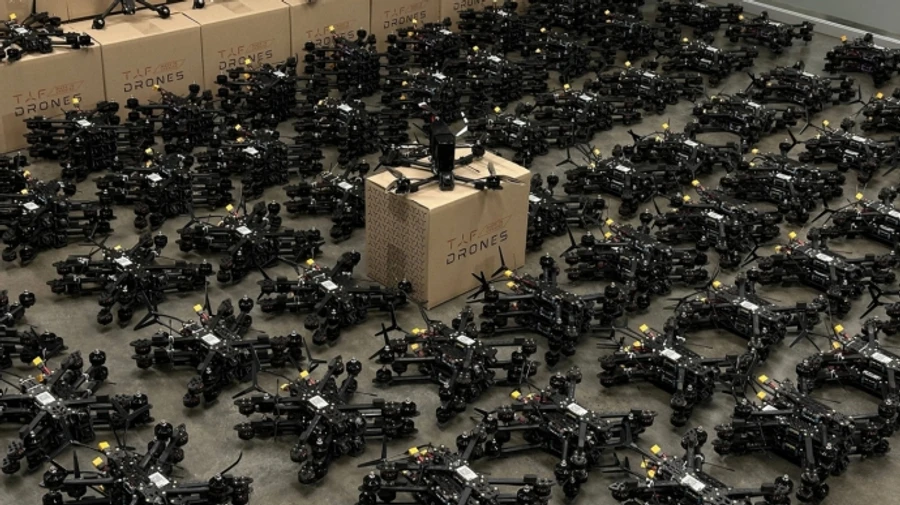
Ukraine’s defense industry reached a projected production capacity of $55 billion for 2026, a figure 55 times larger than at the start of Russia’s full-scale invasion, according to the National Security and Defense Council of Ukraine. In February 2026, Kyiv issued its first wartime export licenses, authorizing the sale of battlefield-tested weapons abroad and confirming that a country under daily bombardment has become one of the world’s fastest-scaling military producers.
The shift matters now because Ukrainian domestic procurement, running near $10 billion to $12 billion a year, absorbs only about a third of that capacity. The surplus is driving two dynamics at once: an export push aimed at generating foreign currency, and a wave of co-production ventures that convert Ukrainian battlefield knowledge into manufacturing lines inside NATO member states. Western militaries are studying the results closely, because the cost-exchange ratios Ukraine has achieved against Russian drones undercut the economics of legacy air defense.
Ukraine Defense Industry Reaches $55 Billion Capacity
The scale-up has been near vertical. Production capacity stood at roughly $1 billion in 2022, rose to between $3 billion and $6 billion in 2023, and reached $35 billion in 2025 before the projected $55 billion figure for 2026. Of that total, Ukrainian officials assess that approximately $35 billion covers long-range and medium-range strike systems, meaning drones and missiles, with the deep-strike segment alone valued near $25 billion.
First-person-view (FPV) drones anchor the industrial base. More than 160 companies now build them, with a combined annual capacity exceeding 8 million units. Ukraine is expected to manufacture around 4.5 million FPV drones in 2026 for military use, and officials credit the platform with over 60 percent of Russian equipment losses in 2025. During 2025 the sector attracted $6.7 billion in international support from the European Union, the Netherlands, Norway, Germany, and Denmark, much of it channeled through the Danish Model, under which allied governments finance weapons production inside Ukrainian factories rather than drawing down their own stockpiles.
The gap between the $55 billion capacity and roughly $10 billion in state procurement is the structural problem exports are meant to solve. Ukraine’s wartime licensing commission approved most of 40 export applications submitted by manufacturers in early 2026. Officials estimate export potential for the year at several billion dollars in the near term, and independent analysts project a range of $10 billion to $30 billion as the mechanism matures.
Interceptor Drones Rewrite the Shahed Cost Equation
The most-studied Ukrainian innovation is the interceptor drone, the core of what Ukrainian planners call “Mala PPO,” or small-scale air defense. The ecosystem pairs cheap interceptor airframes with mobile fire units and automated anti-aircraft guns to blunt Russian drone waves without expending scarce surface-to-air missiles. Interceptor production capacity increased eightfold over the past year, with more than 100,000 units built in 2025 across over 20 manufacturers.
By early 2026, Ukrainian firms were delivering up to 1,000 interceptor drones per day, and President Volodymyr Zelenskyy stated in March that daily output had reached 2,000 units. The operational payoff is measurable. In February 2026, Commander-in-Chief Oleksandr Syrskyi reported that interceptor drones accounted for more than 70 percent of Shahed-type drones destroyed over the Kyiv region, flying roughly 6,300 sorties and downing more than 1,500 Russian uncrewed aircraft that month.
The economics drive Western interest. Ukrainian interceptors cost between roughly $1,000 and $4,000, with the German-funded STRILA priced near $2,300 after localization cut its unit cost by nearly a third. A Shahed-136 costs an estimated $25,000 to $40,000, and a single Patriot interceptor runs into the millions. With Russia launching more than 4,400 Shahed-type drones in January 2026 alone, the ability to trade a $2,300 drone for a $40,000 threat is the exchange-ratio lesson that United States and Gulf planners are now trying to import.
Fiber-Optic FPVs and the Ukraine-Europe Co-Production Model
Two further capabilities define Ukraine’s edge. Fiber-optic FPV drones, guided by a thin physical cable rather than a radio link, are effectively immune to electronic jamming and can strike beyond 30 kilometers with a clear video feed. Ukrainian units reserve them for high-value targets such as main battle tanks, artillery, and air defense systems, and the class accounts for a large share of armored vehicle kills in open terrain. Their principal weakness is the cable itself, which snaps under wind, vegetation, and distance. Separately, Ukrainian long-range strike drones now reach targets beyond 1,500 kilometers, a distance at which few Western governments authorize the use of their own munitions, giving Kyiv a low-cost deep-strike autonomy that has knocked an estimated 20 percent of Russian oil refining capacity offline.
This know-how is now being industrialized abroad. Germany is funding 15,000 STRILA interceptors built through a partnership between Kyiv-based WIY Drones and Munich’s Quantum Systems, while a separate joint venture, Quantum Frontline Industries, plans to deliver 10,000 AI-enabled drones designed by Ukrainian firm Frontline Robotics. The broader Build with Ukraine initiative, backed by roughly 2 billion euros, produced at least seven co-developed drone types unveiled in Berlin in April 2026. The model positions Ukraine less as an aid recipient than as a design and production node feeding NATO’s own rearmament.
Analysis: Ukraine has inverted the traditional arms-transfer relationship. A country that four years ago depended almost entirely on allied stockpiles now exports both hardware and doctrine to the same NATO states that once supplied it. The strategic weight lies less in the topline capacity figure than in the cost model beneath it. Ukraine has shown that mass-produced, attritable, iteratively upgraded systems can hold ground and defend airspace against a larger adversary, and it has done so at price points Western defense industrial bases cannot currently match. For the United States and its allies, the interceptor economics and the fiber-optic anti-armor threat are not distant observations; they are direct inputs to base defense and force protection planning, as the appearance of jam-resistant drones in NATO threat assessments already shows.
The near-term milestones are concrete. Ukraine’s export framework sets a floor near $335,000 per system and a standard 30-day review, with the foreign ministry controlling the approved buyer list. The open questions are whether the co-production ventures deliver at their promised volumes, whether Gulf and European demand converts into firm contracts, and whether the roughly $45 billion gap between capacity and financing narrows. A ceasefire would reshape the demand curve overnight, but the industrial base, and the doctrine it has validated, will outlast the current phase of the war.