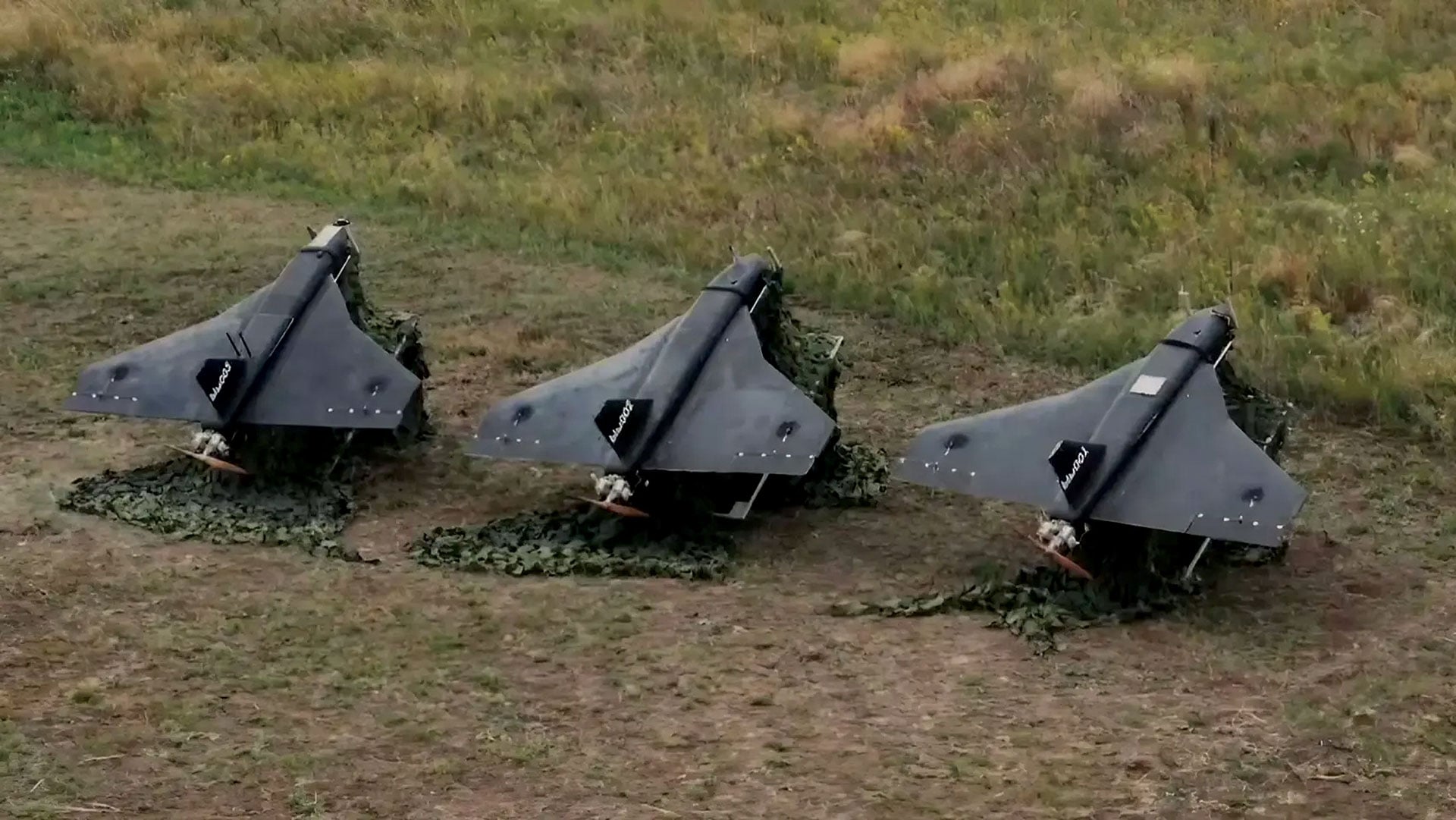
Russia intends to spend $12 billion in 2027 on the production of jet-powered drones and loitering munitions, Ukrainian President Volodymyr Zelensky said in his nightly address on September 26, 2026, citing intelligence drawn from internal Russian planning documents. Zelensky said Ukraine currently intercepts 55 percent of Russia’s jet-powered Shahed-type drones, a rate he contrasted with the more than 90 percent achieved against older, propeller-driven variants.
The disclosure comes amid a sharp escalation in Russia’s use of jet-powered strike drones, a category that barely existed in Ukrainian skies before mid-2025. Russia’s monthly launch volume of these drones rose more than eightfold over the summer to roughly 2,800 in August, holding at a similarly elevated pace with more than 2,730 launched in September, according to Ukrainian figures. Moscow’s jet-propelled variants, built at the Alabuga Special Economic Zone in Tatarstan, replaced the piston engine of the original Shahed-136-derived Geran-2 with a Chinese-sourced turbojet, cutting the reaction window available to Ukrainian air defenses from tens of seconds to a handful. Zelensky’s remarks, delivered as Kyiv pushes allies for tighter sanctions, framed the new spending figures as evidence that Moscow intends to sustain, not wind down, its drone campaign through 2027.
Geran-4 Jet-Powered Shahed Drones Cut Reaction Time to Seconds
Ukraine’s Defense Intelligence directorate (HUR) identifies the variant behind the shift as the Geran-4, a direct descendant of the Geran-2, Russia’s licensed derivative of the Iranian Shahed-136. Where the Geran-2 cruises at roughly 180 kilometers per hour on a piston engine, the Geran-4 swaps that powerplant for a Chinese-made turbojet, generating an estimated 160 kilogram-force of thrust, roughly double the output used on the earlier, now-discontinued Geran-3. HUR states the airframe can maneuver at 300 to 400 kilometers per hour and reach a top speed of about 500 kilometers per hour, with a maximum takeoff weight of roughly 450 kilograms and a warhead of at least 50 kilograms. Its maximum range is contested in open-source reporting: HUR has cited a figure of about 450 kilometers, while separate Ukrainian military-affiliated reporting puts it as high as 850 kilometers. The drone operates at altitudes between 100 and 5,000 meters and can loiter for approximately two and a half hours. HUR says the Geran-4 entered combat use in May 2026, featuring a redesigned, fixed-wing airframe and fewer maintenance hatches to reduce drag. At those speeds, the intercept window for Ukraine’s slower, gun-based and propeller-driven countermeasures collapses to single-digit seconds, air defense units report, a central reason for the gap between the 55 percent and 90 percent interception rates.
Alabuga’s Output and Ukraine’s Interceptor Race to Match It
Ukrainian officials and open-source trackers estimate Russian output of the Geran-4 at roughly 3,000 units a month, manufactured at the same Alabuga complex that produces the slower Geran-2. That volume, sustained through the $12 billion allocation Zelensky says Ukrainian intelligence found in internal Russian budget planning for 2027, would mark a substantial increase over current spending on the same weapons category. Ukraine’s countermeasure is a parallel buildup of dedicated interceptor drones rather than reliance on far costlier surface-to-air missiles against a mass, low-cost threat. Zelensky said 67 Ukrainian companies are now working on interceptor solutions for jet-powered targets, with three to five having demonstrated results in testing. He confirmed a successful combat downing of a Geran-4 in mid-September 2026, following an earlier prototype test on September 15, 2026, that still required control-system refinement. Kyiv’s near-term goal, Zelensky said, is to raise the jet-powered interception rate to parity with the 90 percent already achieved against conventional Shaheds. Meeting that benchmark, he said, will depend on scaling domestic interceptor output and on new government decisions to establish jet-engine manufacturing inside Ukraine, reducing reliance on imported turbojet components for the country’s own interceptor fleet.
Analysis: The economics of this exchange currently favor Moscow unless Ukraine and its partners close the interceptor gap quickly. A Geran-4 reportedly costs a fraction of the interceptor missiles historically used against mass drone raids, and Russia’s roughly 3,000-unit monthly output at Alabuga means even a 55 percent interception rate still allows well over 1,000 strikes to reach Ukrainian territory each month. Zelensky’s explicit framing of the threat as extending beyond Ukraine, paired with his call for tighter sanctions, signals Kyiv’s intent to press Western governments to treat the jet-powered Shahed problem as a shared industrial-base and air-defense challenge rather than a bilateral one. For NATO planners, the same cost-per-intercept arithmetic straining Ukrainian air defense would apply to any alliance member facing a comparable drone saturation campaign.
Watch for corroboration of the reported 2027 budget figures as Western intelligence agencies review the underlying assessment, and for whether Russia’s Alabuga output holds near the reported 3,000-unit monthly pace through the winter months, when jet-powered drone campaigns are expected to intensify. Ukraine’s interceptor program faces its own test: converting September’s prototype successes into units fielded at a rate that can keep pace with Geran-4 production, while Kyiv presses partners for the sanctions package Zelensky says is now under discussion.