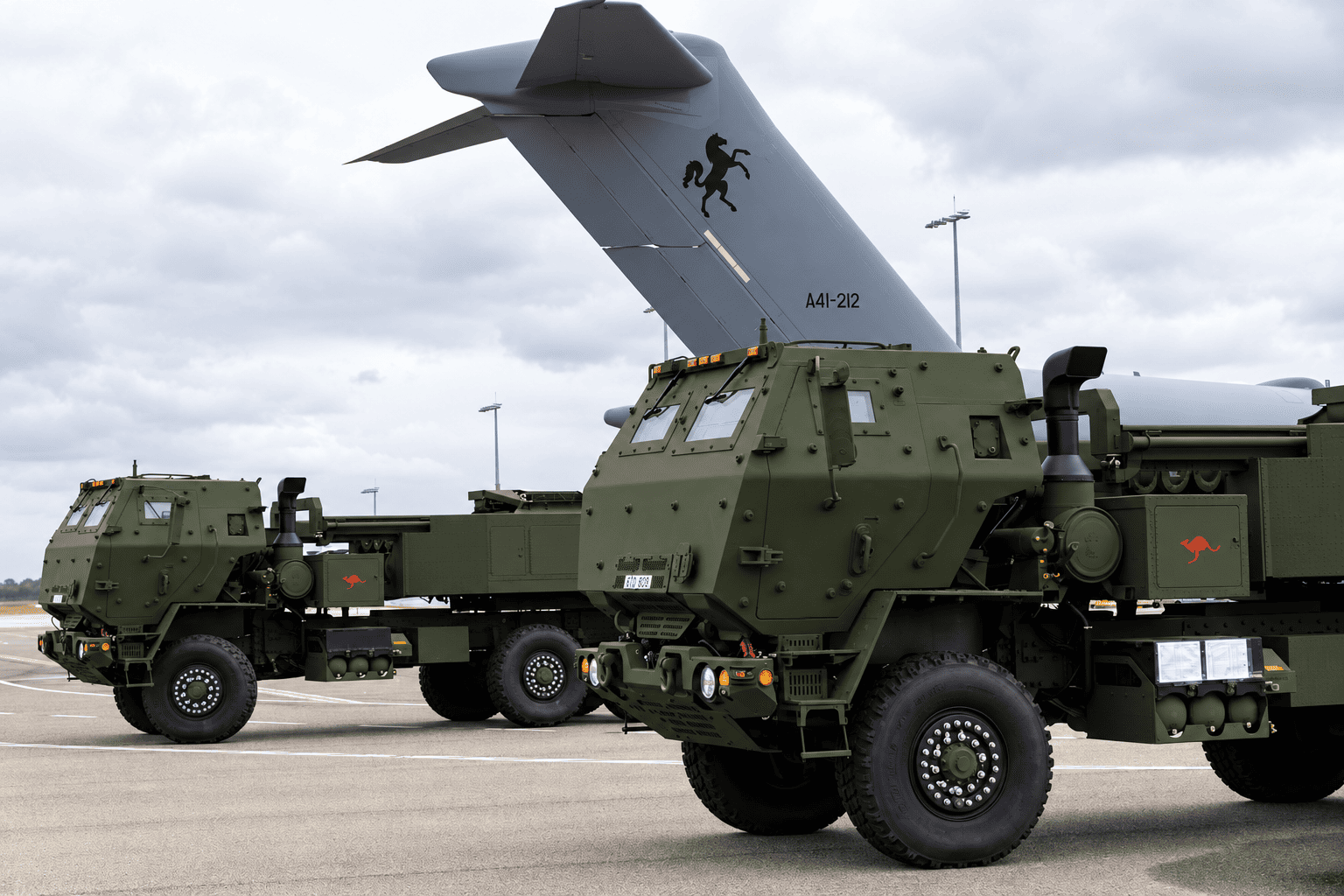
The Australian Army has received its second batch of Lockheed Martin M142 High Mobility Artillery Rocket System (HIMARS) launchers from the United States two years ahead of schedule, the Australian government announced on October 7, 2026. The launchers join the Adelaide-based long-range fires regiment of the 10th Fires Brigade, the formation Canberra plans to grow to as many as 90 HIMARS across two regiments. The government did not disclose how many launchers the new tranche contains.
The delivery follows the arrival of the first two Australian launchers in March 2025 and comes five months after the government selected HIMARS and the Precision Strike Missile (PrSM) for Project LAND 8113 Phase 2 on April 28, 2026. That A$2.3 billion decision, reached after a competitive evaluation against a StrikeMaster bid led by Kongsberg Defence Australia, funds a second long-range fires regiment at the Edinburgh Defence Precinct in South Australia. It sits inside a 2026 Integrated Investment Program that commits up to A$37 billion over the decade to targeting and long-range strike.
Australian HIMARS Fleet: Launchers, Munitions, and PrSM Reach
LAND 8113 Phase 1 covers 42 launchers ordered in two tranches: an initial 20 announced in January 2023 and 22 more added in August 2023. A US Foreign Military Sales approval announced on September 30, 2025, covering up to 48 additional M142 launchers, cleared the way to lift the planned fleet to 90. Minister for Defence Industry Pat Conroy said the program is “now on track to be fully operational four years ahead of schedule,” a benchmark measured against the program’s previously planned delivery schedule.
Publicly available specifications indicate the M142 mounts a single launch pod on a five-ton Family of Medium Tactical Vehicles (FMTV) 6×6 chassis with a crew of three. Each pod carries six 227 mm Guided Multiple Launch Rocket System (GMLRS) rockets or two PrSM. GMLRS reaches beyond 70 km, and the Extended Range GMLRS has been tested to roughly 150 km. PrSM Increment 1, which Australia first fired during Exercise Talisman Sabre 2025, two years earlier than planned, engages targets out to 500 km; the government says future increments will extend that beyond 1,000 km. Increment 2 is being developed with a multimode seeker for moving maritime targets, according to publicly available program information.
That reach is the point. The Army’s longest-range organic fires previously came from the M777A2 155 mm howitzer, and the government frames HIMARS as a more than tenfold increase in striking range. Mobility compounds it: HIMARS is transportable by C-130 and C-17 aircraft, a Royal Australian Air Force C-17A delivered the first Australian launchers in March 2025, and sea trials in Sydney Harbour loaded launchers onto landing craft and the landing helicopter dock HMAS Canberra. Pushed forward from Edinburgh to northern bases or island chokepoints, a PrSM-armed battery can hold surface ships at risk across the sea-air gap without committing aircraft or warships.
From Port Wakefield to Newcastle: Building Sovereign Missile Production
Launchers are only half the equation. In December 2025, Lockheed Martin Australia opened a dedicated GMLRS assembly facility at Port Wakefield, South Australia. On April 9, 2026, an Australian Army HIMARS supported by the 14th Regiment, Royal Australian Artillery fired the first Australian-made GMLRS at the Woomera Test Range, the third live fire by Australian launchers since March 2025. The government says Australia is now the only country outside the United States producing GMLRS, backed by A$320 million to bring local suppliers into the component chain. A US certification flight test of the Australian-built rounds is planned for 2027, according to the manufacturer. Lockheed Martin Australia has identified the Extended Range GMLRS as the logical next step for the line, which would roughly double the reach of locally built rockets.
The longer-range munition is the harder problem. Australia and the United States established a cooperative PrSM program in 2025 covering co-development, co-production, and co-sustainment, coordinated through a joint office in Huntsville, Alabama. The government says it intends to extend local manufacturing from GMLRS to PrSM co-production, but no production start date or annual rate has been announced. A second missile factory, built by Kongsberg Defence Australia at Williamtown near Newcastle, New South Wales, under an investment of up to A$850 million, is scheduled to begin producing Naval Strike Missiles and Joint Strike Missiles in 2027. It does not build HIMARS munitions, but it broadens the Guided Weapons and Explosive Ordnance (GWEO) Enterprise, which the government is funding with up to A$36 billion over the decade.
Analysis: The early delivery confirms that launchers are no longer the pacing item in Australia’s long-range fires buildup; munitions are. A 90-launcher force built around PrSM depends on a missile the US Army is still fielding for itself, and every Australian magazine filled from American lines draws on finite US capacity. That makes Port Wakefield and PrSM co-production strategically more consequential than any delivery date. If Canberra turns the cooperative program into a genuine second production source, it adds allied capacity rather than consuming it. If co-production slips, Australia risks fielding two regiments with shallow magazines.
Defence said in March 2025 that all 42 Phase 1 launchers would arrive by the end of 2028. The next markers are the size and delivery profile of the Phase 2 launcher order, the timing of PrSM Increment 2 deliveries to Australia, the 2027 certification test for locally built GMLRS, and a firm start date for PrSM co-production. Until those figures are public, the second regiment’s readiness date remains an open question.