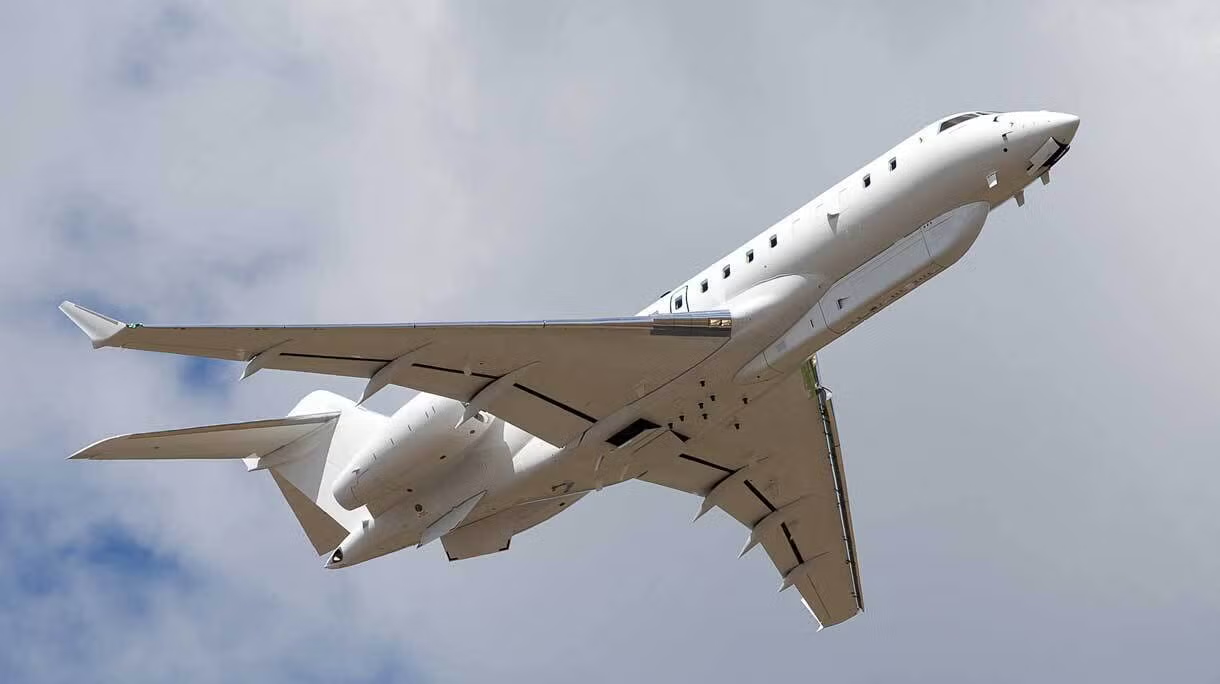
The U.S. Army plans to award three sole-source, firm-fixed-price contracts to bring five contractor-owned intelligence, surveillance and reconnaissance (ISR) business jets under government ownership, according to a notice published October 6, 2026. Army Contracting Command at Aberdeen Proving Ground (ACC-APG), acting for the Headquarters, Department of the Army (HQDA) G-2, names Sierra Nevada Corporation (SNC) for two ATHENA-S aircraft, L3Harris Technologies for one Airborne Reconnaissance and Electronic Warfare System (ARES) jet, and MAG Aerospace for two ATHENA-R aircraft.
The notice addresses a capacity gap the Army accepted deliberately. In fiscal 2025, the service finished divesting its legacy turboprop collectors, the RC-12X Guardrail, the MC-12S Enhanced Medium Altitude Reconnaissance and Surveillance System (EMARSS) and the EO-5C Airborne Reconnaissance Low-Multifunction (ARL-M), roughly 70 aircraft in all, before their replacement, the ME-11B High Accuracy Detection and Exploitation System (HADES), entered service. Contractor-owned, contractor-operated (COCO) jets have carried much of the fixed-wing collection load since. HQDA G-2 now wants uninterrupted access to those aircraft, their signals intelligence (SIGINT), sensor and datalink suites, and cleared crews until HADES can take over.
Why Army ISR Jets Are Moving to Government Ownership
The combined sources sought and notice of intent to sole source invokes Federal Acquisition Regulation (FAR) 6.302-1, which permits bypassing full and open competition when only one responsible source can meet a requirement. The objective is an interim transition of the five aircraft to a government-owned, government-operated (GOGO) model.
The Army offers four justifications. The three companies are the original equipment manufacturers of the modified aircraft, own the proprietary data and integrated mission systems, and hold active Army Airworthiness Releases (AWRs) for these airframes. Any other vendor would force the government to spend “hundreds of millions of dollars” in non-recurring engineering (NRE) to acquire, modify and certify a duplicate fleet. Competition would add a multi-year lead time that the notice warns would create “a catastrophic operational gap.” Finally, about 85% of the incumbents’ workforce holds active Top Secret/Sensitive Compartmented Information (TS/SCI) clearances with access to secure facilities.
Other firms may still respond with five-page capability statements due by 3:00 p.m. EDT on October 16, 2026. Each must show how the bidder would deliver modified aircraft, integrated mission systems and AWRs by a November 2027 deadline without substantial NRE or duplicate acquisition costs. The notice discloses no contract values, periods of performance or timeline for Army aircrews to replace company crews. Its emphasis on a cleared contractor workforce suggests industry personnel will stay embedded through at least part of the transition.
Inside the ATHENA and ARES Global 6500 Collection Fleet
All five aircraft are heavily modified Bombardier Global 6000/6500-series business jets. Publicly available manufacturer specifications credit the Global 6500 with a 51,000-foot ceiling and a range of about 6,600 nautical miles on two Rolls-Royce Pearl 15 turbofans. Altitude is the operational payoff: the retired RC-12X topped out near 35,000 feet, and every additional thousand feet extends the line-of-sight horizon for SIGINT and radar collection while increasing standoff from hostile air defenses.
L3Harris built ARES as a HADES technology demonstrator; it first flew in August 2021. The company rates it for a 14,000-pound mission payload and operations above 40,000 feet for up to 14 hours. After a roughly seven-month upgrade to a full-spectrum SIGINT configuration, it deployed to the Indo-Pacific in 2022.
The Army Theater-Level High-Altitude Expeditionary Next Airborne ISR (ATHENA) effort split into two pairs of jets in 2023. ATHENA-R, the radar variant, went to a MAG Aerospace and L3Harris team in August; it first flew in March 2024 and deployed to South Korea in February 2025 for a four-month operational assessment. ATHENA-S, the SIGINT variant, uses SNC’s Rapidly Configurable-X (RAPCON-X) architecture under a five-year services contract valued at $554 million. SNC cites an operating altitude above 45,000 feet, range beyond 6,000 nautical miles and 14 hours of endurance, and announced on April 15, 2026, that both jets had completed testing and entered COCO service. The notice omits ARTEMIS, the Leidos-integrated Challenger 650 demonstrator, and does not address its status.
How the HADES Timeline Shapes the Bridge Fleet Plan
The Army selected SNC as HADES lead system integrator on August 22, 2024, under a 12-year indefinite-delivery, indefinite-quantity contract with a $93.5 million initial award and a $991.3 million ceiling; the Government Accountability Office later denied a protest by L3Harris. Bombardier delivered the first Global 6500 for ME-11B conversion in November 2024. The Army expects the first prototype before the end of 2026 and a second in mid-2027, with the fleet based at Fort Hood, Texas.
Fleet size remains unsettled. A May 7, 2025, execute order under the Army Transformation Initiative cut the planned buy from 12 aircraft to six. A January 2026 request for information still cited a future objective of up to 14, while an Army spokesperson has described a plan of six production jets and three prototypes.
Analysis: Five government-owned bridge jets would give the Army an organic high-altitude ISR fleet nearly equal to the six production HADES aircraft it currently plans to buy, years before that fleet exists. The move also unwinds the ISR-as-a-service model, under which industry financed airframes and mission systems so the Army could defer capital costs. By citing proprietary data and OEM-held airworthiness releases as the reason it cannot compete the work, the Army concedes that data rights, not airframes, are now the binding constraint. That lesson applies directly to HADES, where SNC is both lead integrator and owner of the RAPCON-X architecture underpinning ATHENA-S and the ME-11B.
The next decision point follows the October 16 deadline, when the Army will judge whether any respondent meets the “clear and convincing” evidence bar the notice sets. Absent a credible challenger, negotiations with the three incumbents would follow, with November 2027 effectively setting the schedule for the airworthiness and crew transition. Contract values, sustainment terms and the fate of ARTEMIS remain undisclosed, and the final size of the HADES fleet will determine how long the five bridge jets stay in Army service.