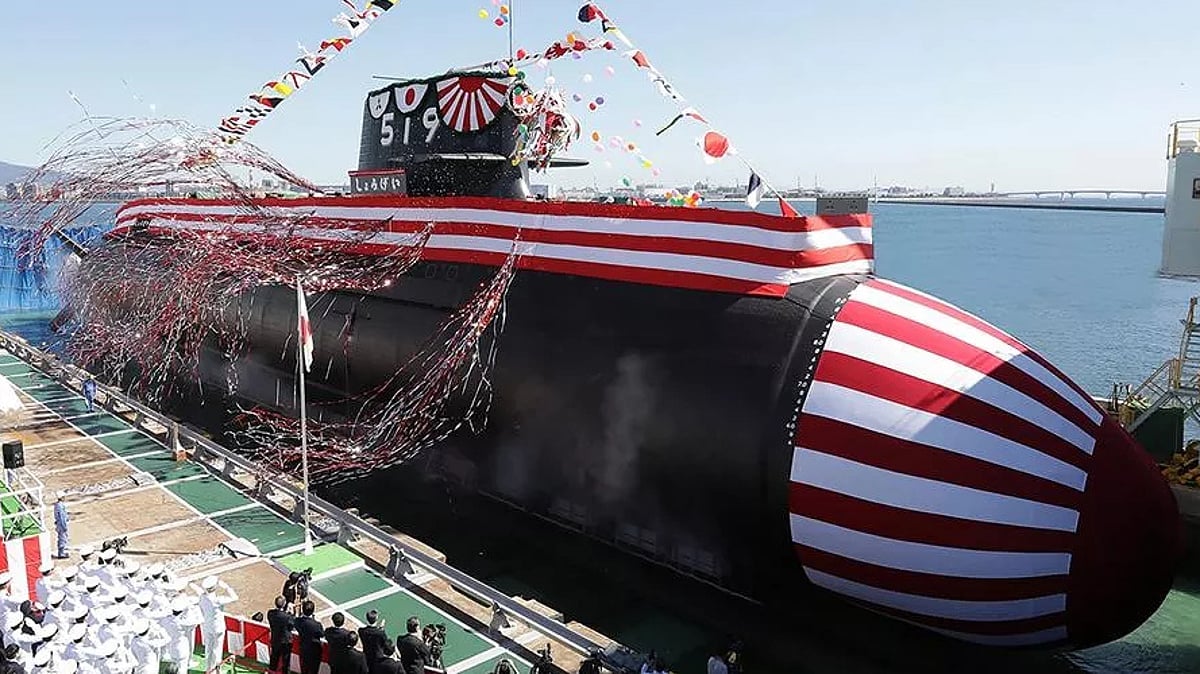
Mitsubishi Heavy Industries (MHI) launched Shogei (SS-519), the seventh Taigei-class diesel-electric attack submarine (SSK) built for the Japan Maritime Self-Defense Force (JMSDF), at its Kobe Shipyard in Hyogo Prefecture on October 8, 2026. The 3,000-tonne boat carries a construction cost of about 80.5 billion yen ($509 million) and is scheduled for delivery to the Ministry of Defense (MoD) in March 2028, the final month of fiscal year 2027.
The launch keeps Japan’s two-yard submarine line on its annual rhythm, but it arrives in a different policy climate. Tokyo is revising its three national security documents before the end of 2026, Defense Minister Shinjiro Koizumi has said nuclear-powered submarines will not be excluded, and the Acquisition, Technology and Logistics Agency (ATLA) is already funding design research on a larger submarine armed with vertical launching system (VLS) cells. Shogei, or Soaring Whale, a name no JMSDF vessel has carried before, is a mature conventional design entering the water just as Japan debates what should follow it.
Taigei-Class Submarine Design: Lithium-Ion Power Replaces Stirling AIP
According to the JMSDF, Shogei measures 84 meters in length with a 9.1-meter beam and a standard displacement of about 3,000 tonnes. Publicly available specifications indicate a hull depth of 10.4 meters and a crew of 70. The hull nearly matches the Soryu class; the change lies in energy storage.
The earlier Oyashio class displaced 2,750 tonnes and ran on lead-acid batteries. The first ten Soryu-class boats, at 2,900 tonnes, added four Stirling air-independent propulsion (AIP) engines for slow, snorkel-free patrols. The final two, Oryu (SS-511) and Toryu (SS-512), dropped AIP for lithium-ion storage, with Oryu bringing the technology into service in March 2020. The Taigei class was designed around large-capacity lithium-ion batteries from the outset, absorbing roughly 100 additional tonnes without lengthening the hull.
Shogei uses a diesel-electric layout of two diesel generators, one electric motor and a single shaft, rated at 4,413 kilowatts (6,000 metric horsepower). Like Raigei (SS-516), Chogei (SS-517) and Sogei (SS-518), she is fitted with the higher-output Kawasaki 12V 25/31 diesel engine, which replaced the 25/25SB units on the first three boats. The upgrade matters operationally: lithium-ion cells accept higher charging currents than lead-acid batteries, so more powerful generators shorten the time spent at snorkel depth, a submarine’s most detectable posture. Reported submerged speed is 20 knots, but the MoD has not disclosed battery capacity or endurance at patrol speeds.
ZQQ-8 Sonar and Type 18 Torpedoes Define Shogei’s Combat Suite
Compared with the Soryu class, the Taigei design pairs improved sonar detection with a quieter hull structure. Publicly available specifications indicate the ZQQ-8 integrated sonar combines a bow array, flank arrays and a fiber-optic towed array, fused by the OYX-1 processing subsystem and presented on the ZQX-12 tactical display. Floating machinery mounts, developed between 2007 and 2014, isolate vibration from the pressure hull at the cost of internal volume. The mast suite includes the NZLR-2 electronic support system, the ZPS-6H navigation radar and non-hull-penetrating optronic masts.
Armament runs through six 533 mm bow tubes. The primary weapon is the Type 18 heavyweight torpedo, successor to the Type 89, with improved propulsion, target detection and signal processing. The tubes also launch the encapsulated UGM-84L Harpoon Block II anti-ship missile, which has a reported range of 248 kilometers (134 nautical miles). At that distance the submarine depends on off-board targeting data, tying its anti-surface role to Japan’s wider maritime surveillance network. The class also carries the torpedo countermeasures system introduced on the last four Soryu boats. No land-attack weapon is fitted.
From Shogei to VLS Submarines: The Propulsion Choice Facing Tokyo
MHI and Kawasaki Heavy Industries (KHI) have alternated annual launches since 2020. MHI floated out Taigei, Jingei, Chogei and now Shogei; KHI launched Hakugei, Raigei and Sogei. Chogei was commissioned in March 2026, and Sogei is due in March 2027. Two further boats, SS-520 and SS-521, were laid down in December 2024 and April 2026 for planned delivery in March 2029 and March 2030.
The follow-on program is a different animal. The December 2022 security documents directed the MoD to pursue submarines with VLS cells capable of firing long-range stand-off missiles. On July 6, 2026, ATLA awarded MHI a 3.9 billion yen ($24.6 million) contract for total ship optimization design research on that next-generation boat, running from fiscal 2026 through fiscal 2029. In September 2025, an expert panel advising the MoD recommended further work on next-generation propulsion without explicitly naming nuclear power.
On September 11, 2026, Koizumi said nuclear-powered boats can stay submerged longer while sustaining far higher speeds, improving crew safety. He also acknowledged higher costs, larger hulls, specialized expertise requirements and potentially greater acoustic signatures. In its launch announcement, MHI said it intends to focus on developing new submarines beyond conventional frameworks.
Analysis: Shogei marks the practical ceiling of Japan’s battery-centric submarine model. Every growth requirement on the table, from VLS cells to larger sonar arrays and unmanned underwater vehicle (UUV) operations, draws on the same fixed submerged energy budget a 3,000-tonne hull can carry. A Taigei boat can sprint at 20 knots, but its batteries drain fast at that pace and force a return to snorkel depth. The choice facing Tokyo is therefore a mission choice: quiet, affordable chokepoint denial, where lithium-ion SSKs excel, or persistent long-range strike patrols deeper into the Western Pacific as Chinese naval activity expands, which favor nuclear propulsion. The second path would also test the Atomic Energy Basic Act, which limits nuclear energy to peaceful purposes, and demand reactor training and maintenance infrastructure the JMSDF does not have.
Shogei now enters outfitting of her hull, machinery, electrical systems and weapons, followed by sea trials ahead of the March 2028 handover. The nearer decision point is the year-end revision of Japan’s security documents, which will signal whether nuclear propulsion moves from consideration to requirement. As of October 8, 2026, the VLS submarine’s displacement, cell count, missile selection, propulsion and construction budget all remain undetermined.