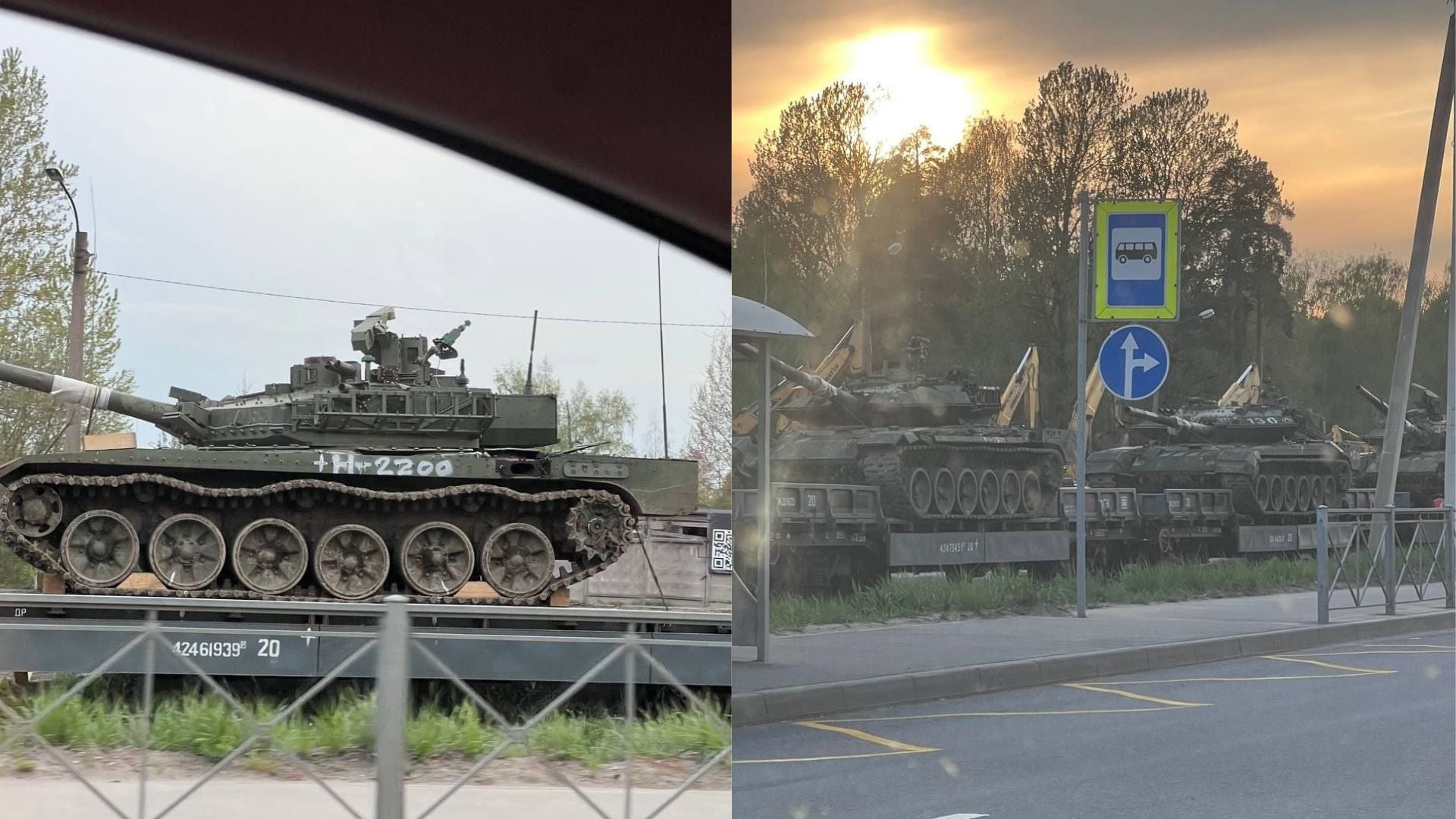
Uralvagonzavod (UVZ), Russia’s main tank manufacturer and the only plant building new T-90M Proryv main battle tanks, is now carrying out capital repairs on T-90Ms damaged in Ukraine, according to Russian armor analysts. Photographs published on October 6, 2026, by an open-source account show heavily damaged T-90Ms loaded on rail flatcars bound for the plant in Nizhny Tagil, Sverdlovsk Oblast; the account said the images were taken in 2025.
The shift puts battlefield repair and new-build production on the same factory floor. UVZ, a subsidiary of the state conglomerate Rostec, has been the single source of new T-90Ms since 2022, and analysts have long disputed how many of those tanks are genuinely new. Open-source estimates range from 60 to 70 units in 2022 to between 150 and 300 per year in 2024 and 2025. Every rebuilt T-90M now competes with that output for labor, optics and machining time.
Why Uralvagonzavod Has Taken On T-90M Tank Repairs
Andrei Tarasenko, a Russian armored vehicle analyst, wrote on Telegram that UVZ, as the monopoly tank maker, had ruined Russia’s network of armored repair plants, known by the Russian abbreviation BTRZ, and was now carrying out capital repairs itself. He added that a capital repair carried out under factory conditions, rather than at a BTRZ, costs about as much as a new tank. Tank-capable BTRZ sites such as the 61st plant near Saint Petersburg and the 103rd plant near Chita are now part of UVZ; open-source imagery analysis has shown them crowded with T-62 and T-72 hulls drawn from long-term storage.
Jakub Janovsky, lead analyst at the Oryx open-source loss-tracking project, pointed to a second variable: where a tank is hit. Vehicles disabled in the contested gray zone between the two armies are usually finished off before recovery crews can reach them, he said, while tanks damaged farther behind the line of contact can be dragged out and repaired with far less effort. That distinction shapes the arithmetic of attrition. Oryx counts damaged and abandoned vehicles alongside destroyed and captured ones; of the 4,452 Russian tank losses it had documented as of October 8, 2026, 165 were listed as damaged and 392 as abandoned.
UVZ has advertised this capability before. In September 2024, a company representative said the plant had restored a T-90M in about four weeks after its turret was struck by 26 drones. Separately, analysts identified in 2024 production-line photographs that some T-90Ms leaving Nizhny Tagil were built on refurbished T-90A hulls, a sign that the boundary between rebuild and new build was already porous.
Kalina, Relikt and Arena-M: What a Factory T-90M Rebuild Restores
Publicly available specifications explain why the work lands at the manufacturer. The T-90M, developed under the Proryv-3 program as Object 188M, pairs a reworked T-72-lineage hull with a new welded turret. It carries a 125 mm 2A46M-4 smoothbore gun fed by an autoloader and able to fire the 9M119M Refleks-M laser-guided missile. The Kalina fire control system combines a thermal-imaging gunner’s sight with a stabilized commander’s panoramic sight, giving the three-man crew a hunter-killer capability. Protection relies on the Relikt explosive reactive armor package and reserve ammunition stowed in the turret bustle, while a V-92S2F diesel delivers 1,130 hp for a combat weight of roughly 46.5 tonnes. Compared with the T-90A it supersedes, most of the T-90M’s added value sits in the turret, fire control and powerplant, the turret elements being the most exposed to top-attack drone strikes.
Those subsystems are the components a field repair unit cannot regenerate. A turret struck repeatedly by first-person-view drones typically loses sights, the remote weapon station, reactive armor cassettes and wiring harnesses. Restoring them requires the same thermal imagers, stabilizers and electronics that feed new-build tanks, parts that Western sanctions on microelectronics and precision machine tools have made harder to source. Rebuilt tanks also leave the plant with the current survivability fit. In recent delivery announcements, UVZ has highlighted an all-around protection kit with a woven steel-cable turret screen, armor over the running gear and rubber strips on spring-loaded hull mounts. Some T-90Ms now carry the Arena-M hard-kill active protection system, which Russian forces demonstrated against attacking drones during the Tsentr-2026 exercise.
Analysis: Routing combat-damaged T-90Ms back to Uralvagonzavod turns a capacity problem into a measurement problem. If a factory rebuild costs close to a new tank and draws on the same optics, gun barrels and skilled welders, each recovered hull displaces new output rather than adding to it. Janovsky has cautioned that some organizations may count factory repairs and upgrades as new production, which would inflate estimates of Russian armored regeneration. For NATO planners sizing the force Russia could reconstitute, the figure that matters is net additions to the fleet, not delivery announcements from Nizhny Tagil.
The scale of the program remains unknown. UVZ does not publish delivery quantities, and neither the company nor the Russian Ministry of Defense has disclosed how many T-90Ms it has repaired. The next indicators will be rail imagery of returning hulls, the pace of Arena-M fitting across new and rebuilt tanks, and whether Moscow expands BTRZ capacity for high-end armor rather than leaving it to its sole tank producer.