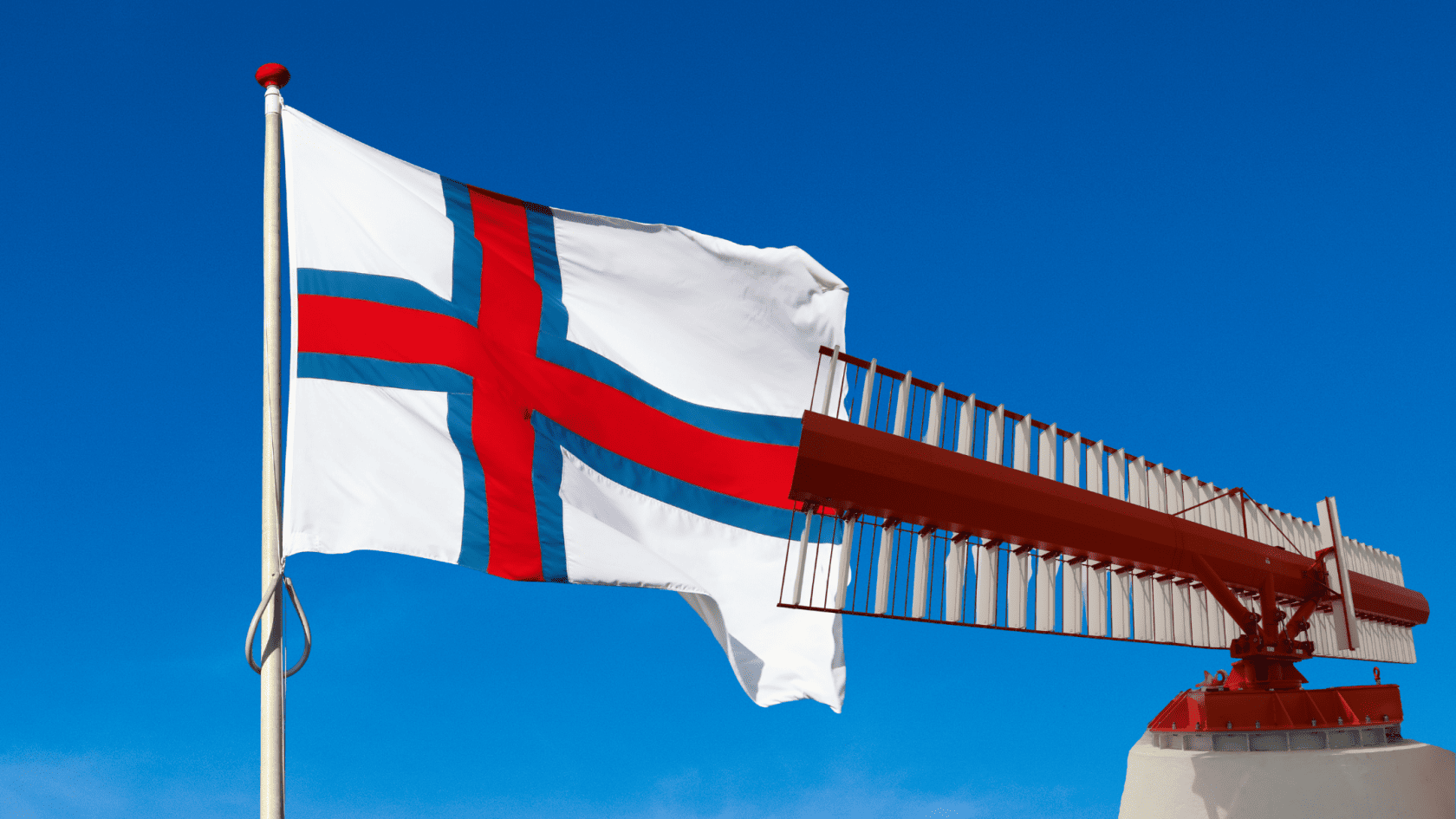
The Danish Ministry of Defence Acquisition and Logistics Organisation (DALO) has selected Thales to supply and install an RSM NG secondary surveillance radar at Sornfelli in the Faroe Islands, the French group announced on October 7, 2026. The new sensor will replace a legacy Thales RSM 970 at the mountaintop site, and Thales says delivery and installation will take under six months with no interruption to air traffic control services.
Sornfelli, a summit of roughly 750 meters on the island of Streymoy, hosted a Cold War-era military air surveillance radar until 2007. Its closure left a primary radar gap between Iceland, Norway and the United Kingdom, at the heart of the Greenland-Iceland-United Kingdom (GIUK) gap. Copenhagen and the Faroese government agreed on June 9, 2022, to return a military radar to the summit, and in December 2025 DALO selected Lockheed Martin’s TPY-4 for Skagen, Bornholm and the Faroe Islands. The Thales order covers the other layer: the cooperative surveillance controllers use to identify and separate transponder-equipped aircraft.
Inside the Thales RSM NG Radar: Mode S and ADS-B Fusion
A secondary surveillance radar does not detect aircraft by reflected energy. It interrogates transponders on 1030 MHz and decodes their replies on 1090 MHz, returning identity, pressure altitude and, under Mode S, a unique 24-bit aircraft address. Thales launched the RSM NG in March 2021 and describes it as a “meta-sensor” that fuses Mode S interrogation with passive reception of Automatic Dependent Surveillance-Broadcast (ADS-B), the satellite-derived position reports equipped aircraft transmit on 1090 MHz. According to Thales, combining both sources speeds up track initiation and improves accuracy.
Publicly available specifications from the 2021 launch indicate the radar handles up to 2,000 tracks and feeds 64 simultaneous data outputs to separate air traffic centers. Thales packed the electronics into two cabinets instead of three, cutting weight and volume by 30 percent, and added health and usage monitoring (HUMS) for condition-based maintenance. The design is cyber-secured under the U.S. National Institute of Standards and Technology (NIST) framework and complies with International Civil Aviation Organization (ICAO) and EUROCONTROL standards, according to the company.
Although DALO is the buyer, the radar also serves civil air traffic control. Controlled airspace above the Faroe Islands sits within the Reykjavik Control Area, managed by AVIANS, the Icelandic provider known as Isavia ANS until March 24, 2026. Naviair, the Danish state-owned provider, runs the aerodrome flight information service at Vágar Airport and maintains surveillance systems across the Faroes. The RSM NG will connect to the AVIANS control center, with Naviair and AVIANS handling integration, and its 64 outputs let one feed reach civil and military users in several countries.
The compressed schedule is the main execution risk, since any coverage gap would degrade separation services for North Atlantic en-route traffic. Thales calls the timeline one of the shortest achieved for a program of this scale but has not described the cutover sequence. Colonel Thomas Pedersen, head of DALO’s Air and Space Division, said: “The Faroe Islands’ strategic location in the North Atlantic makes it important to maintain a stable and reliable air picture throughout the modernisation.”
How the RSM NG Complements Denmark’s TPY-4 Air Defense Radar
A secondary radar sees only aircraft that answer; a military aircraft flying with its transponder off never appears on it. Detecting those non-cooperative targets falls to the TPY-4, an L-band three-dimensional active electronically scanned array (AESA) primary radar operating between 1,215 and 1,400 MHz, according to manufacturer specifications. DALO ordered three TPY-4 units in December 2025 under a sole-source contract valued at roughly $610 million, citing Denmark’s essential security interests, with an option for a fourth radar in Greenland.
Correlating primary returns with Mode S and ADS-B tracks lets an air operations center separate routine transatlantic traffic from unidentified contacts, the first step before any quick reaction alert launch. Thales already markets a sensor that bridges civil and military identification: the RSM NG/IFF, unveiled at the Paris Air Show in June 2025, adds NATO Mode 5 identification friend or foe (IFF) interrogation with data segregation between civil and military modes. The Faroes announcement mentions only Mode S and ADS-B, and DALO has not said whether Mode 5 interrogation at Sornfelli will come from this radar, the TPY-4 or another system.
Analysis: The contract is small, but it shows Denmark rebuilding North Atlantic air surveillance in layers. Since 2007, Sornfelli has supported civil traffic surveillance without military primary coverage; once the TPY-4 arrives, the same summit will host cooperative and non-cooperative sensors serving Reykjavik controllers and Danish military users. That pairing matters in the GIUK gap, where Russian long-range aviation and maritime patrol flights have long tested NATO air policing from Iceland, Norway and the United Kingdom. The weaker link is governance rather than hardware: a radar bought by the military, integrated by two civil providers from two countries and sited on Faroese territory depends on data-sharing arrangements that have not been made public.
Neither Thales nor DALO has disclosed the contract value or a start date, so the under-six-month window cannot yet be tied to a calendar. The next markers are the RSM NG handover to Naviair and AVIANS, the installation schedule for the Faroese TPY-4, and whether Denmark exercises its Greenland option. Whether Sornfelli gains Mode 5 interrogation, through this radar or another sensor, will show how far Copenhagen intends to merge civil and military air pictures over the North Atlantic.