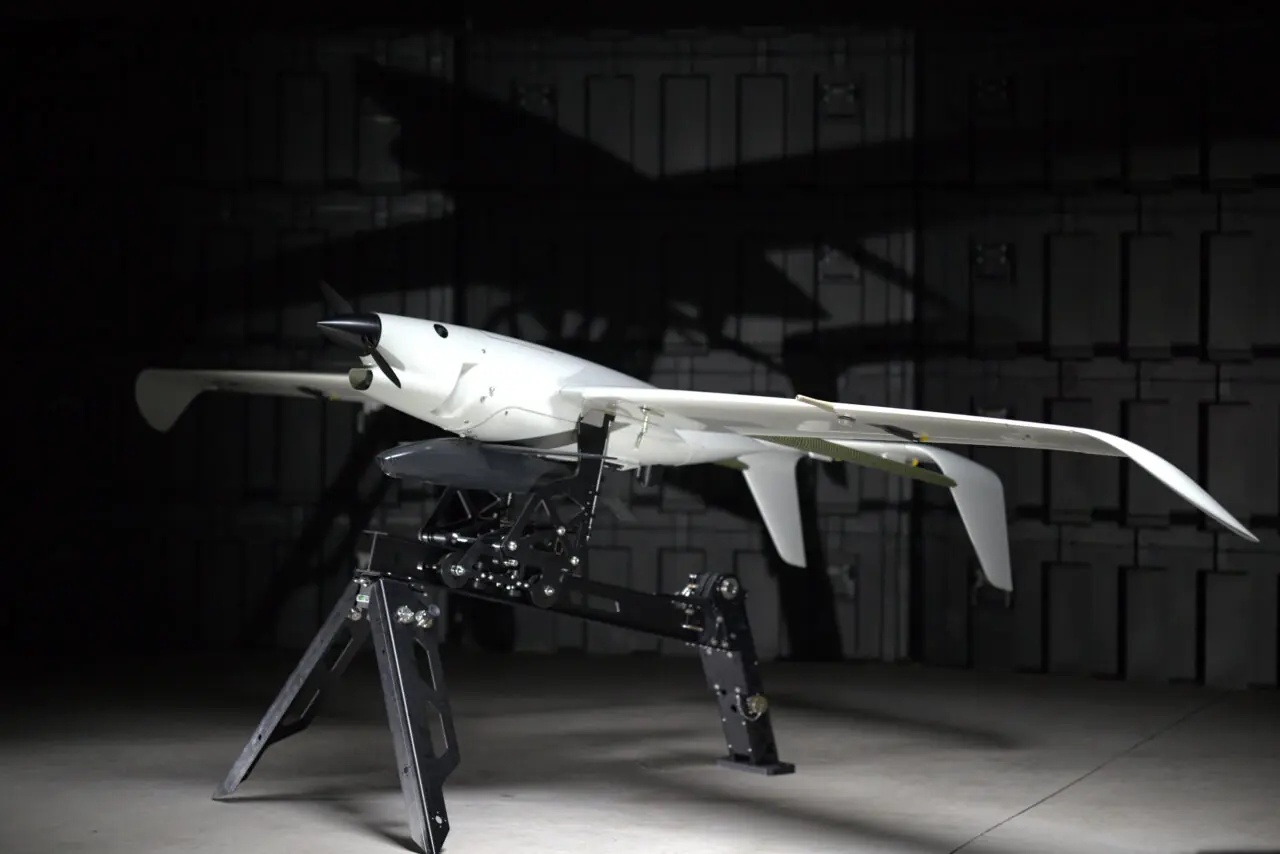
Ukrainian drone maker Skyeton unveiled Stormbird on October 7, 2026, a fixed-wing tactical unmanned aircraft system (UAS) built for precision strike and derived from the company’s Raybird reconnaissance drone. Ukraine’s Ministry of Defense codified the platform in early 2026, and units of the Armed Forces of Ukraine are already using it in combat, according to the company.
The launch takes Skyeton from deep reconnaissance into strike, a shift CEO Roman Knyazhenko described as “a step beyond reconnaissance.” Raybird, designated ACS-3 in Ukrainian service since 2018, has become one of Kyiv’s main long-range intelligence, surveillance and reconnaissance (ISR) assets, and Skyeton reports more than 350,000 combat flight hours on the type. That record now carries weight beyond Ukraine: on September 18, 2026, the Pentagon announced a $10.64 million firm-fixed-price contract to Skyeton Inc., the company’s North Las Vegas, Nevada, subsidiary, for Raybird systems and services, with work due by December 15, 2026.
Stormbird Strike UAS Inherits the Raybird Airframe and Ground Segment
Skyeton describes Stormbird as a compact fixed-wing airframe built on Raybird’s architecture, with enhanced payload integration and support for both autonomous and remotely guided strike missions. The company has not released Stormbird-specific figures for maximum takeoff weight, wingspan, payload mass, endurance or combat radius. That gap matters, because a strike sortie trades fuel for munitions and Stormbird’s reach with a full load remains unknown.
The parent design provides a reference. Manufacturer specifications for the internal combustion engine version of Raybird list endurance above 28 hours, a maximum flight range of more than 2,500 km, an operating ceiling of 5,500 m, a payload capacity of 5 to 10 kg and a wingspan of 3 to 4.2 m depending on configuration. Cruise speed is about 110 km/h within an 80 to 140 km/h envelope. Skyeton has cited a maximum takeoff weight of 23 kg, which places Raybird in the US Department of Defense Group 2 class. The aircraft launches from a catapult, needs no runway and recovers by parachute and airbag, flipping over on landing to protect its payload.
Skyeton says Stormbird uses similar ground infrastructure to Raybird and requires only a small crew. For Ukrainian units already flying Raybird, that points to common launchers, ground control stations and maintenance routines rather than a new logistics chain. The company has not said whether Stormbird relies on Raybird’s line-of-sight datalink, rated beyond 200 km, or on the satellite communications option Skyeton announced for Raybird in February 2026.
Remora, Quadremora and Retranslator: Three Payloads, Three Engagement Modes
Skyeton offers three payload options for Stormbird, each tied to a distinct way of delivering effects.
Remora is a glide munition first shown at XPONENTIAL Europe in Düsseldorf in 2025. Company figures released at the time give it a shaped-charge or high-explosive fragmentation warhead of 1.5 to 2.5 kg, a post-release velocity of about 140 km/h and real-time command guidance backed by a target acquisition system for terminal homing. The operator can steer it manually or let it home automatically after release. Skyeton pitched Remora as a glide munition sized for tactical drones under 25 kg, built to let the carrier strike while staying undetected. The glide profile allows release short of the target rather than a direct overflight, reducing the carrier’s exposure to point defenses.
Quadremora is described only as a first-person view (FPV) type loitering munition. Skyeton has published no range, warhead or endurance figures. Carried by a long-endurance fixed-wing drone, an FPV munition can be released far beyond the reach of ground-launched FPV crews, turning Stormbird into a mothership for terminal attacks on targets it has already located.
Retranslator is a communications relay that extends datalink range and maintains connectivity where ground infrastructure cannot reach. It addresses the limiting factor shared by both munitions: command guidance and FPV control depend on a stable link, and deep targets sit beyond the radio horizon of ground antennas.
How Raybird and Stormbird Pair for ISR and Strike Missions
Skyeton says Stormbird and Raybird can operate together on ISR and strike missions. The concept follows a hunter-killer model: Raybird holds a target area for a day or more with electro-optical, infrared, synthetic aperture radar or radio frequency payloads, while Stormbird delivers munitions against the targets Raybird has fixed.
Survivability is the operative concern. The company says Stormbird’s compact airframe minimizes radar visibility and resists electronic warfare (EW) interference, but it has published no radar cross-section data or details of the EW countermeasures involved. Interceptor drones have become a primary threat to fixed-wing reconnaissance aircraft over Ukraine, and in May 2026 Skyeton added a real-time interceptor detection feature to Raybird that alerts the operator when evasive action is needed. Whether Stormbird carries the same module has not been disclosed.
Autonomy is the other lever. Stormbird’s autonomous mission mode reduces dependence on a continuous operator link in a jammed environment, but Skyeton has not specified which phases run autonomously, from navigation to target recognition and terminal guidance, or what human control applies to weapon release.
Analysis: Stormbird illustrates how Ukraine’s drone industry is moving from single-role aircraft to airframe families that split sensing and strike across common hardware. Its relevance lies less in any one munition than in the gap it targets: precision effects at ranges beyond FPV crews and tube artillery, delivered by a small fixed-wing aircraft that shares Raybird’s ground infrastructure and a small crew. For Western armies, the timing is notable. The US Army has just contracted for Raybird, and a codified, combat-used strike derivative of the same airframe offers a ready test case for pairing ISR and strike on one ground segment.
Key unknowns remain: Stormbird’s takeoff weight, munition load, combat radius, unit cost and production rate. Skyeton has not said whether Stormbird will be built at its plant in Slovakia, which opened in 2024, or offered through its partners in Germany, Poland and the United Kingdom, nor whether Ukrainian export rules would permit foreign sales of a strike variant. Disclosed specifications and Ukrainian procurement volumes are the next markers to watch.