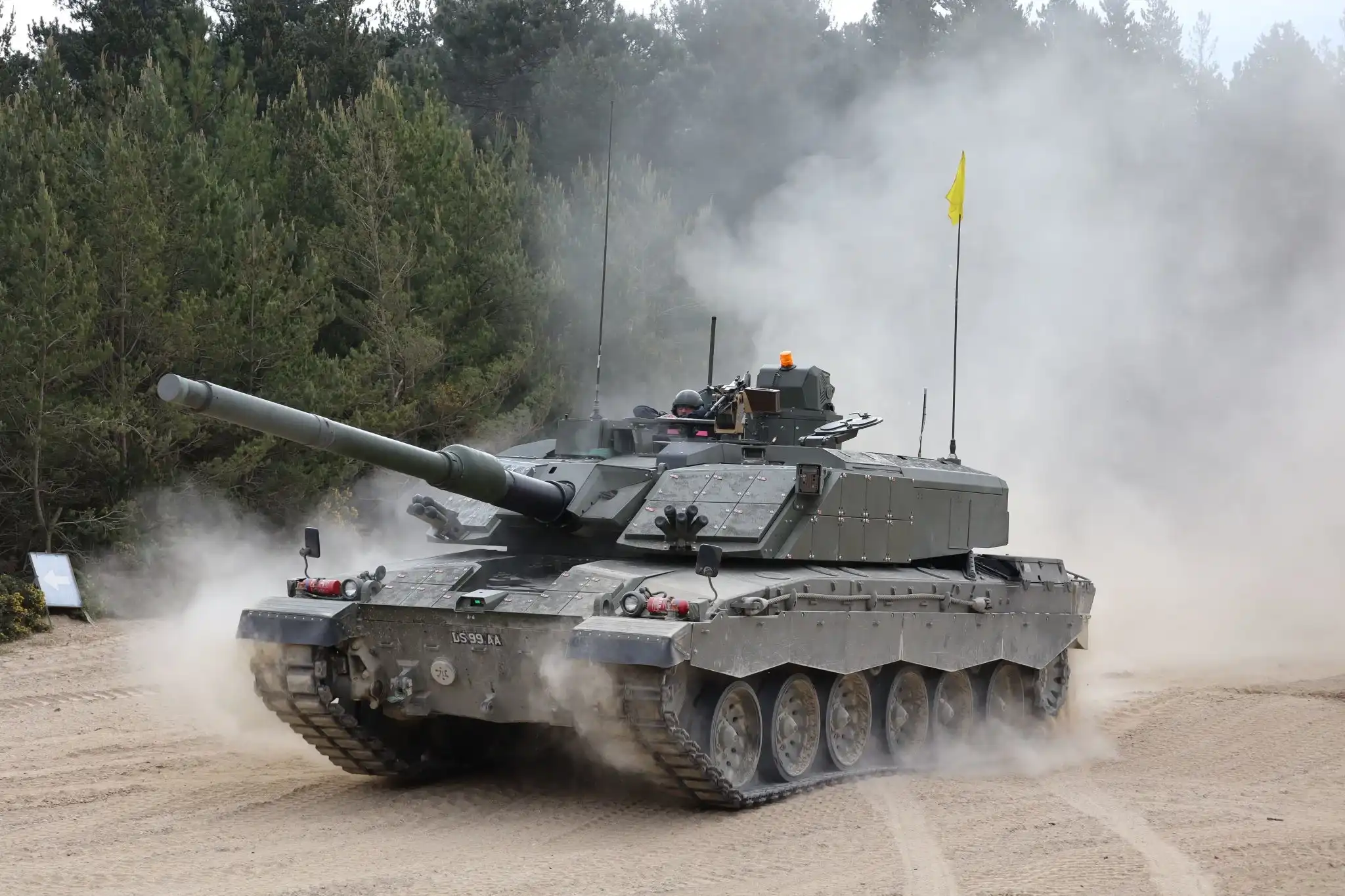
Rheinmetall BAE Systems Land (RBSL) said in a LinkedIn post on October 15, 2026, that its Challenger 3 main battle tank test fleet has driven 2,000 km (1,240 miles), fired more than 200 main armament rounds and deployed 100 smoke grenades, and that the British Army’s next-generation tank will enter a more demanding phase of trials in November.
The figures are the latest checkpoint in the demonstration phase of the £800 million ($1.06 billion) program awarded in May 2021, under which the British-German joint venture is converting 148 Challenger 2 hulls to the Challenger 3 standard. The schedule carries little slack. The Ministry of Defence (MoD) told Parliament in September 2025 that Challenger 3 trials were planned to conclude by the end of 2026, a timeline it said remained under review against emerging technical risk. The tank must then clear its System Qualification Review (SQR) before series conversion begins, with initial operating capability (IOC) targeted for 2027 and full operating capability (FOC) for 2030.
That timetable is now under formal review. In September 2026, Defence Minister Luke Pollard told Parliament that the Armour Main Battle Tank Programme is undergoing a review of programme performance and a related reapproval process, expected in financial year 2026-27, and gave no revised date for IOC or FOC. The answer followed questions on schedule risks identified in the National Infrastructure and Service Transformation Authority’s (NISTA) Major Projects Annual Report 2025-26.
Challenger 3 Trials Move From Demonstration Toward Qualification
RBSL did not specify how many vehicles contributed to the 2,000 km total, or whether the figure includes the 789 km covered during initial mobility trials on UK roads and cross-country routes in 2025. That earlier block, which RBSL reported complete in September 2025, gathered noise and vibration data as part of wider trials covering crew evacuation, radar cross section and indirect vision systems, and fed a Turret Test Rig at RBSL’s Telford facility built to run simulated battlefield missions in support of reliability growth trials from 2026.
Gunnery followed. In January 2026, RBSL completed the first crewed live firing of Challenger 3 at an MoD training center, after initial rounds were fired by remote operation. It was the first UK firing of a newly developed main battle tank in more than 30 years. Pre-production vehicles have since run battlefield mission serials combining cross-country driving, gunnery drills and full crew exercises. The MoD said in 2025 that four prototypes had been delivered, with four more in production.
The company described the November phase only as pushing “the vehicle and its new systems harder and faster,” without naming it. RBSL’s published roadmap places reliability growth trials after crewed firing and weapon system development, followed by the completion of demonstration-phase trials and the SQR that fixes the final manufacturing standard for the remaining hulls. Whether November marks the formal start of reliability growth testing has not been confirmed.
L55A1 Smoothbore Gun Brings NATO Ammunition Commonality to Challenger 3
The central change is the main armament. Challenger 3 replaces Challenger 2’s 120 mm L30A1, the only rifled main gun on a NATO main battle tank, with Rheinmetall’s 120 mm L55A1 smoothbore, the 55-caliber weapon also fitted to the Leopard 2A8. The switch gives British crews access to standard NATO 120 mm natures, including current armor-piercing fin-stabilized discarding sabot (APFSDS) rounds and programmable multipurpose high-explosive rounds that can be set to burst at selected points along their trajectory. Operationally, it ends the Army’s dependence on a finite stock of bespoke rifled ammunition, whose UK production lines have closed, and allows cross-supply with German and Polish tank units.
Trophy APS, Modular Armor and Hydrogas Mobility Upgrades Explained
The new turret carries digital targeting systems built around Generic Vehicle Architecture-compliant interfaces and increased on-board processing. Thales supplies both the TrueHunter commander’s sight and the stabilized TrueHunter gunner’s sight, each with integrated thermal imaging. Survivability rests on a next-generation modular armor system, a laser warning system and Rafael’s Trophy active protection system (APS), selected in June 2021, which detects incoming anti-tank missiles and rockets and defeats them with small explosively formed projectiles. In October 2024, Rafael unveiled a top-attack capability for Trophy, demonstrated against a drone passing overhead; whether the British configuration includes it has not been disclosed.
Mobility upgrades include third-generation Horstman Hydrogas suspension, common-rail fuel injection, improved cooling and air filtration, and an upgraded David Brown Santasalo TN54E transmission for the Perkins CV12-9A 26.1-liter V12 diesel. The tank’s expected core weight is about 66 tonnes.
Analysis: The headline numbers say less than the phase they precede. Spread across a pre-production fleet, 2,000 km is a modest distance for a 66-tonne vehicle expected to remain in service until at least 2040, and the program’s real exposure lies in reliability rather than lethality. Challenger 2’s later years were shaped by an ageing rifled gun and a closed ammunition production line, and with only 148 hulls to equip the Army’s armored regiments, Challenger 3 has little margin for availability problems. The timing is equally telling: a harder trials block opening in November sits awkwardly against an MoD plan to finish trials by the end of 2026 and a programme reapproval still pending, which makes some slippage of qualification into 2027 a realistic prospect. If that happens, the window between a frozen production standard and a credible 2027 IOC shrinks to months. For NATO, the payoff remains interoperability: a British tank fleet firing the alliance’s common 120 mm ammunition removes a long-standing logistics outlier from allied armored planning.
The immediate milestone is the November trials block, for which RBSL has not disclosed a duration, location or number of vehicles. The decision points that follow are the SQR date, the start of series conversion at Telford and confirmation that the 2027 IOC holds. All 148 tanks are planned to be in service by the end of 2030 within reorganized armored regiments. Whether the MoD’s end-2026 target for completing trials survives the coming phase is the clearest unknown, and the first real test of the program’s health.