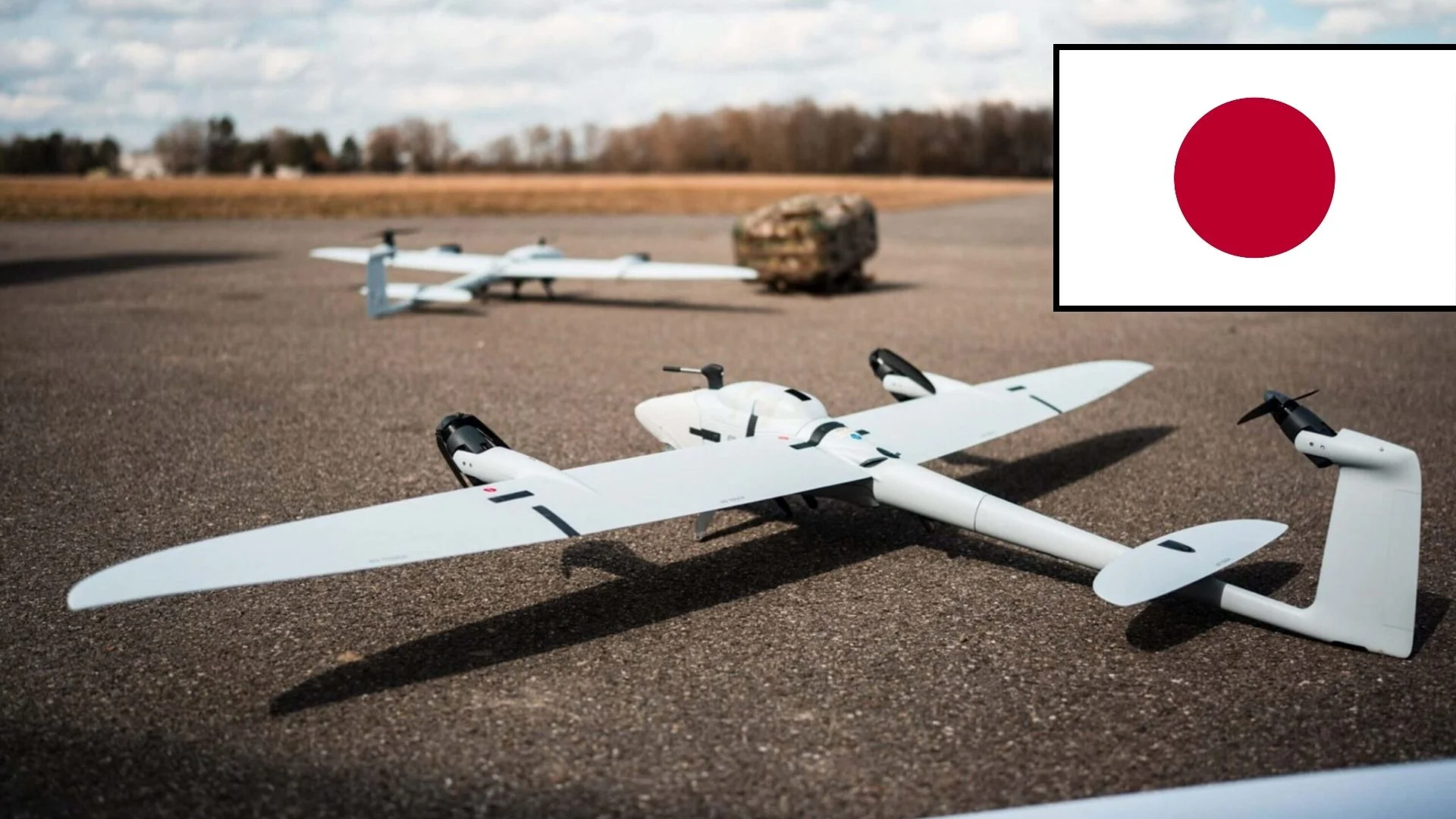
Quantum Systems has established a Japanese subsidiary, Quantum Systems Japan G.K., and opened an office in Tokyo, the German drone manufacturer announced on October 28, 2026. The company paired the move with signed memoranda of understanding (MoUs) with Mitsubishi Chemical and Panasonic, and unveiled it during German Chancellor Friedrich Merz’s first visit to Japan as chancellor.
The timing is deliberate. Merz arrived in Tokyo on October 28 for talks with Prime Minister Sanae Takaichi as part of an October 26 to 30 tour of Singapore, Japan and South Korea, accompanied by a business delegation that included defense companies. Defense industrial cooperation, including drone development, had been flagged as a core agenda item since July. The subsidiary lands as Japan’s Ministry of Defense (MoD) reorients procurement toward unmanned systems to offset a shrinking recruitment pool and a deteriorating regional threat environment.
Quantum Systems Japan Enters a Market Shaped by SHIELD
The MoD’s fiscal year (FY) 2027 budget request, submitted on August 31, seeks a record 8.9 trillion yen, roughly $55.6 billion, and rests on three pillars: new ways of warfare, sustained operations in a prolonged conflict, and a stronger defense industrial base. Unmanned systems sit at the center. Priority projects include unmanned aerial vehicles (UAVs) for intelligence, surveillance and targeting, attack UAVs, research into standoff missile launch modules for unmanned underwater vehicles (UUVs), and small general-purpose unmanned ground vehicles. The ministry states it intends to make the Self-Defense Forces (SDF) a world leader in the use of unmanned assets.
The flagship effort is SHIELD, the Synchronized, Hybrid, Integrated and Enhanced Littoral Defense concept, funded at 100.1 billion yen in the FY2026 budget. SHIELD is designed as a layered coastal defense network of aerial, surface and underwater unmanned vehicles across all three SDF services, with operational capability targeted by the end of FY2027 in March 2028. Its component list includes reconnaissance drones, short-, medium- and long-range attack drones, and interceptor drones to protect radar sites.
Quantum Systems already has a foothold in that process. On July 15, 2026, Japan’s Acquisition, Technology and Logistics Agency (ATLA) selected the company for its Counter-UAS Proof-of-Concept Program, part of ATLA’s Early Acquisition Program aimed at accelerating the evaluation of interceptor drones for the SDF. Neither the company nor ATLA has disclosed which system is under evaluation or the program’s timeline. A permanent Tokyo office gives the company a direct interface with ATLA and the services while that evaluation runs.
MOSAIC UXS and the Mitsubishi Chemical and Panasonic Partnerships
The industrial component remains loosely defined. Quantum Systems says the MoUs build on existing relationships with both companies and are intended to combine Japanese manufacturing expertise with its own experience developing and producing unmanned systems. The company has not disclosed the scope of either agreement, any work share, investment figures, or whether local production of complete airframes is planned. Publicly available company information shows Mitsubishi Chemical active in advanced materials and carbon fiber composites, and Panasonic in batteries and industrial electronics, both critical inputs for small electric UAVs; how either will contribute has not been specified.
The company’s pitch to Tokyo centers on MOSAIC UXS, which it describes as an AI-enabled mission combat system that networks air, land and sea unmanned platforms and counter-UXS sensors into a single operational picture. Its airborne portfolio is built around electric vertical takeoff and landing (eVTOL) fixed-wing UAVs. Publicly available specifications for the short-range Twister list a 1.25 m wingspan, a 3.8 kg maximum takeoff weight, 90 minutes of endurance, a 15 km AES-256 encrypted datalink and onboard NVIDIA Jetson Orin processing. The larger Vector, operated by Germany and Ukraine among others, offers up to three hours of endurance. Those profiles align with SHIELD’s reconnaissance and targeting layers, although the company has not stated which products it will offer in Japan.
Quantum Systems frames its offer around Ukraine, where its drones have seen extensive combat use. Earlier in October, Merz announced a German-funded interceptor drone package for Ukraine produced by the company. “When personnel are scarce and threats evolve fast, technological advantage is decisive,” Co-CEO Sven Kruck said. Chief Revenue Officer Martin Karkour added that the challenge “is no longer simply acquiring individual platforms but ensuring that different capabilities can operate together across all domains.”
Analysis: For now, the subsidiary is a market-access move more than an industrial commitment. Japan’s unmanned buildup is drawing a crowded field: the Maritime Self-Defense Force is seeking 17 additional MQ-9B SeaGuardians in the FY2027 request, domestic firm Terra Drone is already supplying the MoD, and ATLA signed a letter of intent with Türkiye’s defense procurement agency in 2026 that could lead to joint drone production. Foreign entrants that localize supply chains align better with the budget’s industrial-base pillar and with Tokyo’s stated goal of reducing dependence on overseas suppliers. Quantum Systems’ differentiator is the integration layer rather than any single airframe, which fits SHIELD’s network-centric design.
Next milestones include the Cabinet’s final FY2027 budget, expected by year-end and likely to grow once Japan completes the revision of its three key security documents, ATLA’s counter-UAS evaluation results, and SHIELD’s March 2028 deadline. Quantum Systems has not announced staffing for the Tokyo office, a production site, or a timeline for turning the two MoUs into binding contracts.