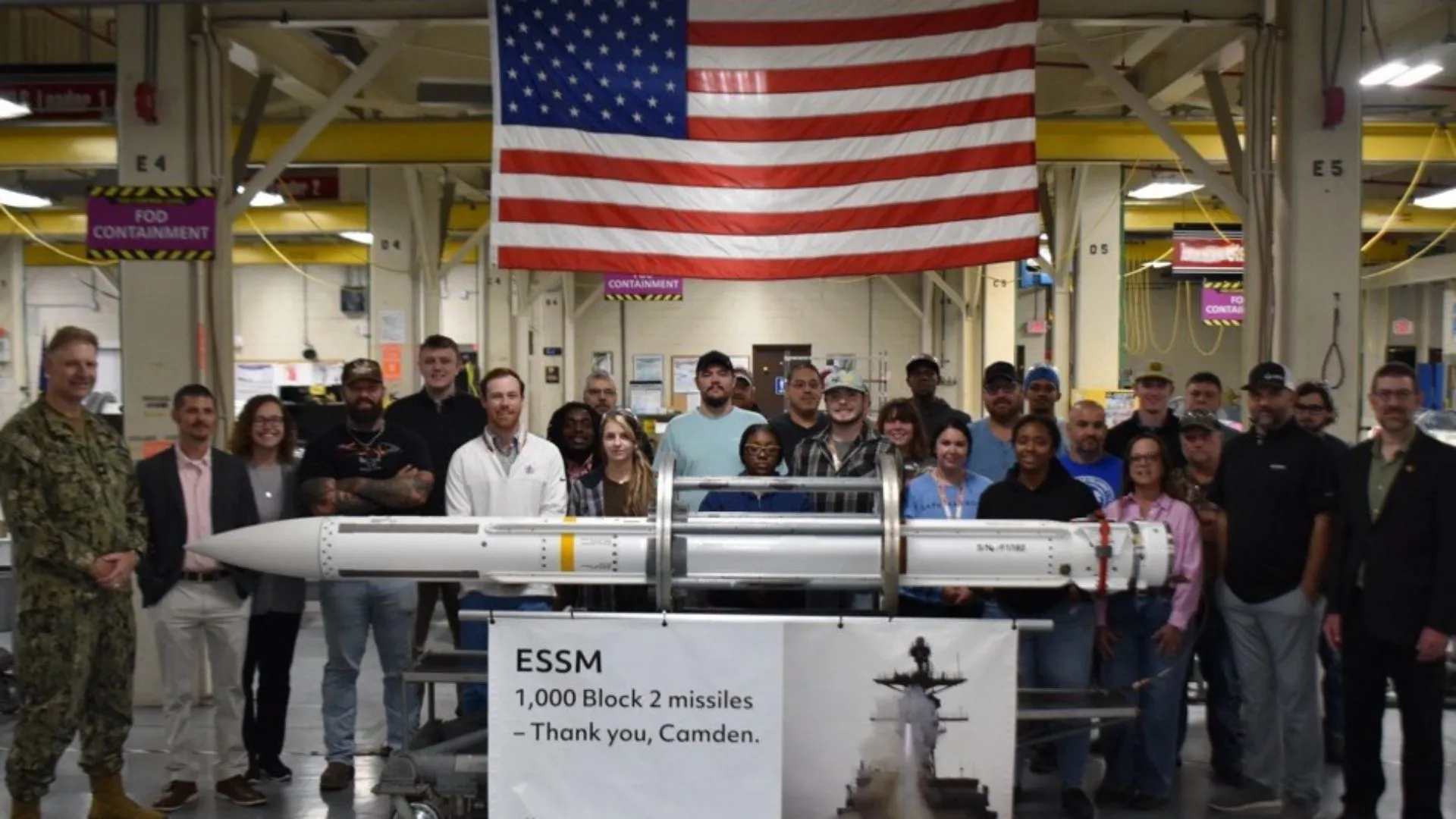
The US Navy’s NATO SEASPARROW Program (PMX-312) has taken delivery of the 1,000th Evolved SeaSparrow Missile (ESSM) Block 2 built for the 12-nation NATO SEASPARROW Consortium, the Navy announced on November 2, 2026. Program officials and industry partners marked the milestone on October 28 in Camden, Arkansas, a work site for prime contractor Raytheon, an RTX business.
The second 500 missiles arrived quickly. According to the Navy, the program logged its 500th Block 2 delivery in June 2025, meaning cumulative deliveries doubled in roughly 16 months. That pace follows a deliberate industrial ramp: Raytheon pledged in October 2025 to invest in infrastructure and material to nearly double its production rate by June 2026, and the Navy awarded an $833 million contract modification in April 2026 for additional missile assemblies and containers for all 12 consortium nations, with deliveries running through 2030.
ESSM Block 2 Dual-Mode Seeker and Quad-Pack Magazine Depth
ESSM Block 2 is a ship-launched, medium-range surface-to-air missile for ship self-defense and local-area defense against anti-ship cruise missiles, aircraft, drones, and surface craft. Its core upgrade over Block 1 is a new guidance section carrying a dual-mode X-band seeker that pairs the legacy semi-active radar homing channel with active radar homing. Block 1 relies on continuous-wave illumination from the launching ship’s fire-control radars through the terminal phase; Block 2 can finish the intercept on its own seeker.
That difference matters most in a saturation raid. On ships with a limited number of illuminators, semi-active shots queue behind the radars painting each target. An active terminal mode frees those channels, letting Aegis and other combat systems run more simultaneous engagements. Block 2 also accepts midcourse updates over a datalink compatible with the Cooperative Engagement Capability (CEC), opening the door to intercepts cued by off-board sensors.
Publicly available specifications indicate a range beyond 50 km (27 nautical miles), a top speed above Mach 4, and a 39 kg (86 lb) blast-fragmentation warhead. Block 2 retains the Block 1 solid-propellant rocket motor and widens the guidance section to the full 10-inch (254 mm) airframe diameter.
That diameter is the program’s force-structure asset. Four Block 2 rounds fit in a single Mk 25 quad-pack canister inside one Mk 41 Vertical Launching System (VLS) cell, the space a single SM-2 would occupy. The missile also fires from the Mk 29 trainable launcher on carriers and amphibious ships, the Mk 48 and Mk 57 VLS, and the Mk 56 dual-pack launcher on smaller combatants. In layered defense, Block 2 absorbs the inner-tier share of a raid and preserves SM-2 and SM-6 rounds for longer-range shots.
How the NATO SEASPARROW Consortium Is Scaling Block 2 Production
Established in 1968, the NATO SEASPARROW Project is one of the alliance’s longest-running cooperative weapons programs. Its members are Australia, Belgium, Canada, Denmark, Germany, Greece, the Netherlands, Norway, Portugal, Spain, Türkiye, and the United States. PMX-312, managed under the Navy’s Portfolio Acquisition Executive (PAE) Munitions, runs the program for the consortium.
Industrial workshare follows that membership. The April 2026 award spreads work across more than 20 locations, with Tucson, Arizona, at 12%, Edinburgh, South Australia, at 11%, and Mississauga, Canada, at 10%. Fiscal 2025 production options also listed Camden among US work sites, alongside locations in California, Massachusetts, New Hampshire, New York, and Oregon. Block 2 entered low-rate initial production under a $190.5 million award in 2019 and moved to full-rate production in September 2022 through a contract worth up to $1.28 billion.
Demand now extends beyond the consortium. In June 2025, Japan’s Mitsubishi Electric Corporation (MELCO) awarded Raytheon a $250 million direct commercial sale covering kits, components, and technical support for licensed Block 2 production in Japan, which sits outside the consortium but already fields ESSM across its destroyer fleet. Within the consortium, fleet integration continues: Norway’s Defence Materiel Agency conducted the first live Block 2 firing from the Fridtjof Nansen-class frigate KNM Otto Sverdrup off Andøya in late September 2026, testing new Aegis software and the missile’s active guidance.
Capt. John Bowman, the PMX-312 program manager, said the milestone “demonstrates the enduring value of international cooperation and a resilient industrial base in delivering proven maritime-defense capability at the scale our nations require.”
Analysis: The milestone shows that a multinational missile line can accelerate without a new airframe, but it also exposes the gap that remains. Deliveries between the 500th and 1,000th rounds imply an average of roughly 375 missiles a year, well short of the roughly 700 a year Raytheon has described as its longer-term goal. That shortfall matters because Block 2 is the most magazine-efficient way to deepen a destroyer’s inner layer: every quad-packed cell adds four interceptors, sparing SM-2 and SM-6 rounds that cost more and take longer to replace. For the consortium, production rate, not missile performance, is now the binding constraint.
The next decision point is the Next Significant Variant (NSV). Naval Sea Systems Command issued a sources-sought notice on August 20, 2026, for a successor that keeps the 10-inch diameter for quad-pack compatibility and stays releasable to all 12 members; responses closed on October 19. The Navy has not disclosed a fiscal 2027 production target, a Block 2 inventory objective, or an NSV development schedule. Those figures will show whether the ramp holds.