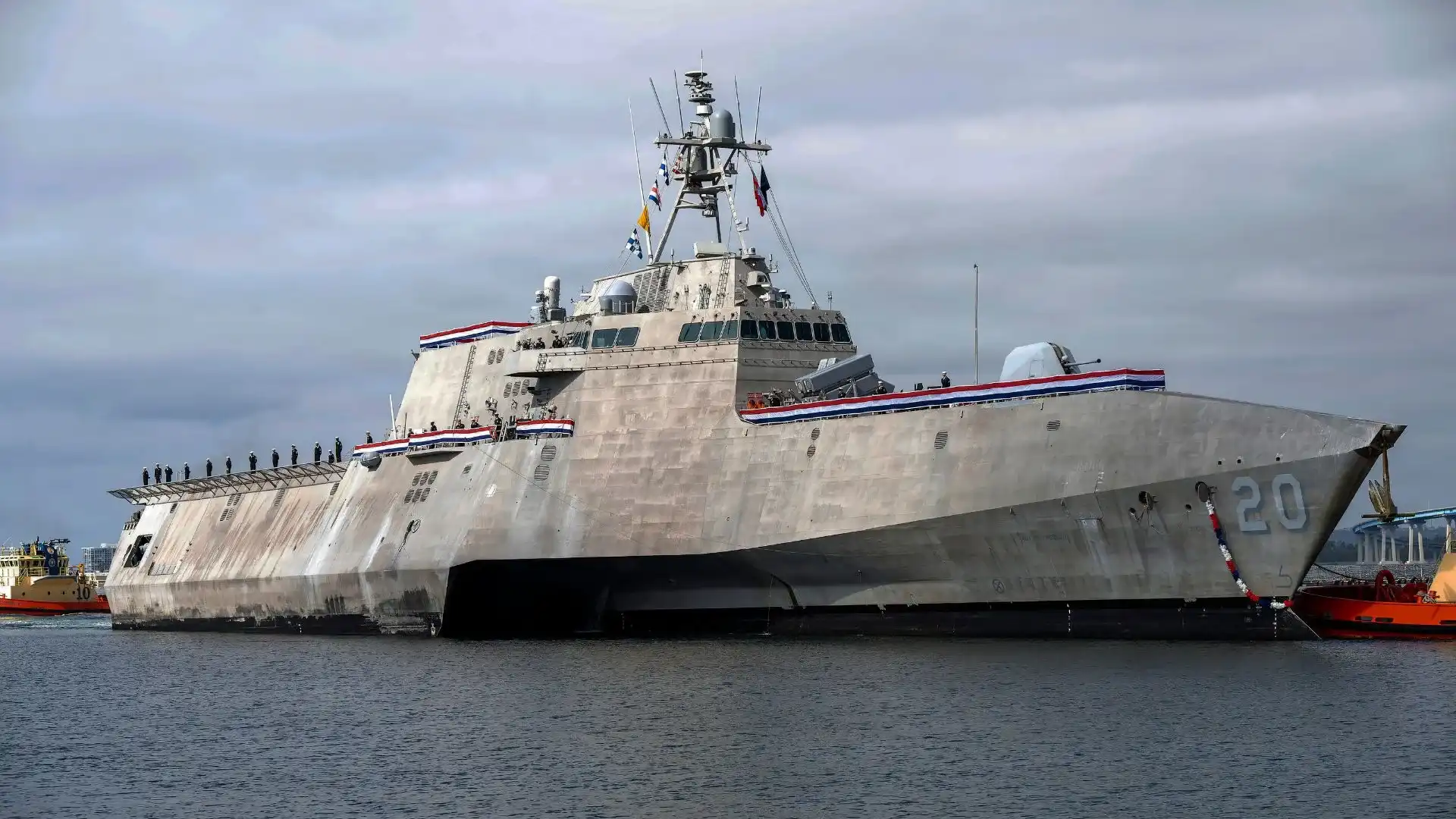
The US Navy awarded BAE Systems Maritime Solutions and Austal USA a combined $100,070,990 on November 6, 2026, to drydock, repair and modernize two Independence-variant littoral combat ships (LCS) homeported in San Diego, according to the Pentagon’s daily contract announcements. BAE Systems received a $56,639,711 firm-fixed-price contract action for the Fiscal 2027 Docking Selected Restricted Availability (DSRA) of USS Cincinnati (LCS 20), while Austal USA received $43,431,279 for the same type of availability on USS Canberra (LCS 30).
The awards come as the Navy extends the life of a fleet it was retiring early only a few years ago. In January 2026, service officials reversed plans to decommission five Freedom-variant and two Independence-variant hulls ahead of their expected service lives, pointing to Independence-variant performance on mine countermeasures missions in the US 5th Fleet area. With the final LCS commissioned in May 2026 and no hulls left under construction, depot availabilities now set the ceiling on how many ships the LCS force can put to sea.
Littoral Combat Ship Maintenance Contracts: Scope, Value, and Funding
Both awards cover all labor, supervision, equipment, production, testing, facilities and quality assurance required to prepare for and accomplish a Chief of Naval Operations availability for critical modernization, maintenance and repair programs. Options would raise the Cincinnati contract to $60,385,105 and the Canberra contract to $44,868,123, a cumulative potential value of $105,253,228 across both ships.
All work will be performed in San Diego. Cincinnati is expected to complete its availability by April 2028 and Canberra by February 2028. Both were competed in full and open competition: BAE Systems’ bid was one of two offers, while Austal USA prevailed among four. Naval Sea Systems Command is the contracting activity for Cincinnati (N0002427C4441), and the Program Acquisition Executive Maritime handled Canberra (N0002427C4413).
The funding mix stands out. Fiscal 2027 other procurement, Navy (OPN) funds account for $56,269,899.57, or 99.3%, of the Cincinnati obligation, with $369,812 in operations and maintenance, Navy (O&MN) funds covering the rest. On Canberra, OPN covers $42,471,394 (97.8%) and O&MN $959,885 (2.2%). Because OPN finances the procurement and installation of equipment, the split points to availabilities weighted toward modernization rather than routine repair. The announcements do not identify which systems will be installed.
Independence-Variant Hulls and the San Diego Drydock Industrial Base
Navy data list Cincinnati, commissioned October 5, 2019, at 418 feet long with a 104-foot beam, a 14-foot draft and a 3,104-ton displacement, a top speed above 40 knots and a core crew of 40 sailors. Publicly available specifications indicate the aluminum trimaran is driven by two General Electric LM2500 gas turbines and two MTU 20V 8000 diesels feeding four Wärtsilä waterjets, with a 57 mm Mk 110 gun and SeaRAM as baseline self-defense armament. That hull form explains why a docking availability matters: underwater structure and waterjets can only be fully inspected and repaired out of the water, and Independence-variant hulls have previously been reported with structural cracking that imposed speed restrictions on some ships.
Cincinnati returned to Naval Base San Diego on March 4, 2026, after an eight-month deployment across the US 3rd and 7th Fleet areas, with port calls in Brunei, Cambodia, Indonesia, Malaysia, the Philippines and the Marshall Islands, including a January 24, 2026, stop at Cambodia’s Ream Naval Base. Canberra, built by Austal USA in Mobile, Alabama, was commissioned on July 22, 2023, at Fleet Base East in Sydney, the first US Navy commissioning held in Australia.
Austal USA operates a waterfront yard in National City, adjacent to Naval Base San Diego, built around a floating dry dock with 9,000 light tons of lifting capacity sized for LCS and other small surface combatants; Canberra’s post-shakedown availability, in 2023, was the first job executed at the yard. BAE Systems’ win on Cincinnati, itself an Austal-built ship, shows the original builder holds no lock on sustaining its own design.
Analysis: These contracts show the Navy funding a modernization path for the Independence variant rather than managing it toward retirement. Spending procurement dollars on hulls commissioned in 2019 and 2023 is consistent with the January 2026 reversal and with the class’s value in mine countermeasures, a mission with few other platforms to carry it. Keeping two qualified drydock bidders in the homeport also matters: competition helps contain cost and schedule risk for a small fleet where every ship in the yard reduces deployable capacity.
The next markers are the start of each docking period, any exercise of contract options and the scheduled completion dates of February 2028 for Canberra and April 2028 for Cincinnati. Key unknowns remain the specific modernization packages and whether the work touches weapons or mission package integration. Further DSRA awards for other Independence-variant hulls would show whether these contracts open a broader modernization wave.