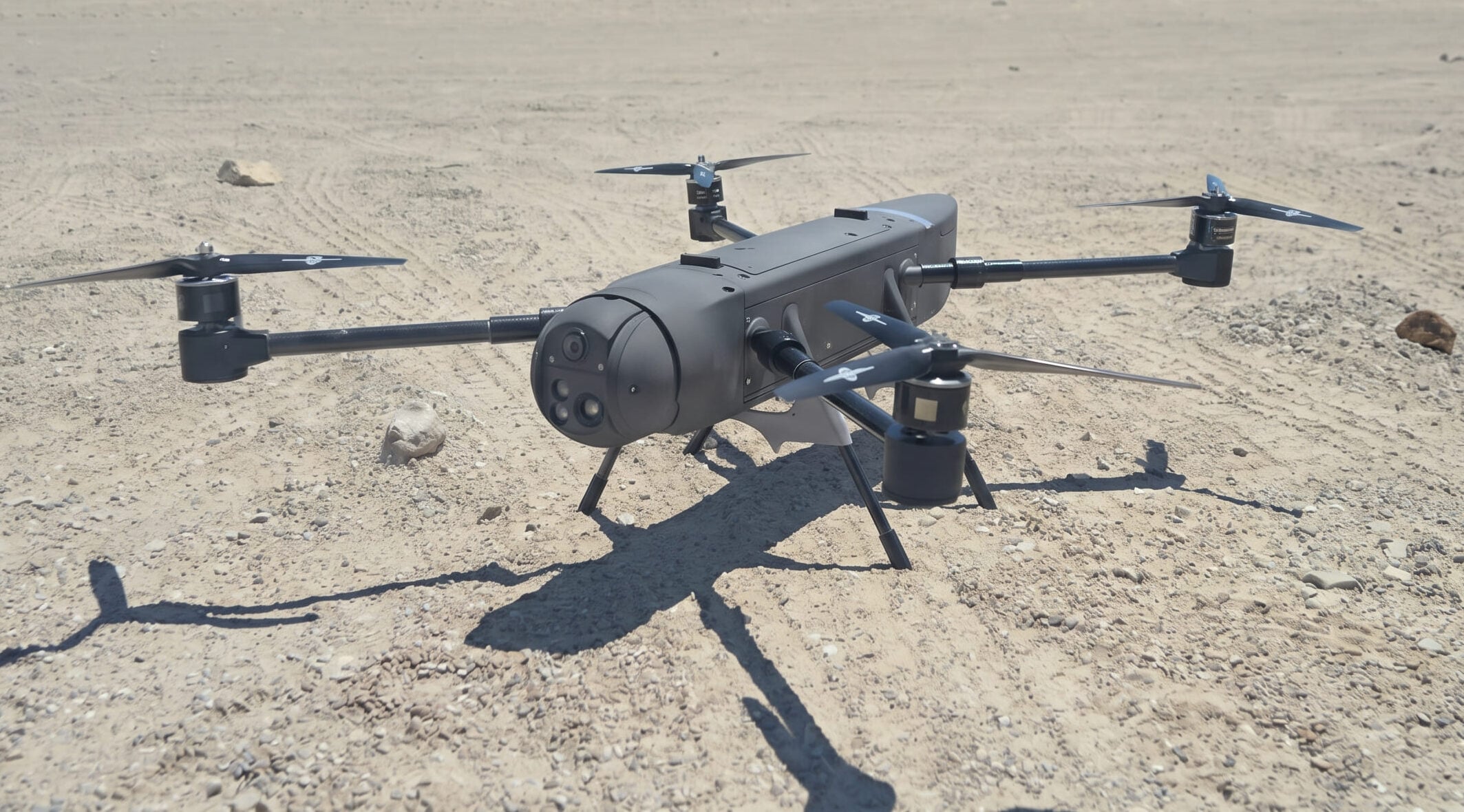
Prague-based CSG has joined the development of SwarmShot, a modular autonomous counter-unmanned aircraft system (C-UAS) designed to turn compatible drones into reusable air-to-air interceptors. The group participates through Federal Ammunition, part of its U.S. ammunition division The Kinetic Group, alongside O.F. Mossberg & Sons and Palladyne AI. The three companies announced the effort on October 7, 2026, and CSG confirmed its role a day later.
The program targets the cost-exchange problem exposed by the war in Ukraine, where cheap drones routinely force defenders to expend interceptors worth far more than their targets. The U.S. Army has responded by thickening its inner layer with low-cost kinetic options, including an order worth approximately $11.6 million for Mossberg 590A1 shotguns announced in December 2025, which the company has confirmed are intended for counter-drone use. CSG, which closed its roughly $2.2 billion acquisition of The Kinetic Group in November 2024, now extends that ammunition base into autonomy-enabled effectors.
SwarmShot Drone Interceptor Architecture: Shotshell, Weapon, and Autonomy
SwarmShot is being engineered as a single integrated system with a defined division of labor. Federal leads ammunition design and terminal-effect optimization for a specialized counter-UAS shotshell, drawing on what the partners describe as a recent U.S. Army counter-UAS ammunition contract whose value and specifications were not disclosed. Mossberg leads the lightweight airborne weapon module, including remote operation, recoil management, reliability and safety. Palladyne AI owns UAS integration, fire control, terminal-intercept autonomy and coordination among multiple interceptors.
Mossberg President and Chief Operating Officer Doug Bell stressed that the module is “not simply an existing shotgun mounted to a drone.” The distinction carries real engineering weight. Recoil that a soldier absorbs through the shoulder becomes a flight-control disturbance on a small multirotor, and an uncompensated shot can push the aircraft off its aim point before a follow-up round.
The autonomy layer is IntelliSwarm, which pairs Palladyne AI’s BRAIN edge flight computer with its SwarmOS collaborative autonomy software. IntelliSwarm is designed to ingest validated threat tracks from existing sensors or command systems, allocate targets among available interceptors, compute intercept paths, maneuver each aircraft into firing position and re-task the swarm as targets move or new threats appear. SwarmShot therefore relies on an external detection and command layer for cueing rather than replacing it.
Key parameters remain undisclosed: shell gauge and shot payload, module weight, magazine capacity, effective engagement distance and the target speed envelope. Those figures will determine which threat classes the system can realistically defeat, and they are the first data points evaluators will request.
From Project Convergence to Gremlin-X and a Multi-OEM Kit
The swarming capability behind SwarmShot already has Army exposure. Palladyne says SwarmOS integrated with Anduril’s Lattice command-and-control software at Project Convergence Capstone 6, coordinating unmanned aircraft from multiple manufacturers while soldiers retained authority over weapons employment. During the earlier Ivy Mass rehearsal, the company says a single soldier trained on the system in under 30 minutes supervised drones from several vendors.
The first host airframe is Gremlin-X, Palladyne AI’s reusable but attritable multirotor mini-bomber, which the partners describe as a Group 1 quadcopter. In June 2026, the Army selected Palladyne under its Disruptive Applications Broad Agency Announcement to develop and validate SwarmOS and Gremlin-X with operational units, including the 4th Infantry Division in Colorado and California. The SwarmShot module is intended to let the same aircraft switch between its precision-strike role and a counter-UAS mission, giving small units one airframe for two tasks.
After qualification on Gremlin-X, the partners plan to sell SwarmShot as an integration kit bundling Federal ammunition, the Mossberg module, IntelliSwarm hardware and software, fire-control electronics, modular aircraft interfaces and platform-specific integration support. Palladyne AI Chief Executive Ben Wolff summarized the concept: “One SwarmShot-equipped aircraft is a reusable interceptor.” Reuse is the economic core. A one-way interceptor drone is consumed with every engagement, while an aircraft that fires and returns shifts the marginal cost per engagement toward ammunition. For Federal, that model creates a recurring consumables stream tied to every fielded interceptor. Named applications include protection of deployed forces, airfields, command posts, logistics sites, ships and mobile formations.
Analysis: SwarmShot addresses the core weakness of shotgun-based drone defense, its short reach, by making the shooter mobile rather than the projectile smarter. Against Group 1 quadcopters, first-person-view (FPV) attack drones and slow loitering munitions, that is a credible inner-layer concept. Against faster one-way attack drones such as the Shahed-136, which publicly available specifications credit with a cruise speed near 185 km/h, a multirotor interceptor will struggle to close. The decisive challenges are mechanical rather than algorithmic: recoil control on a small airframe, lethal patterns at the stand-off a moving aircraft can hold, and safe fire over friendly forces. The announcement also leaves open where human authorization sits in the engagement chain, a question evaluators will press under DoD Directive 3000.09, the Pentagon’s policy on autonomy in weapon systems.
Development schedules, customer engagements and financial terms were not disclosed. The initial program covers ammunition and terminal-effect testing, airborne weapon integration, recoil and aircraft-stability trials, live-fire flight testing, weapons-safety controls and integration with third-party sensors and command systems. A nearer milestone is the Army’s FUZE xTech Apex Intercept finals, expected in October or November 2026, where Palladyne’s BRAIN flight computer is a finalist. Live-fire data from a SwarmShot-equipped Gremlin-X will be the first real measure of the concept.