L3Harris Technologies’ Red Wolf and Green Wolf launched effects have completed 60 flight tests, the company disclosed on October 9, 2026. The campaign, which began in 2021, comprises 13 launches from fixed-wing aircraft, three from rotary-wing aircraft and 44 from ground launchers, with the vehicles carrying 17 mission payloads and integrating two autonomy engines.
The milestone arrives as the Pentagon shifts toward affordable, expendable strike and sensing systems. Red Wolf already has a funded path: on January 30, 2026, Naval Air Systems Command (NAVAIR) awarded L3Harris an $86.2 million Other Transaction Agreement (OTA) to develop, test and manufacture the vehicle for the U.S. Marine Corps’ Precision Attack Strike Munition (PASM) program, with deliveries for the AH-1Z Viper attack helicopter due by late fiscal year 2027. The U.S. Army is building its own launched effects portfolio in short-, medium- and long-range tiers. L3Harris reported more than 40 flights at the vehicles’ unveiling on July 17, 2025, and 52 at the time of the PASM award.
L3Harris Red Wolf Test Record: 60 Flights, 17 Payloads
Ground launches dominate the record at 44 of 60 flights, or 73 percent; L3Harris lists a rocket-assisted ground launcher among its launch options. The company has not broken down the 13 fixed-wing launches by aircraft. Open-source reporting from the Army’s EDGE 21 experiment described an early iteration of the vehicle as launchable from an MQ-1C Gray Eagle, and L3Harris has since showcased Red Wolf integration on its SKY RAIDER II INTERNATIONAL light attack aircraft, derived from the Air Tractor AT-802.
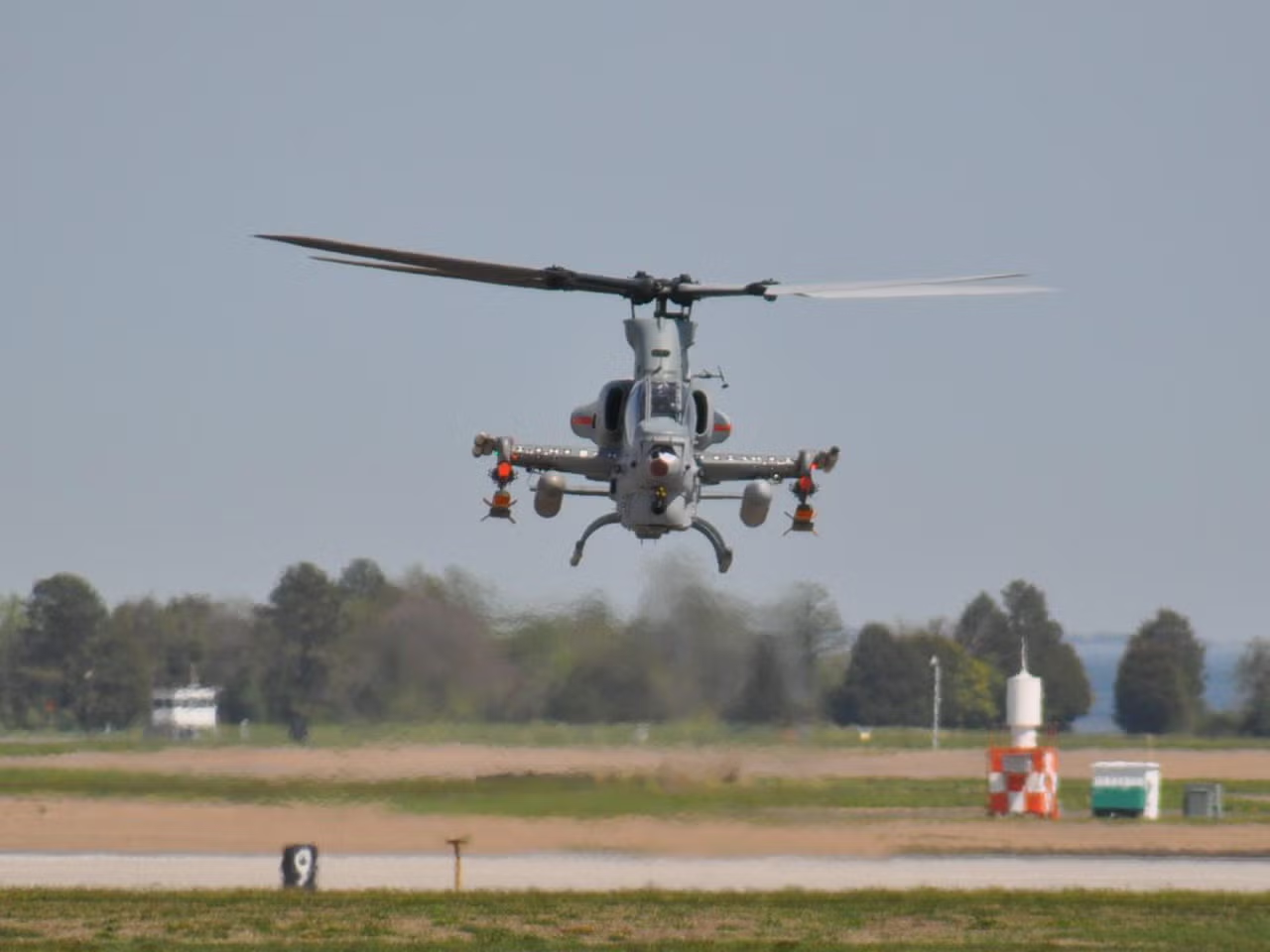
The three rotary-wing launches carry the most operational weight. They include a November 2024 Long Range Precision Fires shot from an AH-1Z at Yuma Proving Ground, Arizona, and a September 2025 low-altitude live fire over the Atlantic Test Range, where a Red Wolf launched by Air Test and Evaluation Squadron 21 (HX-21) engaged a sea-based target. L3Harris states Red Wolf is the only launched effect to have deployed from the Viper.
The payload ledger says more than the flight count. Integrating 10 radios indicates the airframe has been wired into multiple service networks and datalinks, a prerequisite for beyond-line-of-sight retargeting and communications relay. Six electronic warfare (EW) payloads underpin Green Wolf’s role. The single seeker is the thinnest line in the record: terminal guidance for the strike variant appears to rest on one integrated design, which L3Harris has not identified.
The company also did not name the two autonomy engines. The documented case is Shield AI’s Hivemind, which flew aboard Green Wolf in an Army-supported test announced July 16, 2026. Hivemind rerouted follow-on unmanned aircraft around electromagnetic threats flagged by L3Harris’ Distributed Spectrum Collaboration and Operations (DiSCO) battle management software, without human input.
One Host Vehicle, Two Missions: Red Wolf Strike and Green Wolf EW
Red Wolf and Green Wolf share a single host air vehicle. Red Wolf carries a kinetic payload for long-range precision strike; Green Wolf carries electronic attack and detect, identify, locate and report (DILR) capabilities. L3Harris credits the airframe with more than 200 nautical miles (about 370 kilometers) of range at low altitude, more than 60 minutes of endurance and high subsonic speed. Publicly available reporting indicates a small turbojet powerplant and fold-out wings. The company has not released dimensions, weight, warhead type or seeker modality, and test rounds photographed on the AH-1Z carry an X-form tail where company renders show a plus-form tail, a sign the configuration is still evolving.
Range is the core of the PASM case. The AGM-179 Joint Air-to-Ground Missile (JAGM) Medium Range, the Viper’s newest precision weapon, is credited in open sources with roughly 16 kilometers of reach. A helicopter firing Red Wolf could engage surface combatants from more than 20 times that distance, well outside shipborne short- and medium-range air defenses.
The shared airframe also drives the logistics argument. One integration effort per launch platform covers both strike and EW, and one sustainment chain supports both rounds. An optional parachute recovery system allows in-theater refurbishment, so a Green Wolf need not be expended on every sortie. Industry estimates have placed Red Wolf’s unit cost near $300,000, with production scalable to roughly 1,000 vehicles per year; neither figure has been confirmed in a contract. L3Harris says its Ashburn, Virginia, facility runs an active launched effects production line.
Analysis: The 60-flight figure is company-reported, combines two variants and spans demonstrations for multiple Pentagon customers, so it measures engineering maturity rather than operational readiness; neither vehicle is fielded. Its real value lies in the integration record. The Army’s medium-range lethal launched effects effort, the Long Range Precision Munition, requires compatibility with a government-developed dispenser for ground and rotary-wing platforms, while the Marine Corps is buying through a prototype OTA. In both cases, a vendor that has already flown 10 radios, six EW payloads and two autonomy stacks can absorb government-furnished subsystems with less schedule risk. The open question is cost: the affordable mass argument depends on unit prices holding at volume, and no production contract has yet tested that.
The next public venue is the Association of the United States Army (AUSA) Annual Meeting in Washington, October 12 to 14, 2026, where L3Harris is exhibiting. The Army’s January 2026 solicitation targeted an October 2026 prototype OTA award for the Long Range Precision Munition; L3Harris has not said whether it is competing. For the Marine Corps, the next marker is PASM delivery by late fiscal year 2027.