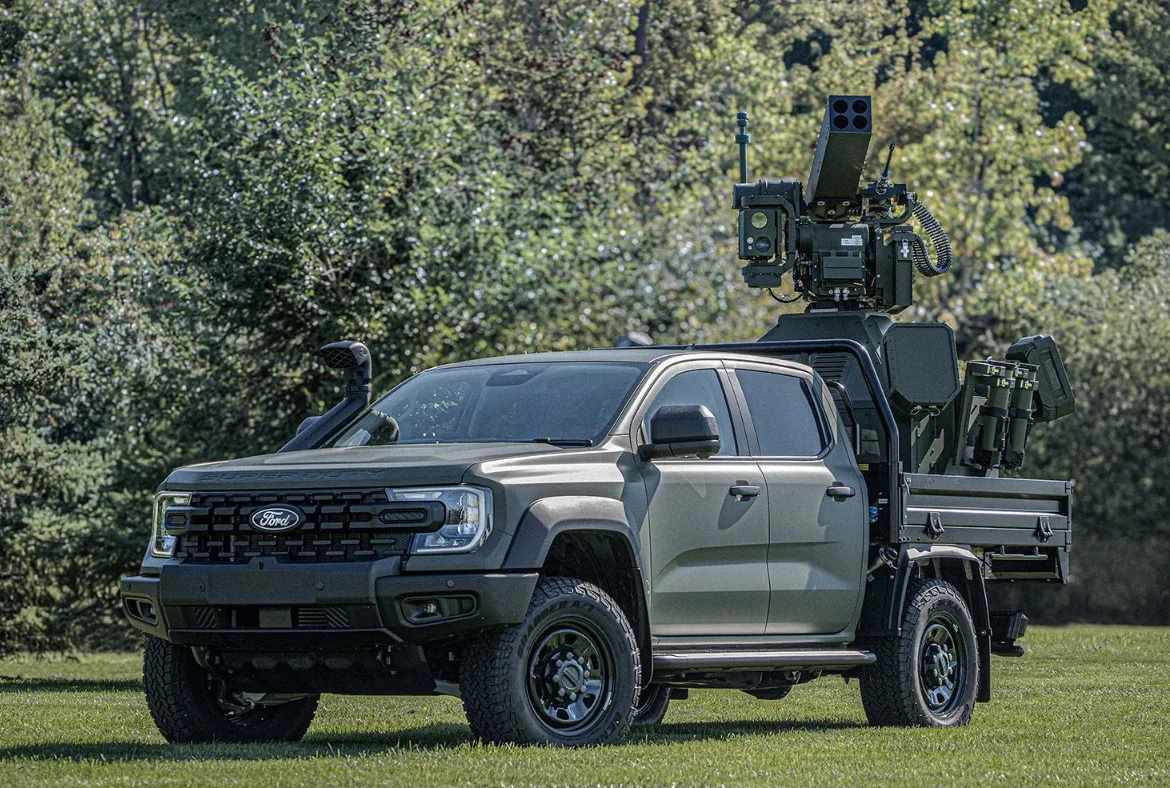
The U.S. Army will brief industry on October 27-28, 2026, in Huntsville, Alabama, on the Maneuver-Short Range Air Defense (M-SHORAD) Increment 4 program, a vehicle-agnostic, palletized air defense system meant to protect light and airborne maneuver forces against drones, helicopters, and fixed-wing aircraft. The special notice, published October 8 by Army Contracting Command-Redstone, targets prospective system integrators for development and production.
The industry day builds on a request for information (RFI) released on March 27, 2026, and follows Army leadership’s approval of the Increment 4 capability development document in October 2025. It addresses a gap the service has acknowledged since its first Increment 4 RFI in May 2024: Stryker-based air defense cannot follow airborne and air assault units into the fight, while Group 1 to 3 unmanned aircraft systems (UAS) now threaten formations at every echelon. The fiscal 2027 budget request includes $108.1 million in research, development, test and evaluation funding for the effort.
M-SHORAD Increment 4 Requirements: A Self-Contained Pallet for Light Forces
According to the notice, Increment 4 will protect Joint Forcible Entry (JFE) units and the Army’s new Mobile Brigade Combat Teams (MBCT) in both dismounted and mounted operations. It will defend against Group 1 to 3 UAS as well as rotary-wing and fixed-wing aircraft, and it will rest on a Modular Open Systems Approach (MOSA) framework delivering tailorable and reconfigurable sensors, electronic warfare (EW), and kinetic defeat capabilities.
Under the Department of Defense UAS classification, that threat set runs from quadcopters under 20 pounds to Group 3 aircraft of up to 1,320 pounds maximum takeoff weight operating below 18,000 feet. Covering that envelope from a light vehicle demands a layered effector mix rather than a single weapon: EW against small commercial drones, guns or interceptors against larger platforms and crewed aircraft.
The March RFI defined the physical concept as a Self-Loading Equipment Dock (SLED) or comparable pallet carrying multiple kinetic and non-kinetic defenses, mountable on the Infantry Squad Vehicle (ISV) and the uncrewed Robotic Combat Vehicle. The SLED must keep independent functionality while carried, and host vehicles must return to full capability once it is removed. The Army acknowledged tight size, weight, and power (SWaP) margins on those carriers. Publicly available specifications indicate the ISV carries nine soldiers and roughly 3,200 pounds of payload and can be sling-loaded under a UH-60 Black Hawk, a hard ceiling for any integrator. The 2024 RFI had already called for C-130 transportability, airdrop, and sling-load capability.
From SGT Stout to NGSRI: Where Increment 4 Fits in the Family
Increment 4 is the lightest branch of a multi-increment effort. Increment 1, designated SGT Stout, mounts FIM-92 Stinger missiles, an XM914 30mm automatic cannon, an M240 7.62mm machine gun, and a multi-mission radar on the M1265A1 Stryker Double V Hull. Leonardo DRS configures the weapons and radar package, and General Dynamics Land Systems (GDLS) installs it. The first systems reached the 5th Battalion, 4th Air Defense Artillery Regiment in Germany in April 2021; units at Fort Sill and Fort Hood followed, and Fort Bragg completes fielding by late fiscal 2026, at 36 vehicles per battalion. The fiscal 2027 request seeks $712.7 million for 14 more.
Increment 2, the DE M-SHORAD armed with a 50-kilowatt laser, was not fielded after a fiscal 2023-2024 user assessment exposed heat dissipation and ruggedization problems on a constantly moving vehicle. Increment 3 will upgrade the Stryker fleet with the Next Generation Short Range Interceptor (NGSRI), the Stinger replacement under competitive development by Lockheed Martin and Raytheon, with single-vendor selection planned for fiscal 2028. It also adds the XM1223 Multi-Mode Proximity Airburst 30mm round, slated for fielding in late fiscal 2028.
Increment 4 draws on all three. Rather than another fully integrated combat vehicle, the Army wants a mission module that converges proven counter-UAS and M-SHORAD subsystems, with results from the Project Flytrap counter-drone experiments feeding the requirement.
How PAE Fires Is Courting System Integrators and Subsystem Suppliers
The notice places the program under Portfolio Acquisition Executive (PAE) Fires and its Defensive Fires portfolio, structures created by the Army’s 2025 acquisition overhaul, which consolidated 12 program executive offices into six portfolio organizations. The agenda covers an Increment 4 overview, a keynote address, a joint panel with questions, and one-on-one breakouts. Attendance is capped at three representatives per organization, and registration closes October 23.
Prime system integrators interested in development and production are the primary audience. The Army has also invited suppliers of sensors, effectors, motion systems, remote weapon stations, and command and control (C2) to encourage teaming. That two-tier approach suggests the government intends to own the open architecture and hold one integrator accountable for the pallet, while keeping sensor and effector slots competitive over the system’s life.
GDLS will show a SLED-based Increment 4 concept on a Ford Ranger pickup at the Association of the U.S. Army (AUSA) annual meeting on October 12-14. The company offers the SLED in light, medium, and heavy configurations but has not disclosed the fitted weapons or sensors.
Analysis: Increment 4 marks the Army’s shift from building air defense vehicles to buying air defense payloads. Decoupling the mission module from the carrier lets airlift-constrained formations, starting at Fort Bragg, home of the 82nd Airborne Division, gain organic counter-air protection without adding a heavy platform, and lets the service refresh EW and effector components as drone threats evolve on the timelines seen in Ukraine and the Middle East. The risk is SWaP: fitting a radar, an EW suite, a kinetic effector with adequate magazine depth, and a C2 node onto an ISV-class pallet is the core engineering problem, and a $108.1 million fiscal 2027 line points to prototyping rather than production at scale.
The Army has not said when a formal solicitation will follow, how many integrators it will carry into prototyping, or which effectors will define the baseline pallet. The program still targets initial operational capability by late fiscal 2029, with first fielding at Fort Bragg, North Carolina, leaving roughly three years to select, prototype, test, and deliver.