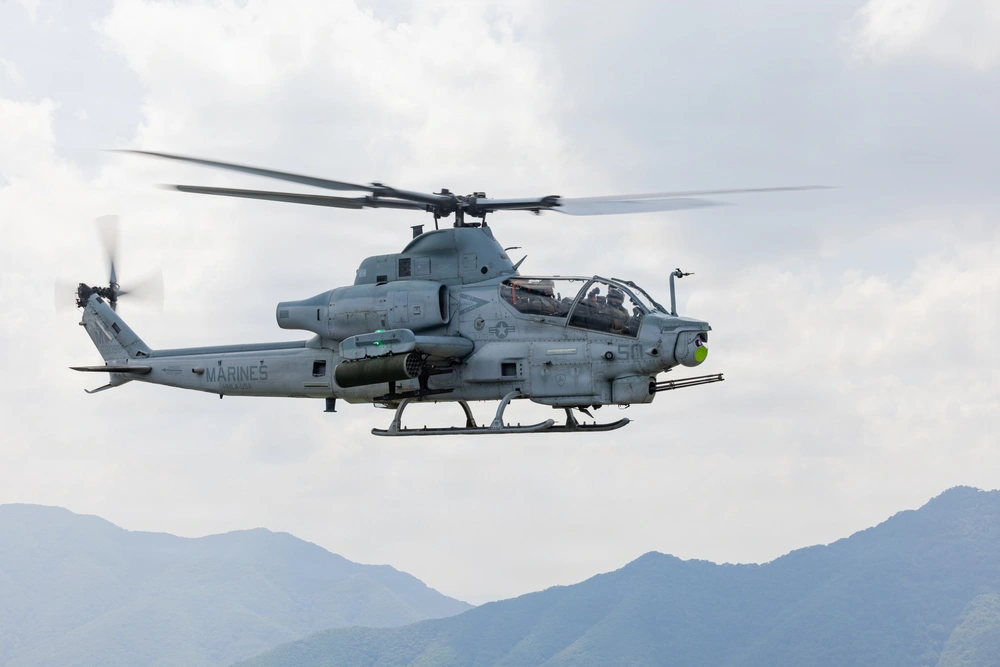
The U.S. Marine Corps Light/Attack Helicopter Program Office (PMA-276) and Air Test and Evaluation Squadron 21 (HX-21) fired an Advanced Precision Kill Weapon System (APKWS) laser-guided rocket from an AH-1Z Viper attack helicopter into the Upper Zion impact area at Fort A.P. Hill, Virginia, on May 12, 2026. PMA-276 disclosed the shot on October 8, 2026, describing it as the initial APKWS delivery within the installation’s tightly restricted range footprint.
The test did not introduce the weapon to the Marine attack fleet. APKWS reached initial operational capability with the Marine Corps in 2012 on the AH-1W Super Cobra and UH-1Y Venom, and program documents have listed the guided rocket among AH-1Z stores for years. The May 12 shot instead validated how to employ it on a range that leaves little room for safety templates. That matters as the Marine Corps prepares its light attack helicopter squadrons (HMLAs) to train and fight from expeditionary sites.
How HX-21 Validated AH-1Z APKWS Delivery at Fort A.P. Hill
Fort A.P. Hill’s Directorate of Plans, Training, Mobilization and Security (DPTMS), led by Matt Fleetwood, worked with the installation’s Range Control to build a tailored Weapons Delivery Zone (WDZ) sized for live rocket employment. Range Control imposed safety check-holds across adjacent training sectors to clear the WDZ and protect surrounding activity.
According to the program office, the shot verified integration parameters, safety protocols and ordnance handling procedures that now feed fleet H-1 training pipelines. Col. Jason Duke, PMA-276 program manager, said the H-1 team demonstrated “precise, scalable effects that commanders can employ with confidence” in one of the most space-constrained range environments the community uses. HX-21 ordnance officer Michael Hunt said the WDZ construct and range deconfliction developed for the event “translate directly into repeatable procedures” for Marines operating from expeditionary sites.
The event doubled as a field classroom. Twenty-six observers from across the Naval Aviation Enterprise attended, including personnel from PMA-276, the Direct and Time Sensitive Strike Program Office (PMA-242), which manages APKWS for the Navy, the Aviation Simulation Center and HX-21. The program office has not released the engagement range, launch profile, warhead type or designation method, including whether the Viper crew lased its own target.
WGU-59/B Guidance Kit: Range, Seeker, and Warhead Specifications
APKWS converts a standard 2.75-inch (70 mm) Hydra rocket into a semi-active laser-guided munition by threading the BAE Systems WGU-59/B mid-body guidance section between the 10-pound high-explosive warhead and the Mk 66 Mod 4 rocket motor. Publicly available specifications indicate the guidance section measures 18.5 inches and weighs 9.8 pounds, producing an all-up round of 73.77 inches and 32.6 pounds with a top speed of about 1,000 meters per second. Distributed Aperture Semi-Active Laser Seeker (DASALS) optics sit in the flip-out wings and deploy roughly half a second after launch, leaving the existing warhead, fuze and motor untouched.
From rotary-wing platforms, BAE Systems lists an engagement envelope of 1.5 to 6.5 kilometers; fixed-wing launch extends maximum range to 14 kilometers. Warhead options include the M151 and the Mk 152, which the Navy qualified for safer handling aboard ships, relevant for Vipers deploying on amphibious warships.
The weapon’s value lies in what it displaces. A Hellfire or Joint Air-to-Ground Missile (JAGM) weighs roughly 100 pounds; APKWS delivers precision at about one-third the cost and weight of legacy laser-guided weapons, with a far smaller warhead. That trade explains the program office’s pitch of a scalable, low-collateral option against time-critical targets. Supply is deep: BAE Systems delivered its 100,000th kit in February 2026 and produces under a five-year Navy contract worth up to $1.7 billion, awarded December 10, 2025.
How the AH-1Z Viper Carries and Designates Guided Rockets
The AH-1Z replaced the two-bladed AH-1W with a four-bladed composite rotor, a new transmission and two General Electric T700-GE-401C turboshafts rated at 1,800 shaft horsepower each. Empty weight is 12,300 pounds and maximum gross weight 18,500 pounds across six wing stations. Publicly available specifications indicate the Viper carries up to 16 Hellfire-class missiles on four M272 launchers, a turreted M197 20 mm three-barrel cannon with 750 rounds, AIM-9 Sidewinders and 2.75-inch rockets in seven-shot LAU-68 or 19-shot LAU-61 launchers.
The enabling sensor is the Lockheed Martin AN/AAQ-30 Target Sight System (TSS), a stabilized turret combining a third-generation mid-wave infrared sensor, color television camera, laser rangefinder and laser designator. The TSS lets a crew lase its own APKWS targets or engage spots designated by another aircraft or a joint terminal attack controller, which matters when a Viper section must service several fleeting targets.
The Viper shares 85 percent parts commonality with the UH-1Y, shrinking the logistics tail at austere sites. U.S. production of the AH-1Z ended in 2022, so the fleet’s growth path now runs through weapons, sensors and procedures rather than new airframes. Bahrain and the Czech Republic also operate the type, and Washington approved Prague’s request for 600 WGU-59A/B kits in July 2024, giving partner operators a stake in the Virginia procedures.
Analysis: The capability is not new; the procedure is. Under Force Design, Marine aviation expects to operate from expeditionary advanced bases where training space is scarce, and the size of a weapon’s safety template often decides whether crews can live-fire. By converting a tightly restricted range into a validated, repeatable WDZ template, PMA-276 and HX-21 have lowered a barrier that limits how often HMLA crews practice precision fires before deploying. The program office’s nod to manned-unmanned teaming points to a logical pairing: a small drone or ground team lasing targets for a standoff Viper, with APKWS supplying cheap magazine depth. In a contested littoral fight, precision shots per sortie may matter as much as reach.
PMA-276 has not published a timeline for folding the Fort A.P. Hill procedures into HMLA training syllabi, nor said whether similar WDZ templates will follow at other ranges. Next indicators include AH-1Z shots against moving or maritime targets, APKWS integration into manned-unmanned teaming demonstrations, and whether counter-drone APKWS variants under development for fighters migrate to the Viper.