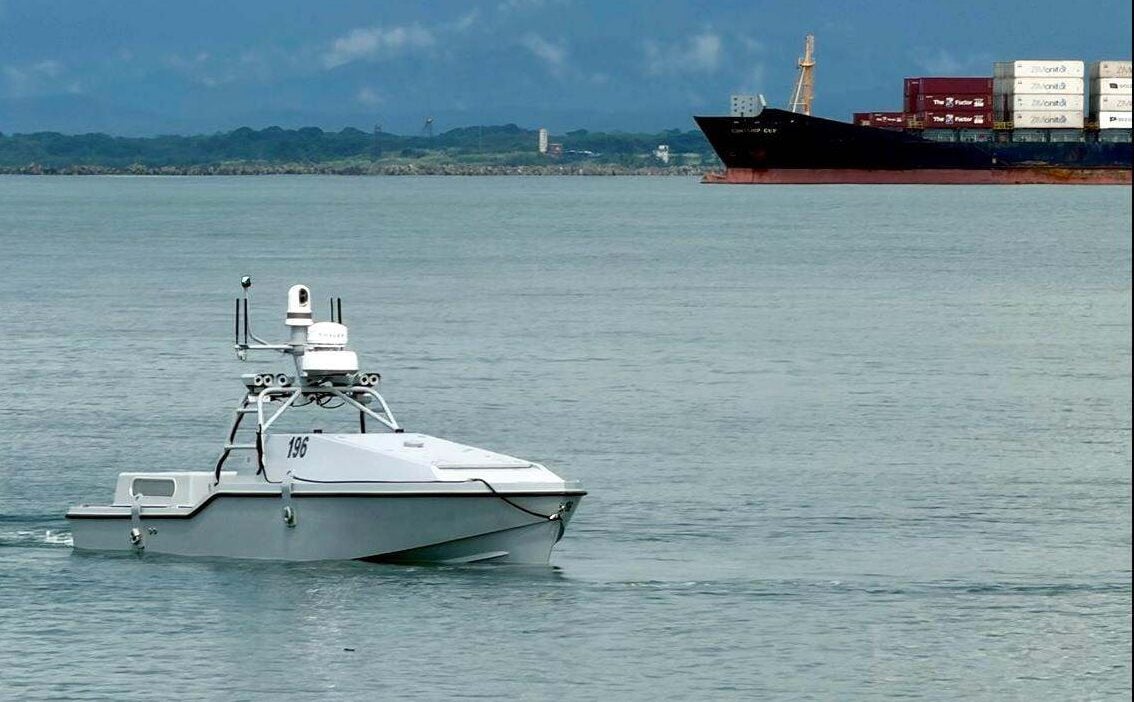
Panama’s National Aeronaval Service (SENAN) has integrated Saronic Technologies’ Corsair autonomous surface vessels into its maritime surveillance and counter-narcotics operations, with U.S. personnel providing expertise and technical support under a long-standing bilateral security arrangement. SENAN announced the move on October 8, 2026, as the Department of War released imagery dated the same day showing Corsair craft conducting coordinated operations in Panamanian waters.
The deployment extends the reach of the SOUTHCOM Autonomous Warfare Command (SAWC), which Gen. Francis L. Donovan, commander of U.S. Southern Command (SOUTHCOM), established on April 21, 2026, to field autonomous, semi-autonomous and unmanned systems against transnational criminal networks. Earlier this month, SOUTHCOM designated Naval Station Guantanamo Bay as the first SAWC training and mission support site, with official imagery there also featuring the Corsair. Panama is a logical next node: its Caribbean and Pacific coastlines flank the approaches to the Panama Canal, and both serve as established corridors for cocaine moving north.
How SENAN Will Employ Corsair Autonomous Surface Vessels
According to SENAN, the Corsairs will widen patrol coverage over areas of operational interest and complement the service’s patrol boats, aircraft and maritime interdiction network. The integration rests on the Salas-Becker Supplementary Arrangement, signed in February 2002 to expand a 1991 accord on U.S. Coast Guard support to Panama’s maritime forces. It remains the legal basis for combined counter-drug operations in Panamanian waters.
SENAN set two explicit limits. Panamanian personnel retain control of every mission, and all law enforcement actions remain the exclusive responsibility of Panamanian tactical personnel assigned to the maritime fleet. SENAN also describes the craft as remotely operated surface systems rather than autonomous vessels, a framing that keeps Panamanian command authority at the center of the arrangement.
Several details remain undisclosed. Neither Panama nor SOUTHCOM has stated how many Corsairs are deployed, where they are based, how long they will operate, or whether they remain U.S. Navy property. Released imagery shows at least two craft operating together. Ownership is the most consequential unknown, because it separates this arrangement from outright transfers such as the four K1000ULE long-endurance unmanned aircraft SENAN incorporated in September, which Panamanian personnel operate exclusively.
Range, Payload, and Autonomy: Inside the 24-Foot Corsair
Saronic originally developed the Corsair for the Pentagon’s Replicator initiative. Manufacturer figures give the 24-foot (7.3-meter) craft a payload of roughly 1,000 pounds, a top speed above 35 knots and a range of about 1,000 nautical miles. Publicly released imagery indicates a sensor fit built around a gyro-stabilized electro-optical/infrared camera and a pulse-compression radar for navigation and surface search.
For counter-narcotics work, endurance matters more than speed. A 1,000-nautical-mile envelope lets a single craft hold station on trafficking routes for extended periods, cueing crewed assets only when a contact warrants interception. The Corsair’s top speed sits well below the 50-knot-plus SENAN interceptors that conduct the chase, so the craft functions as a persistent sensor and tracking node rather than a pursuit platform. Its autonomy software processes perception data on board, allowing the vessel to keep navigating when satellite links or GPS signals degrade, which also reduces bandwidth demands on a partner force without dedicated unmanned control infrastructure.
The Corsair arrives with an operational record. The U.S. Navy announced a $392 million Other Transaction Authority (OTA) production agreement with Saronic in December 2025, with nearly $200 million obligated at award. Corsairs joined U.S. 5th Fleet’s Task Force 59 in March 2026, recovered two downed U.S. Army AH-64 Apache crew members near the Strait of Hormuz in June, and in July struck a submarine and ship maintenance facility at Iran’s Bandar Abbas Naval Base in what U.S. Central Command (CENTCOM) called the first U.S. combat use of sea drones. No armament has been disclosed for the Panama deployment.
SAWC and the Expanding Unmanned Network Around Panama
The Corsair adds a new layer to a U.S.-supported surveillance architecture assembled around the isthmus in 18 months. In April 2025, Panama signed a memorandum of understanding allowing U.S. forces to use Panamanian facilities for interdiction missions and joint training. In spring 2026, the State Department’s Bureau of International Narcotics and Law Enforcement Affairs (INL) delivered two 41-foot interceptors valued at $2.085 million, the first of six planned over three years. The K1000ULE aircraft followed in September, with nine SENAN personnel certified as operators.
Farther offshore, U.S. Naval Forces Southern Command/U.S. 4th Fleet runs 21 Saildrone Voyager unmanned surface vessels in the Caribbean and Eastern Pacific in support of Joint Interagency Task Force South. The Corsair closes the gap between those long-dwell sensors and SENAN’s crewed boats, placing a faster autonomous node inside Panama’s territorial sea, where interdictions actually occur.
Analysis: The Panama deployment shows how SAWC intends to scale: by embedding U.S. autonomous hardware inside partner-nation command structures rather than standing up a separate U.S. patrol presence. That model lowers the political cost of persistent surveillance near the canal, a sensitive question in Panama since 2025, while giving SOUTHCOM performance data on the Corsair in a permissive environment. It also inverts the platform’s recent profile: a hull proven in one-way attack now operates under a framework that reserves every law enforcement act for Panamanian crews. The durability test is sustainment. If SENAN cannot absorb maintenance, software updates and data management without a permanent U.S. technical footprint, the arrangement remains a U.S. capability under Panamanian tasking rather than a transferred one.
The next markers are disclosure of fleet size and ownership, the first SENAN interdiction publicly credited to Corsair cueing, and whether SAWC replicates the model with Central American partners such as Honduras and El Salvador, where U.S. forces already operate from host-nation facilities. The annual bilateral review of the Salas-Becker arrangement gives Panama a formal venue to set terms on data sharing and the scope of U.S. technical support.