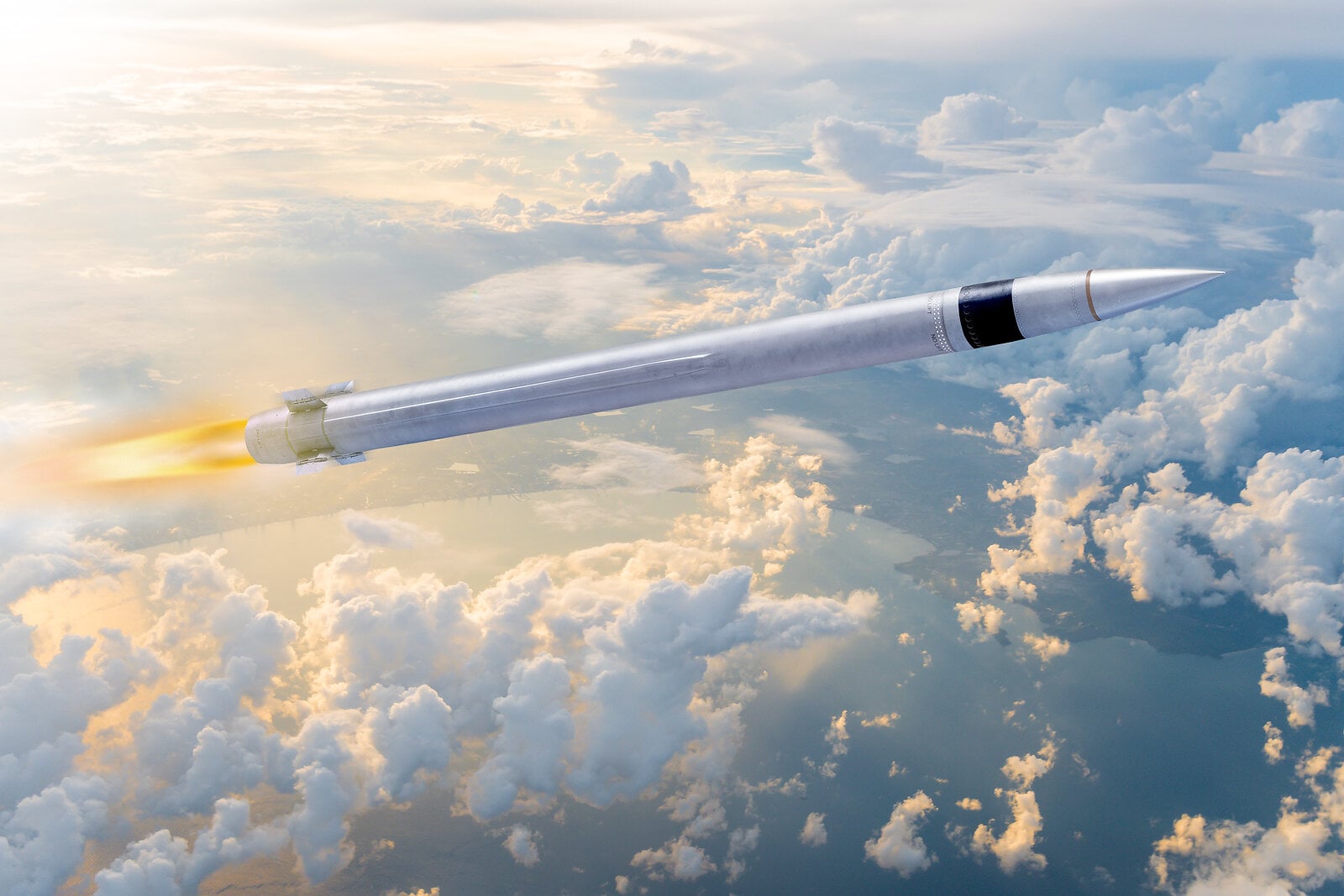
Lockheed Martin on October 9, 2026, unveiled the PAC-3 Edge, a new Patriot-family interceptor designed to defeat hypersonic and advanced missile threats at longer ranges and higher altitudes than the PAC-3 Missile Segment Enhancement (MSE). The missile is the company’s entry in the US Army’s Future Interceptor competition. Lockheed Martin said the Army has advanced it to the next stage of development, with testing due to begin in 2027 and deployment targeted by 2031.
The announcement puts a name and a schedule on an effort the Army shelved two years ago. The service canceled its Lower-Tier Future Interceptor (LTFI) program in October 2024 on cost grounds and chose to keep upgrading the PAC-3 MSE. A year later, Maj. Gen. Frank Lozano, then program executive officer for missiles and space, said he expected the effort to return, and the Army has since revived it as its Future Interceptor program. The restart comes as combat use in Ukraine and the Middle East draws down Patriot stocks, and as a July 29, 2026, award brings the Army’s seven-year PAC-3 MSE production contract to up to $58.6 billion.
PAC-3 Edge Interceptor Design: New Seeker, Motor, and Flight Controls
Lockheed Martin presents the PAC-3 Edge as a development of the MSE that changes three subsystems. The first is a new seeker that the company builds in-house, designed by its Strigo Product Center. Lockheed Martin disclosed Strigo on August 10, 2026, as a family of modular radio-frequency sensors, missile datalinks, and seekers built on a common baseline, and said it has invested $250 million in the center to date. Strigo technology has already informed aspects of the seeker package for the Precision Strike Missile (PrSM) Increment 2. The MSE, by comparison, carries an active Ka-band radar seeker that Boeing produces in Huntsville, Alabama. Lockheed Martin has not disclosed the Edge seeker’s operating band or whether it uses more than one sensing mode.
The second change is propulsion. The Edge uses a multi-pulse solid rocket motor designed by Northrop Grumman. The MSE flies on an 11.4-inch, dual-pulse solid rocket motor from L3Harris, which absorbed Aerojet Rocketdyne in 2023. A multi-pulse design lets an interceptor hold back energy for the endgame, which matters against targets that maneuver late in flight. The company has not stated how many pulses the new motor provides. The third change is an upgraded control system intended to improve performance at range and altitude.
Lockheed Martin has released no dimensions, launch weight, speed, range, or altitude figures for the Edge, and has not confirmed whether it retains the MSE’s hit-to-kill mechanism. Tim Cahill, president of Lockheed Martin Missiles and Fire Control, said the new missile offers greater maneuverability, power, and velocity than the MSE. The MSE’s own engagement envelope is classified. Open-source estimates put its reach against ballistic missiles at about 30 to 35 kilometers, compared with about 20 kilometers for the earlier PAC-3 Cost Reduction Initiative (CRI) round.
Launcher, IBCS, and HIMARS Flex Integration for Layered Defense
Lockheed Martin designed the Edge to work with launchers and command networks that already exist or are in development. The company lists the Northrop Grumman-built Integrated Battle Command System (IBCS), the M903 Patriot launcher, containerized launchers, and HIMARS Flex as integration targets. An M903 carries 12 PAC-3 MSE rounds. Lockheed Martin has not said whether the Edge keeps the MSE canister dimensions, so the load-out per launcher remains unconfirmed. HIMARS Flex, which the company introduced in June 2026, is a dual-pod evolution of the M142 launcher that can carry eight PAC-3 interceptors.
An interceptor that fires from existing launchers and takes targeting data through IBCS avoids the cost of a new launcher fleet and a separate fire control chain.
The Edge would sit at the top of a four-member PAC-3 family. Below it are the MSE, the legacy CRI, and the PAC-3 Adapted Capability Effector (ACE), which Lockheed Martin introduced at the Farnborough International Airshow on July 20, 2026. The ACE costs less than half as much as an MSE, according to the company, and uses a blast-fragmentation warhead, a single-pulse motor, and a simplified seeker. The Edge moves in the opposite direction, toward the high-altitude, high-speed end of the lower-tier battlespace.
Future Interceptor Competition: Cost, Production, and Rival Bidders
Future Interceptor remains a competition, but Lockheed Martin did not identify rival bidders, the type of agreement it holds, or its value. Before the 2024 cancellation, Lockheed Martin and Raytheon were the two expected LTFI contenders. Lozano said in October 2025 that he wanted to cast a wider net, use a middle-tier acquisition pathway built around rapid prototyping, and field a minimum viable capability within three to five years of a formal program start. Lockheed Martin’s 2027 test and 2031 deployment dates fit inside that window.
On cost, Cahill said an Edge round would be priced about the same as an MSE. The MSE has averaged about $4 million per round in past budgets, and the Army’s fiscal 2027 budget proposal prices it at about $5.3 million. Cahill also said full-rate Edge production would reach about 2,000 rounds a year, comparable with the MSE target. Under a framework agreement signed on January 6, 2026, Lockheed Martin is raising annual MSE production capacity from about 600 rounds to about 2,000 over seven years, after delivering 620 in 2025.
Analysis: The PAC-3 Edge shows how the Army’s second attempt at a Patriot successor differs from the first. The incumbent is offering a derivative that keeps the launcher and the command network while replacing the two subsystems that govern endgame performance against fast, maneuvering targets. Both come from different suppliers than the MSE’s seeker and motor, which widens a stretched supplier base but adds qualification work before a 2027 test start. At MSE-level pricing, the Edge does not address cost per shot. That problem falls to the ACE and to the Army’s separate Low Cost Interceptor effort, which targets a unit cost below $1 million. If all three tracks hold, the Army ends up with a tiered magazine in place of a single premium round.
The next markers are an Army statement on which vendors advanced and under what terms, and the first PAC-3 Edge test in 2027. Open questions include the seeker type, the kill mechanism, the missile’s dimensions and launcher load-out, and how the Army will fund Edge production alongside the MSE buy. The Association of the United States Army annual meeting, held October 12 to 14, 2026, in Washington, offers an early opportunity to fill in those details.