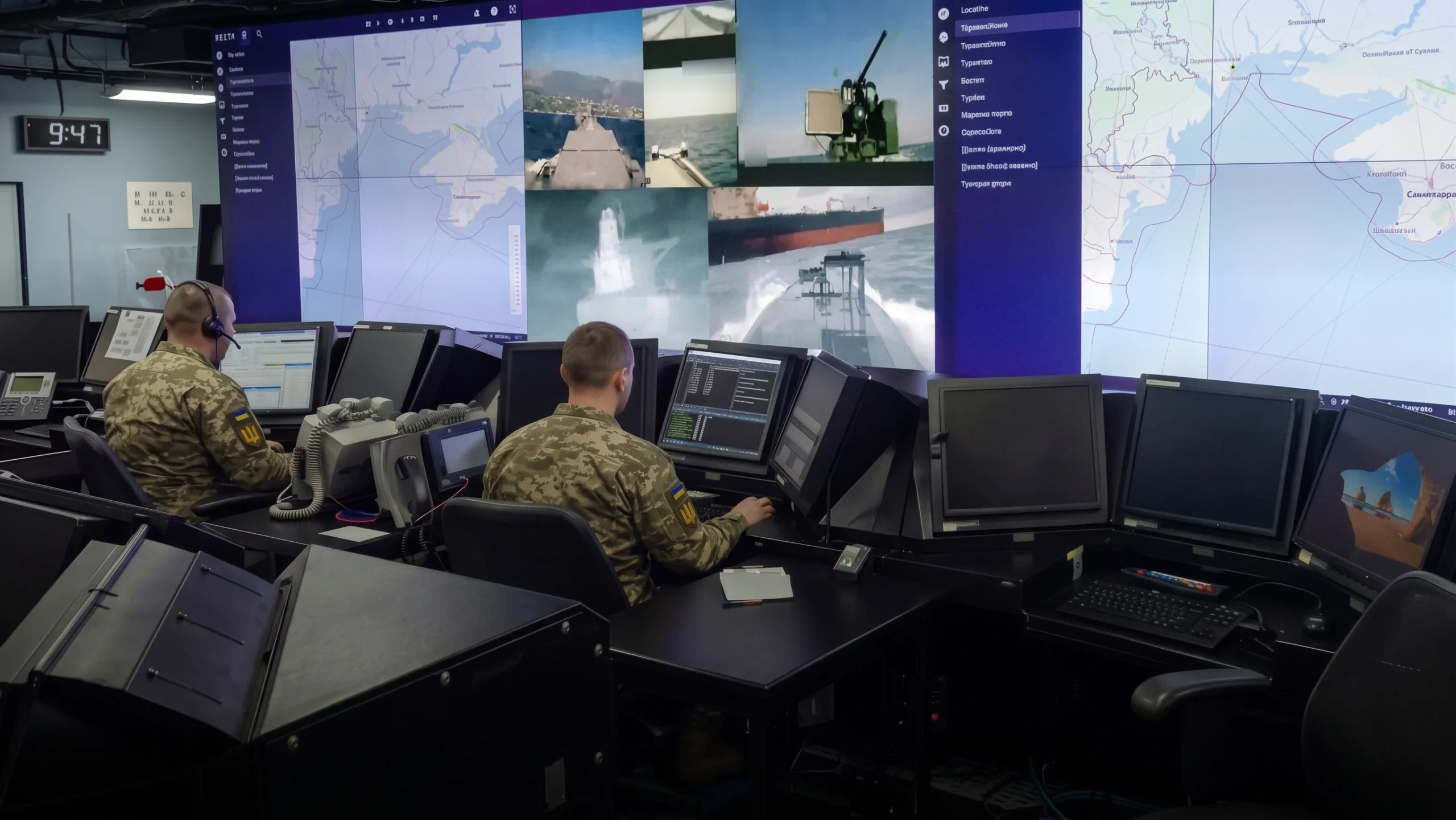
Ukraine’s DELTA combat system integrated every NATO-standard data feed presented to it during REPMUS 2026, the alliance’s largest exercise for maritime unmanned systems, according to the Ukrainian Ministry of Defence. Ukrainian service members used the platform to plan and coordinate maritime operations while ingesting telemetry from unmanned aerial, surface and subsurface systems as well as radars, the ministry said in a statement on October 14, 2026.
REPMUS (Robotic Experimentation and Prototyping with Maritime Unmanned Systems) ran from August 31 to September 25, 2026, at Tróia and Sesimbra on Portugal’s Setúbal Peninsula. The Portuguese Navy led the exercise with the University of Porto’s Faculty of Engineering, the NATO Centre for Maritime Research and Experimentation (CMRE), the NATO Joint Capability Group Maritime Unmanned Systems and the European Defence Agency. According to NATO, the 2026 edition brought together representatives of 36 navies and more than 300 unmanned systems. It was Ukraine’s third consecutive REPMUS, and the first since Kyiv ordered DELTA deployed across every level of its Defence Forces in August 2025.
How the DELTA Combat System Fused NATO-Standard Feeds at REPMUS
The Ukrainian contingent drew personnel from several services and branches and ran its activities through DELTA. Training serials alongside allied units covered reconnaissance, maritime area monitoring, maneuvering, and escort and simulated engagement exercises. Ukrainian personnel also briefed partners on wartime employment of unmanned systems in the maritime domain.
The headline result is technical: DELTA ingested all assets transmitting telemetry in line with STANAG 4817, spanning aerial, surface and subsurface drones and radar sensors. The ministry did not disclose how many assets were connected, which manufacturers or national teams supplied them, or whether DELTA again served as a primary command-and-control node for a multinational team, as it did in 2025.
The Ukrainian team also reported uninterrupted operation under unstable connectivity and judged streaming through the Vezha module easier than on other platforms. That assessment comes from the Ukrainian side rather than an independent NATO evaluation. It nonetheless addresses the core requirement at sea, where intermittent links and electronic interference are the norm rather than the exception. Vezha, a battlefield video analytics module integrated into DELTA in October 2024, carries real-time drone footage; by July 2026 the ministry said DELTA was handling more than 75,000 video streams a day, with the built-in Avengers AI platform performing automatic detection of enemy objects.
Why STANAG 4817 Compliance Matters for Allied Unmanned Operations
STANAG 4817 is the NATO standardization agreement for multi-domain control stations. It defines a common reference architecture and standardized interfaces across command-and-control layers, from high-level command structures down to individual vehicle ground control stations, and is designed to remain compatible with STANAG 4586 for unmanned aircraft control. As of late 2025, the standard was in its final development stages ahead of ratification; its formal ratification status as of October 2026 could not be independently confirmed.
The operational value is interchangeability. A command system that natively reads STANAG 4817 telemetry can accept any compliant vehicle without a bespoke integration, and the standard supports controlled handover of platforms between control nodes. For Ukraine, which fields a mix of domestic and allied-supplied drones, conformity reduces integration friction at home and positions DELTA as a credible partner node in combined operations.
DELTA was built by the Ministry of Defence’s Center for Innovation and Development of Defense Technologies, which traces its roots to the Aerorozvidka volunteer group, and has been in development since 2016. The Cabinet of Ministers approved its use in the Defence Forces in February 2023. Ukrainian teams have tested the system at NATO interoperability events including the Coalition Warrior Interoperability eXercise (CWIX), where in 2024 they demonstrated exchange of a full operational picture with allied systems.
From REPMUS 2025 to 2026: DELTA’s Expanding Maritime Unmanned Role
At REPMUS 2025, Ukraine joined the exercise’s red team, and DELTA became the primary command platform for that combined multinational force. The ministry said at the time that the system coordinated more than 100 unmanned platforms across maritime, underwater, land and air domains, and routed video from all red team unmanned systems through Vezha. The 2026 messaging shifts from scale to standards conformity and resilience, without a comparable platform count.
The system’s operational load at home frames the claim. The ministry reported that troops logged more than 200,000 drone strikes in DELTA in June 2026 alone, an average of over 6,600 a day, and add more than 8 million new objects to its digital map each month. In early 2026, the Mission Control module added a single drone management layer that replaced paper reporting across all corps and force groupings.
NATO used the same exercise to assess the connectivity backbone and mission-engineering layer of Task Force X-Arctic, an Allied Command Transformation and CMRE effort to deliver situational awareness across the North Atlantic, the Arctic and the High North through networked uncrewed systems.
Analysis: The significance of REPMUS 2026 lies less in a single exercise result than in the trajectory it confirms. A national command-and-control ecosystem built under wartime pressure, outside any NATO procurement program, is converging with the interface standard allies are adopting for their own unmanned fleets. If allied evaluators corroborate the Ukrainian findings, Kyiv becomes a contributor of integration expertise and combat-tested software rather than only a consumer of allied drones, a shift relevant to any future multinational maritime security arrangement in the Black Sea. The caveat is that a Portuguese exercise range does not replicate Russian electronic warfare density, and the ministry’s account remains self-reported.
The next markers are concrete. NATO plans a Task Force X-Arctic trial in Norway at the end of 2026, STANAG 4817 ratification remains a pending milestone, and any CMRE or Joint Capability Group findings from REPMUS 2026 would provide the independent validation the ministry’s statement lacks. The ministry said Ukraine will keep sharing combat experience with unmanned systems and deepen interoperability with NATO member forces.