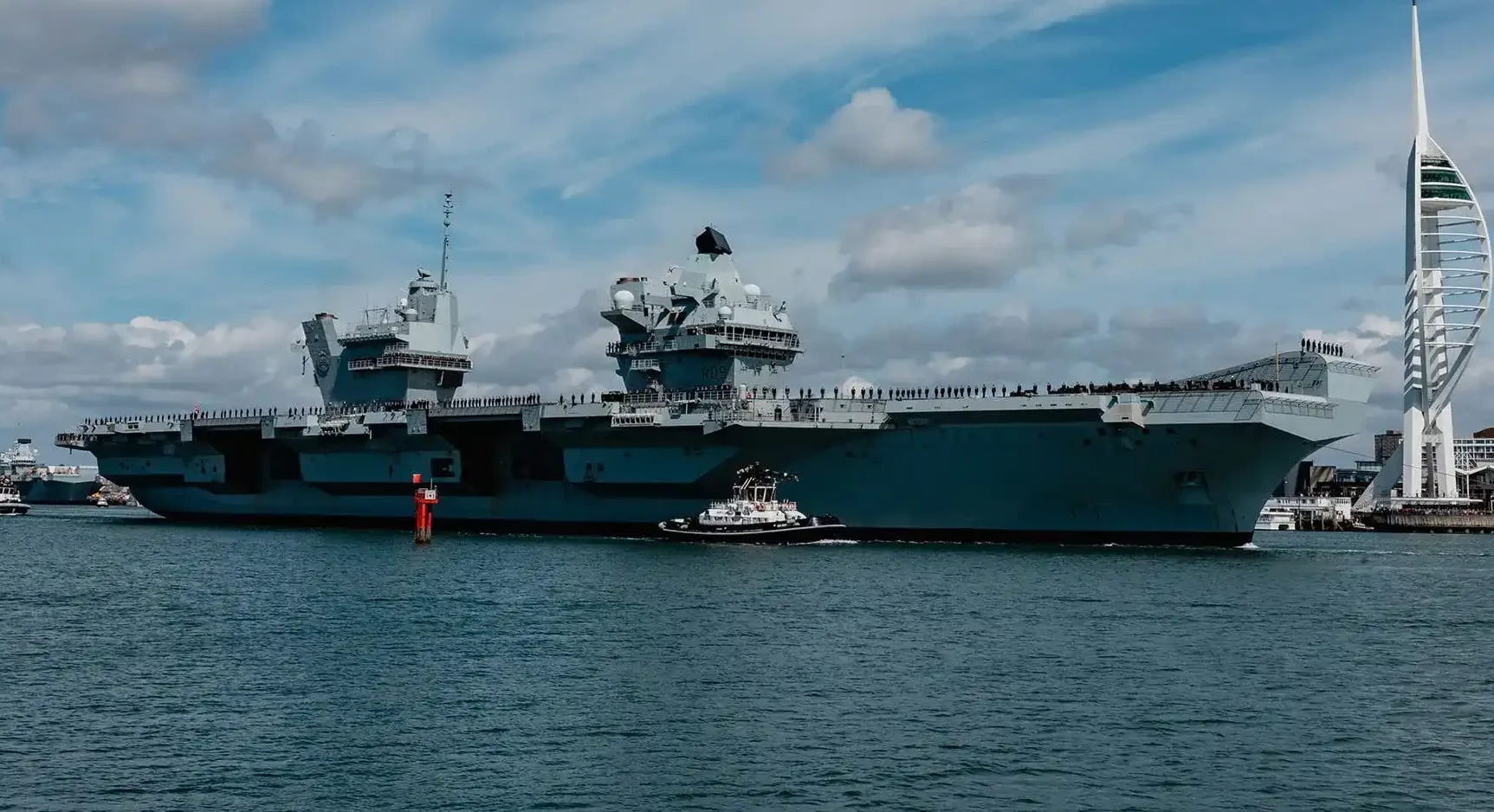
The UK Carrier Strike Group is heading back to the Arctic and North Atlantic, with HMS Prince of Wales leading the second phase of Operation Firecrest under NATO command, the Royal Navy announced on October 17, 2026. The Queen Elizabeth-class carrier sails with the Type 45 destroyer HMS Dauntless and more than 1,200 British personnel, embarking F-35 Lightning II jets, Merlin and Wildcat helicopters and Malloy uncrewed aircraft for operations alongside Norway, Denmark and Germany.
Prime Minister Keir Starmer announced the deployment at the Munich Security Conference on February 14, 2026. The first phase, flown from April to July with the destroyer HMS Duncan and the tanker RFA Tidespring, delivered NATO’s Arctic Sentry enhanced Vigilance Activity and the first NATO air policing mission over Iceland launched from a European carrier. On July 2, 2026, two F-35Bs from 809 Naval Air Squadron intercepted a Russian Tu-142 Bear F that dropped sonobuoys near the carrier in the Norwegian Sea. The carrier returned to Portsmouth on July 24, 2026.
Inside the HMS Prince of Wales Hybrid Air Wing for Phase 2
Publicly available specifications put HMS Prince of Wales at roughly 65,000 tonnes and 284 meters in length, powered by an integrated full electric plant built around two Rolls-Royce MT30 gas turbines rated at 36 MW each and four Wärtsilä diesel generators, for a top speed above 25 knots. Her Type 997 Artisan 3D radar and S1850M long-range volume search radar feed the fighter controllers who direct F-35 intercepts; the Royal Navy said during phase one that the group tracks incoming aircraft beyond 200 miles. With only Phalanx close-in weapon systems for self-defense, the carrier depends on its air wing and escort.
The Royal Navy has not disclosed how many F-35Bs are embarked for phase two. In phase one, 809 Naval Air Squadron jets used RAF and Italian tanker support to strike as far as Poland during Exercise Neptune Strike. The rotary-wing component splits by mission: Merlin HM2 helicopters provide the anti-submarine screen with dipping sonar and sonobuoys, Merlin HC4 Commando aircraft handle utility lift, and Wildcat HMA2 helicopters armed with Martlet lightweight multirole missiles cover surface and counter-drone tasks.
The Malloy Aeronautics T-150, built by a BAE Systems subsidiary, is an electric octocopter that lifts up to 68 kilograms at up to 60 mph, and it flew the Royal Navy’s first ship-to-ship drone delivery, from Prince of Wales to Dauntless, during the 2025 Operation Highmast deployment. Because 95% of stores moved between ships on earlier carrier deployments weighed under 50 kilograms, each drone run frees a Merlin for anti-submarine work.
HMS Dauntless and the Sea Viper Shield Over the Strike Group
The Type 45 displaces between 8,000 and 8,500 tonnes, carries the SAMPSON active electronically scanned array radar high on its foremast, and fires Aster 15 and Aster 30 interceptors from a 48-cell Sylver vertical launch system under the Sea Viper system. Publicly available data indicate Sea Viper can launch eight missiles in under 10 seconds and guide up to 16 at once, capacity sized for salvos of supersonic anti-ship missiles in Russia’s Northern Fleet inventory.
Dauntless was the first of class to complete the Power Improvement Project, returning to service in 2023 after her two 2 MW Wärtsilä diesel generators were replaced by three 3 MW MTU Series 4000 units. The fix allows cruising on diesels alone, addressing the propulsion failures that long undermined Type 45 availability. She then entered a three-month support period with BAE Systems in late February 2026 to restore full operational capability ahead of this tasking.
The release names only Dauntless; no frigate, attack submarine or Royal Fleet Auxiliary tanker has been publicly confirmed for phase two. A Type 45 carries no towed-array sonar, leaving the deep anti-submarine fight to the Merlin HM2 force and to allied navies in waters patrolled by Northern Fleet submarines.
Neptune Strike and Oslo Summits Anchor the NATO Mission
The strike group will again operate under NATO command, contributing to the alliance’s enhanced vigilance activity, including the latest iteration of the Neptune Strike exercise series across Europe and the North Atlantic. “I am delighted to return to the Arctic and North Atlantic as we build on the successes of the first phase of Op Firecrest,” said Commodore Richard Hewitt, commander of the UK Carrier Strike Group. Minister for the Armed Forces Louise Sandher-Jones said the deployment “is a clear demonstration of the UK’s commitment to the Alliance and contribution to the enduring security and stability of the North Atlantic.”
HMS Prince of Wales is also scheduled to host the Atlantic Future Forum alongside in Oslo on November 11 and 12, 2026, the eighth edition of the summit and the first held in mainland Europe, as well as the International Sea Power Conference.
The Ministry of Defence framed the deployment alongside the 800-strong UK battlegroup in Estonia and restated that the UK will join NATO’s Dual Capable Aircraft mission with F-35A jets, a commitment announced in June 2025 for 12 aircraft at RAF Marham and confirmed in the Defence Investment Plan.
Analysis: Phase two matters less for what sails than for what it proves. Sending a carrier back to the same theater within three months of returning home demonstrates persistence, the quality NATO’s northern planners struggle to secure from Europe’s small carrier inventory. A deck in the Norwegian Sea gives the alliance a mobile air base where Iceland has no air force. The trade-off is depth. With one named escort, the UK supplies the deck, air wing and command staff while relying on Norwegian, Danish and German units for anti-submarine and surface screening. That is the NATO-first model London has adopted, but it also exposes how few frigates and destroyers the Royal Navy can generate for a sustained High North presence.
Beyond the Oslo forum, the Royal Navy has not published phase two’s duration, the size of the embarked F-35B detachment, the Neptune Strike dates or whether additional British or allied escorts will join. Those answers will show whether Firecrest becomes a template for recurring UK carrier presence on NATO’s Northern Flank.