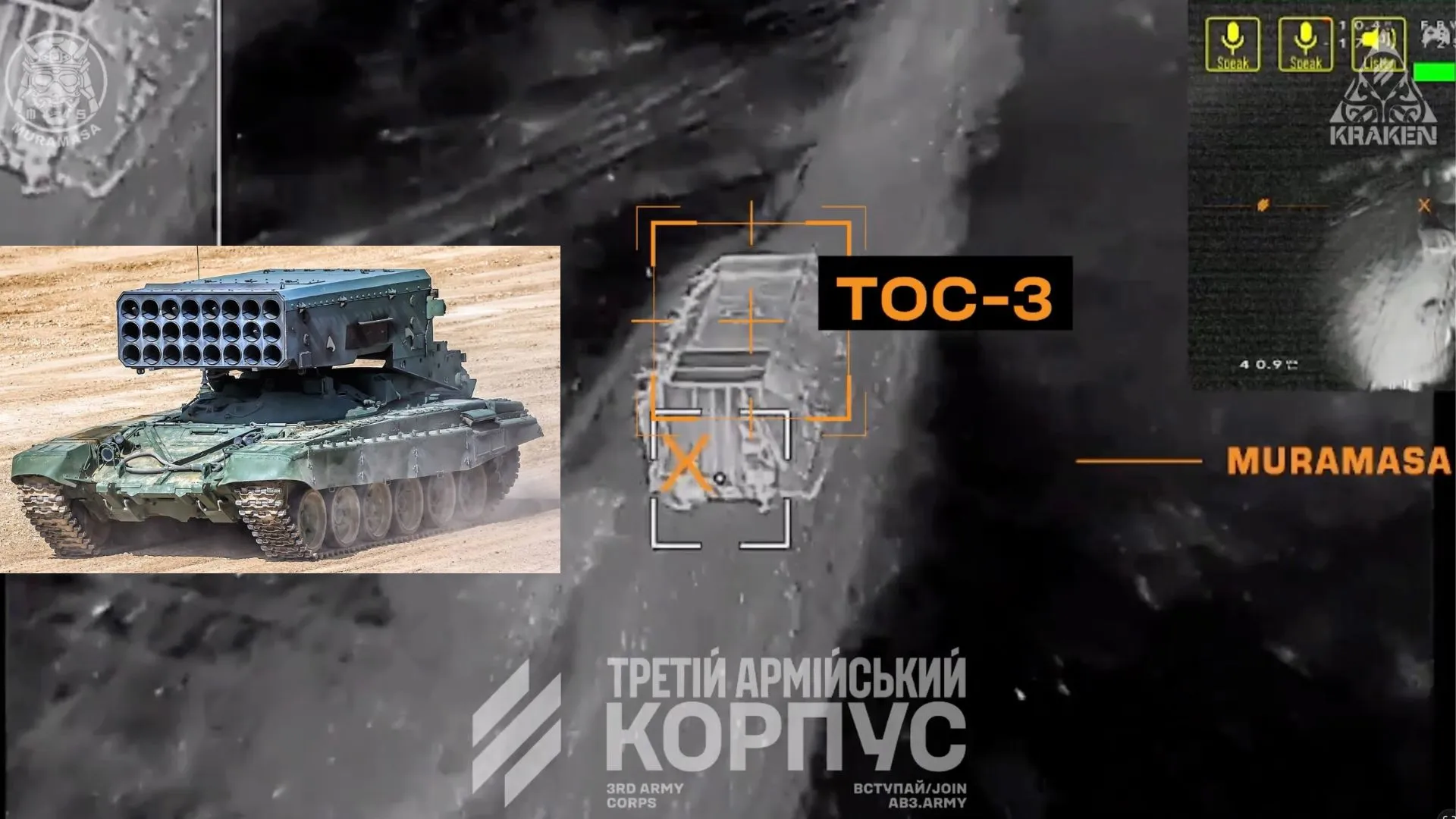
Drone operators from Ukraine’s 21st Separate Unmanned Systems Regiment “Kraken 1654” have struck a Russian TOS-3 Drakon heavy flamethrower system on the Lyman axis, Ukraine’s 3rd Army Corps announced on October 17, 2026. According to the corps, the regiment’s Muramasa unit engaged the vehicle roughly 12 kilometers behind the line of contact after observing it conduct a fire mission, and the corps released drone footage of the attack.
The strike took place during Operation Vivaldi, the counteroffensive the 3rd Army Corps, commanded by Brigadier General Andrii Biletskyi, has run north of Lyman in Donetsk Oblast. On October 14, the corps said the operation’s four stages had returned 16 settlements and 277 square kilometers to Ukrainian control. The engagement is also the second publicly documented hit on a TOS-3 in less than two weeks: on October 6, Ukraine’s 57th Separate Motorized Infantry Brigade released footage of a Drakon struck while moving along a road near Shebekino, in Russia’s Belgorod Oblast. The corps called it its own first strike on the type but did not give the date of the attack.
TOS-3 Drakon Specifications: Range, Protection and Launcher Design
According to the 3rd Army Corps, the TOS-3 extends the Russian heavy flamethrower family that includes the TOS-1A Solntsepyok and the wheeled TOS-2 Tosochka. The corps lists a 15-tube launcher for unguided thermobaric rockets, an approximate range of 15 kilometers, a crew of three, slat armor against shaped-charge threats and explosive reactive armor.
Publicly available specifications indicate the launcher sits on a tracked T-72 chassis, with Kontakt-5 reactive armor around the hull, factory anti-drone screening over the launcher module and onboard electronic warfare equipment. Omsktransmash filed a trademark application for the Drakon name in 2024, the year the system first appeared in Russian footage. On February 4, 2026, Russia’s Ministry of Defense showed the TOS-3 in combat with its 29th Separate Radiation, Chemical and Biological Defense Brigade.
The cut from the TOS-1A’s 24 tubes to 15 is the defining design trade. Open-source assessments tie it to the TBS-M3 rocket developed for the TOS-2 and credited with a range of up to 15 kilometers, against roughly 6 kilometers for the TOS-1A, which required line of sight and laser ranging to its target. Some Ukrainian assessments credit the TOS-3 with 15 to 24 kilometers; the upper figure is unconfirmed. Each rocket reportedly weighs more than 200 kilograms, and open-source estimates put the cost of a complete system between $6.5 million and $15 million. The added standoff is meant to keep crews outside the reach of 120 mm mortars and most anti-tank guided missiles, the threats that cost Russia earlier TOS vehicles pushed to within a few kilometers of the front.
How Kraken Drone Operators Caught the Drakon 12 Kilometers Out
The engagement exposes the limits of that standoff. A 15-kilometer range pulls the launcher back from the trench line but leaves it inside the depth that Ukrainian strike-drone units now patrol. The Kraken regiment, stood up in September 2025 with experienced personnel transferred from the Defence Intelligence of Ukraine’s Kraken unit, serves as the 3rd Army Corps’ dedicated unmanned systems formation.
Detection appears to have followed the launcher’s own fire. A full thermobaric salvo produces a heat and blast signature that persistent overhead reconnaissance can cue onto within minutes, and the corps said operators attacked only after recording the Drakon firing. The released footage shows the vehicle, labeled TOS-3, under an aiming reticle before impact. The corps has not identified the drone or munition used, where the vehicle was hit, or whether the slat screens and anti-drone netting were defeated.
Russia fields the TOS family through its radiation, chemical and biological defense troops, and Moscow has not disclosed how many TOS-3 systems are in service.
Analysis: Two TOS-3 hits within roughly 11 days, on different sectors and by different Ukrainian formations, indicate that range alone does not restore survivability for Russian area-effect systems. The Drakon answers the threats of 2022, mortars, guided missiles and direct fire, by moving the launcher about 9 kilometers further back than the TOS-1A. The current kill zone, however, is defined by drone endurance rather than line of sight, and 12 to 15 kilometers sits well inside the reach of Ukrainian strike-drone units. For armies weighing thermobaric and rocket artillery programs, the takeaway is that signature management and displacement speed after firing count as much as engagement range.
Key unknowns remain the vehicle’s final status, the weapon used and the size of the TOS-3 fleet. The claim had not been independently verified at the time of publication. Further visual confirmation, and any sign that Russia adds protection or restricts the Drakon’s firing patterns, will show how quickly the type’s battlefield profile is eroding as fighting on the Lyman axis continues.