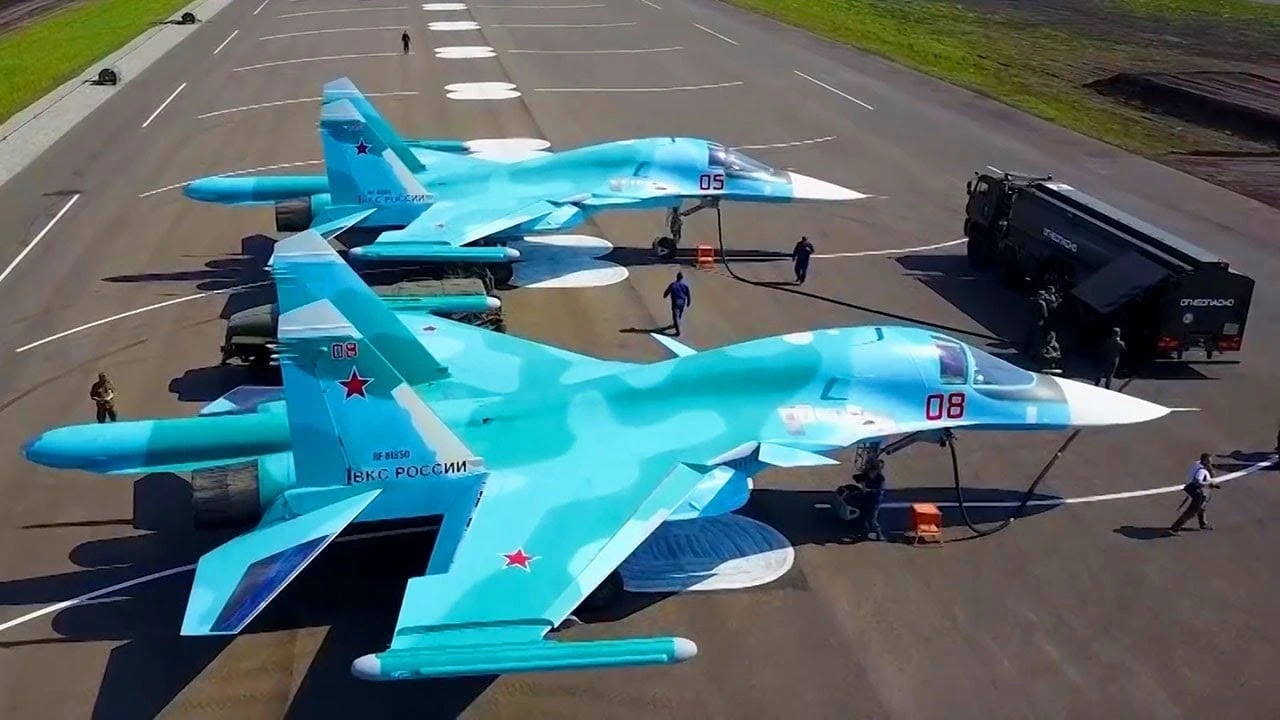
Ukraine’s Navy struck the Borisoglebsk military airfield in Russia’s Voronezh region with its Neptune coastal missile system overnight on October 15, 2026, hitting six Su-34M fighter-bombers. Commercial satellite imagery released the same day indicates that four of the aircraft were destroyed and two sustained heavy damage.
The Su-34 is Russia’s principal launch platform for the guided glide bombs that hit Ukrainian frontline positions and cities, and the strike landed eight days after United Aircraft Corporation (UAC) announced its second Su-34 delivery batch of 2026 on October 7. The Ukrainian Navy said the attack also destroyed flight support equipment and triggered secondary explosions and a fire. Ukraine’s General Staff and Ministry of Defense later confirmed that all six jets sustained damage “of varying degrees.” Moscow had not acknowledged the losses at the time of writing, though several pro-Russian Telegram channels conceded them.
Borisoglebsk Airfield Strike: What the Satellite Imagery Shows
Imagery published by Ukrainian aviation monitoring channels compares the aircraft parking area on October 13 with frames captured after the attack. The earlier image shows six Su-34s parked in the open at the spot later struck; the post-strike frames show four airframes reduced to burned wreckage and two with substantial damage. That picture sits between the Navy’s initial statement that all six bombers were destroyed and the General Staff’s more cautious wording. The final tally has not been independently verified, and the Navy said it is still assessing damage to support equipment and base infrastructure.
The air base sits about 6 kilometers east of the town and roughly 300 kilometers from the Ukrainian border. It hosts a major training center for Russian Aerospace Forces strike and bomber crews and falls within the area of responsibility of the 105th Mixed Aviation Division, which operates Su-34, Su-35S and Su-30SM aircraft. Ukrainian drones previously hit Borisoglebsk on October 3, 2024, targeting aircraft and a glide bomb depot, and again on July 8, 2026. Assessments after the July attack described the base as hosting no permanently assigned combat aircraft and serving mainly as a refueling and rearming point. Six Su-34s on the ramp on October 13 suggest Russia had returned to using the airfield as a forward operating location for its bomber force.
Su-34M Sensors, Payload, and Russia’s Glide Bomb Campaign
The Sukhoi Su-34, NATO reporting name Fullback, is a two-seat, twin-engine strike aircraft derived from the Su-27 airframe, with a side-by-side cockpit inside an armored titanium capsule. Publicly available specifications indicate two Saturn AL-31F-M1 afterburning turbofans, a top speed of about Mach 1.8, 12 hardpoints and an ordnance load of up to 8,000 kilograms. UAC states the aircraft can fly non-stop sorties of up to 10 hours, reflecting its large internal fuel capacity and in-flight refueling probe.
The Su-34M standard emerged from the Sych research and development program. Its defining addition is a family of three interchangeable reconnaissance pods on a common data bus: the UKR-RL side-looking radar pod, the UKR-RT electronic intelligence pod built around the M410 sensor, and the UKR-OE electro-optical pod pairing an infrared scanner with the Antrakt camera system. Each pod can relay data to ground stations over a wideband datalink in near real time. Russia reportedly ordered 76 new-build Su-34Ms in 2020 for delivery by 2027, and UAC claims the variant doubles the combat potential of the baseline jet.
Operationally, the Su-34 anchors Russia’s glide bomb campaign. FAB-series bombs fitted with UMPK wing and guidance kits are released tens of kilometers from the target, outside the reach of many Ukrainian short-range air defense systems. Destroying the carrier on the ground removes the threat before it reaches the release point. Ukrainian forces also hit Su-34s at Shagol airfield in Chelyabinsk on April 25, 2026, at Akhtubinsk on August 20 and at Khanskaya on October 4.
R-360 to Neptune-D: Range and Warhead Behind the Strike
The Neptune entered Ukrainian service in 2021 as the R-360 coastal anti-ship missile, a subsonic, sea-skimming design powered by an MS-400 turbojet, carrying a 150-kilogram warhead to a declared range of about 280 kilometers. Two of them sank the Black Sea Fleet flagship Moskva in April 2022. The extended-range Neptune-D system and its RK-360L missile carry a 260-kilogram warhead to a declared 1,000 kilometers, according to specifications released by Ukraine’s state defense industry in 2025, and can follow a preset route without relying on satellite navigation.
The Navy disclosed neither the variant nor the number of missiles fired at Borisoglebsk. Launch geometry offers a clue: the airfield lies roughly 300 kilometers from the Ukrainian border, and launchers typically sit well back from the front, placing the target beyond the baseline R-360’s declared reach. That points toward an extended-range variant, though Ukrainian officials have not confirmed it. The long-range missile reportedly uses the existing truck-mounted launcher, letting coastal units switch between maritime and land-attack tasks.
Analysis: The strike exposes a basing problem Russia has not solved. Recent satellite imagery shows Moscow erecting large aircraft shelters at Engels-2 for its strategic bombers, but tactical strike jets still park in the open at airfields inside Ukraine’s expanding missile and drone envelope. Losing four Su-34Ms outright, with two more sidelined, is material for a production line estimated at 18 to 30 airframes a year that has announced only two delivery batches in 2026. Open-source loss trackers had already documented more than 40 Su-34 losses before this strike. A multi-aircraft kill on a single ramp by a domestic Ukrainian missile also shows that Kyiv’s deep-strike campaign no longer rests solely on long-range drones or foreign-supplied weapons.
Follow-on imagery over the coming days should show whether the two damaged airframes are repairable and whether Russia disperses its remaining Su-34s away from Borisoglebsk. Other indicators to watch: any Russian Ministry of Defense comment, further Neptune-D use against air bases, and the size of the next UAC Su-34 batch, promised before the end of 2026. Ukraine’s Defense Ministry signaled more to come on October 15: “Work on key Russian military targets continues.”