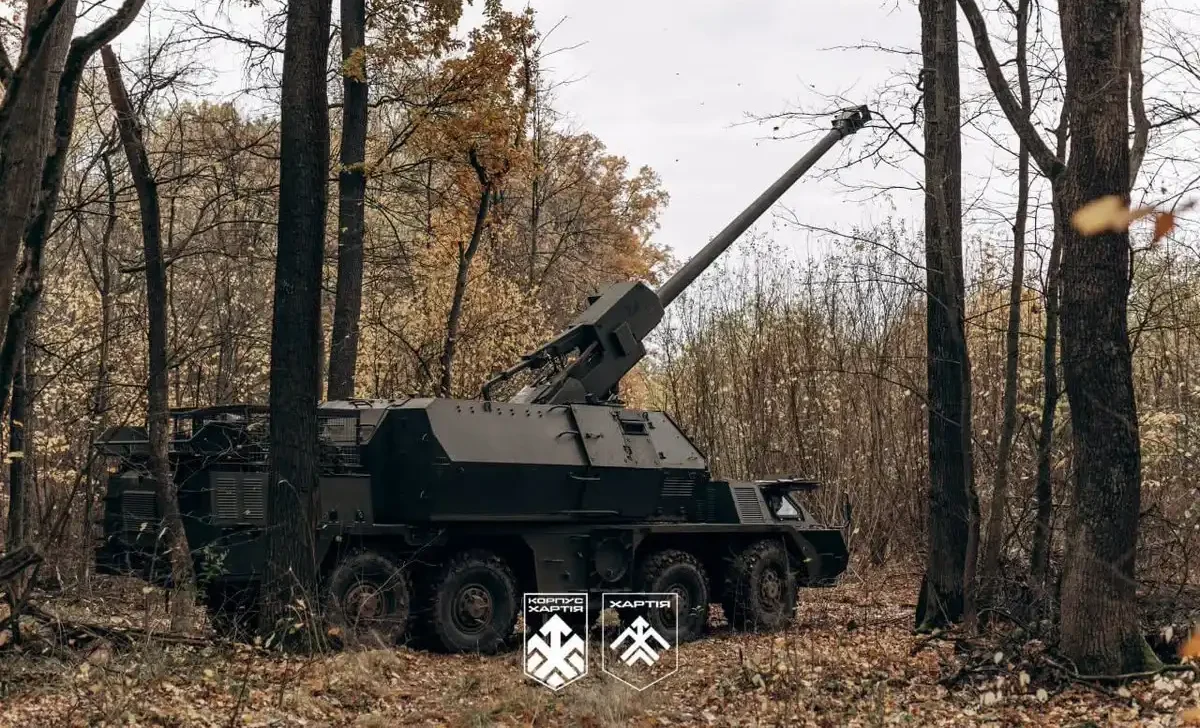
Ukraine’s Ministry of Defence says a Slovak-built Zuzana 2 155mm wheeled self-propelled howitzer is on combat duty with the artillery battalion of the National Guard’s 13th Khartiia Brigade. The ministry released photographs of the gun and its crew in a netted woodland position, describing a fire chain that runs from reconnaissance and command posts to the gun line, with every crew task serving “one result: hitting the enemy.”
The posting puts a NATO-standard, 52-caliber gun with a formation that has defended the approaches to Kharkiv since 2022 and now anchors the National Guard’s 2nd Khartiia Corps. Kyiv bought eight units under a commercial contract with Slovakia signed in June 2022 and received the last on January 16, 2023. A second batch of 16, jointly funded by Germany, Denmark and Norway for €92 million, began arriving on August 1, 2023; Germany’s Ministry of Defense said in April 2025 that nine of those had been delivered. The ministry did not say when Khartiia received the howitzer or how many the battalion fields.
Zuzana 2 Howitzer Design: From DANA Roots to a 52-Caliber Gun
Konštrukta-Defence built the Zuzana 2 as the third generation of a family that began with the Czechoslovak 152mm DANA vz. 77 and continued with the 155mm, 45-caliber Zuzana vz. 2000. The defining change is the 52-caliber barrel. Maximum range rises to about 41 km with extended-range rounds, against a 5 km minimum, and the gun accepts any NATO-standard 155mm projectile and charge.
Loading is fully automatic for both projectile and propellant. Two conveyors carry 40 projectiles and 40 charges ready to fire, feeding an automatic rate of five rounds in the first minute and 13 rounds in three minutes. The fire control system supports multiple round simultaneous impact (MRSI) missions, in which one gun lands several shells on a target almost together. The crew numbers four, and while the turret traverses through 360 degrees, the manufacturer lists a firing sector of ±60 degrees.
At the automatic rate, 40 ready rounds cover roughly nine minutes of fire before the crew must replenish, enough for several fire missions from one position. MRSI lets a single tube approximate a short battery volley against infantry in the open, the target set Khartiia faces in repeated Russian assaults north of Kharkiv.
Fire Control, Protection and Mobility on the Tatra 8×8 Chassis
The Zuzana 2 operates as an autonomous firing unit. Inertial navigation, a muzzle velocity radar and an on-board fire control system working with digital maps let the crew lay the gun and correct for barrel wear without a surveyed position. For direct fire, a sighting system combines a TV camera, a thermal imager and a laser rangefinder. A 12.7mm machine gun on the turret roof provides local defense.
Survivability features reflect pre-2022 assumptions about the threat. The armored cab and turret protect the crew against small arms fire and shell fragments, NBC protection and automatic fire suppression are fitted, and the turret carries smoke grenade launchers on each side. That suite offers little against first-person-view (FPV) drones and loitering munitions, now a primary threat to artillery on this front.
Publicly available specifications indicate the system rides on a Tatra 817 8×8 chassis powered by a Tatra T3D-928-70 V8 diesel rated at 325 kW (436 hp), giving a top road speed of 90 km/h and a road range of 650 km. Combat weight is reported at about 33.8 tonnes and length at 14.2 meters. Wheeled mobility supports fast displacement after firing, but the vehicle’s size complicates concealment, which is why Khartiia’s photographs show it under heavy netting in tree cover.
How Zuzana 2 Compares to CAESAR, Bohdana and Msta-S
The most consequential comparison is with the guns it faces. Russia’s tracked 2S19 Msta-S fires a 152mm, 47-caliber gun; publicly available specifications indicate about 25 km with standard high-explosive rounds and roughly 29 km with base-bleed ammunition. With extended-range 155mm rounds, the Zuzana 2 can hold Russian batteries at risk from beyond that envelope, the margin that decides counter-battery duels.
Against Western and Ukrainian 52-caliber peers, range is broadly equal and the differences lie in design philosophy. France’s CAESAR uses a lighter, open truck layout and a crew of about five. Ukraine’s own 2S22 Bohdana follows the same open approach, and President Volodymyr Zelensky said in October 2025 that domestic output had reached 40 units a month. The Zuzana 2 trades that simplicity for automation, armor and a four-person crew, at a price: the 2022 trilateral contract implies about €5.75 million per gun, and later reporting put the unit cost near $8 million.
Analysis: The Zuzana 2 gives Khartiia’s artillery battalion range overmatch against Russian 152mm guns and an automated, crew-protective design that exposes fewer gunners per tube, but it arrives as a system without an industrial future. Slovakia’s state-owned producer reportedly plans to halt Zuzana 2 production and shift to the lighter EVA, with Slovak press reporting in October 2025 citing combat experience in Ukraine as the main reason. For Ukraine, that turns a capable gun into a sustainment problem: a fleet capped at 24 units if every order is filled, a unique turret and autoloader, and barrels and loader components drawn from a line that is winding down.
Key unknowns remain. Public data on the trilateral batch is inconsistent: Germany reported nine delivered by April 2025, while October 2025 reporting described the remaining deliveries as delayed. The number of guns assigned to Khartiia is undisclosed. Konštrukta-Defence has explored cooperation with Ukraine’s Kramatorsk Heavy Machine Tool Plant, maker of the Bohdana. Slovakia’s own artillery modernization has moved to the EVA M3, with a framework agreement for 16 vehicles signed in December 2025. Field reports from National Guard crews on barrel wear and autoloader reliability will show how long the Zuzana 2 can stay in the line.