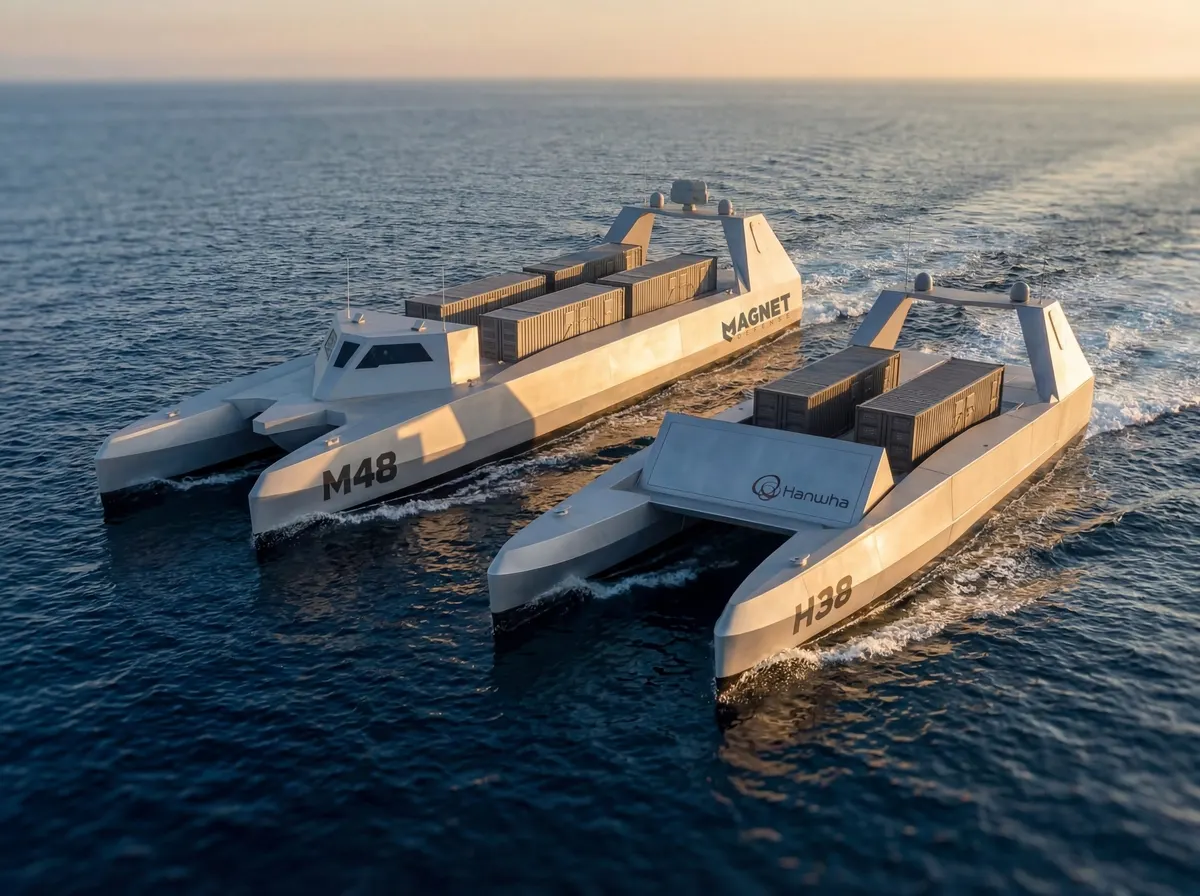
Hanwha Aerospace has displayed a 40-foot containerized version of its second-generation Korean Vertical Launching System, the KVLS-II, packaged as a strike payload for the 38-meter medium unmanned surface vessel (MUSV) it is developing with Miami-based Magnet Defense, displayed as the H38 and also referred to as the M38. Hanwha Defense USA showed a scale model of the two-cell container at the Association of the United States Army (AUSA) Annual Meeting and Exposition in Washington, D.C., held October 12 to 14, 2026.
The display is Hanwha’s first public showing of the KVLS-II in a containerized format, a configuration Hanwha labeled CVLS-II on its stand. It comes as the US Navy and allied fleets look to spread missile magazines across smaller, cheaper and uncrewed hulls instead of concentrating them in a few large surface combatants.
Hanwha Containerized VLS Family: Four Launchers, Two Box Sizes
Hanwha brought four containerized systems to the show, split between 20-foot and 40-foot ISO containers. The M38 can embark up to four 20-foot packages, two 40-foot packages, or a mixed load of two 20-foot units and one 40-foot unit, according to the company.
The heaviest option is the 40-foot KVLS-II container. Hanwha positions it for the Long-range Surface-to-Air Missile (L-SAM), whose naval variant is meant to replace the SM-2 in Republic of Korea Navy service, and for larger ballistic and cruise missiles. No strike missile has been named for it. Claims circulating online that it could launch medium-range ballistic missiles or hypersonic cruise missiles remain unconfirmed, and Hanwha Aerospace has said it has not confirmed reported figures of a 500-kilometer range and up to 32 ballistic missiles for the vessel.
Panels at the stand also depicted the containerized vertical launcher on a heavy truck. In Hanwha’s sequence, the vehicle deploys its stabilizers, raises the launcher module from horizontal to vertical, and fires missiles that turn toward their assigned targets after launch, for 360-degree engagement coverage. The CVLS-II model itself shows the cell module stowed horizontally inside the container on an erector, so Hanwha is pitching the family for land-based mobile launchers as well as unmanned vessels.
A second 40-foot container carries four first-generation KVLS cells able to fire the K745A1 Red Shark rocket-launched anti-submarine torpedo, the SSM-700K Haeseong family of surface-to-surface missiles and the K-SAAM Haegung short-range interceptor. A compact 20-foot box holds four shortened KVLS cells intended mainly for K-SAAM.
The fourth option ports the K239 Chunmoo multiple rocket launcher into a 20-foot container, using the same pods and launch mechanism as the truck-mounted system. It carries two pods, each loaded with six CGR-080 guided rockets, four CTM-MR ballistic missiles with a 160-kilometer range, four CTM-160 anti-ship ballistic missiles, one CTM-290 ballistic missile with a 290-kilometer range, or one CTM-X.
The cell count is telling. Lockheed Martin’s Mk 70 Payload Delivery System fits four strike-length Mk 41 cells into the same 40-foot footprint; Hanwha fits two KVLS-II cells, reflecting the larger missiles and exhaust loads the launcher was built to handle.
KVLS-II Heritage: From KDX-III Batch-II Destroyers to a 40-Foot Box
The KVLS-II is not a paper launcher. South Korea’s Defense Acquisition Program Administration (DAPA) marked completion of its development on September 25, 2025, at Hanwha Aerospace’s Changwon 2 plant, closing a five-year program worth about 71 billion won that began in late 2020.
Like its predecessor, the KVLS-II is a hot-launch system, but it is engineered to handle the hotter exhaust of more powerful missiles, and any of its cells can take surface-to-air, anti-ship or land-attack weapons. Publicly available specifications indicate a four-cell module measuring 3.0 by 2.4 by 9.8 meters, against 7.7 meters of height for the eight-cell first-generation module. That depth also exceeds the 7.93-meter four-cell module of the US Mk 57 Peripheral VLS fitted to the Zumwalt-class destroyers.
The launcher’s first platform is the KDX-III Batch-II Aegis destroyer Jeongjo the Great, delivered to the Republic of Korea Navy at the end of 2024, whose 88-cell configuration pairs 48 Mk 41 cells and 16 KVLS cells with 24 KVLS-II cells in six four-cell modules. The future KDDX destroyer, whose lead ship Hanwha Ocean is due to deliver by the end of 2032, will also carry KVLS-II cells alongside first-generation KVLS cells. Open-source reporting has long tied the KVLS-II to a planned ship-launched ballistic missile for the Republic of Korea Navy, consistent with its cell size and exhaust capacity.
How Hanwha and Magnet Defense Are Building the M38 and M48 MUSV
The intended carrier comes from a partnership Hanwha Defense USA (HDUSA) and Magnet Defense formalized through a memorandum of understanding at the Sea-Air-Space exposition in April 2026. It covers a 38-meter MUSV, AI-driven robotic shipyards and autonomy software. According to Hanwha’s Kevin Schoonover, Hanwha handles most of the construction and the integration of autonomous weapons, while Magnet Defense owns navigation autonomy and vessel operation.
The 38-meter M38 serves as the program’s test vehicle. Production is set to move to the 48-meter M48 standard, and steel has already been cut for the first M48 while M38 testing continues.
On the stand, Hanwha presented the vessel as the H38, a twin-hull catamaran derived from the M48 baseline but 10 meters shorter and without crew accommodation. Hanwha figures reported at the show give it a 75-metric-ton payload allowance, a top speed of 28 knots and a cruising range of 5,800 nautical miles at 15 knots. The H38 model showed one launcher module erected to the vertical from its container.
Magnet Defense claims a range of 17,000 nautical miles for its design. Its demonstrator completed a 32,000-nautical-mile round trip from Miami to American Samoa in 2024, transiting the Panama Canal and operating in conditions up to Sea State 9. Company and partner materials have attributed that voyage to both the M38 and M48 designations, and the exact hull configuration that made the crossing has not been clarified.
Analysis: The containerized KVLS-II is a statement about where large missiles can live. The US Navy has spent years seeking magazine depth from uncrewed and modular platforms, and the US Army already fields the Typhon Mid-Range Capability from Mk 41-derived launchers on trailers. A Korean option with a larger cell, a domestic missile catalog and a production line in Changwon would give allied navies a second industrial source for containerized fires alongside Lockheed Martin’s Mk 41 family. Yet hot-launch exhaust management on a small hull, reloading at sea and the targeting chain an uncrewed shooter needs for over-the-horizon engagements all remain undemonstrated, and any ballistic payload exceeding the Missile Technology Control Regime threshold of 300 kilometers and 500 kilograms would face export hurdles.
The KVLS-II container remains a scale model, with no published weight, power requirements or test schedule. The next markers are H38 payload testing, which Hanwha plans for January 2027, a live firing from any containerized Hanwha launcher aboard the vessel, completion of the first M48 hull, and whether the US Navy or the Republic of Korea Navy funds an armed MUSV configuration. Magnet Defense has scheduled delivery of the first production M48 for the second quarter of 2027.