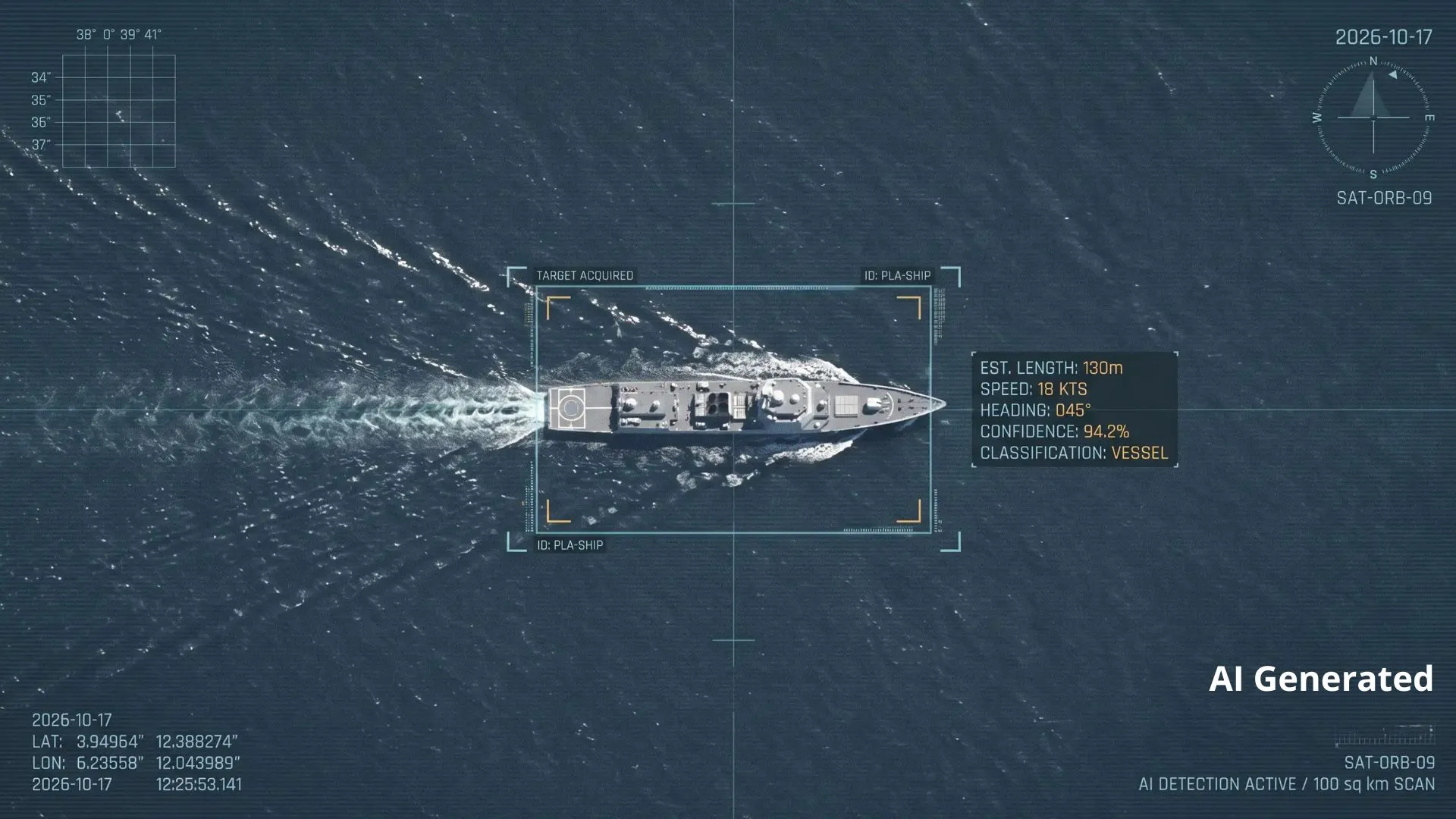
Taiwan’s Ministry of National Defense has contracted a geospatial firm to deliver an artificial intelligence (AI) system that automatically detects People’s Liberation Army (PLA) ships, aircraft, missile launchers and radar vehicles in satellite imagery. The Communication Development Office (CDO), the ministry’s principal signals intelligence unit, awarded the NT$46.555 million (approximately US$1.45 million) contract to ThinkTron Ltd. The contract took effect on September 25, 2026, and the system is scheduled for completion by the end of April 2027.
The award, published on Taiwan’s government e-procurement platform in mid-October, moves the project from prototype planning to contract. Defense Minister Wellington Koo Li-hsiung confirmed in February 2026 that the armed forces would develop a prototype of the system this year. The effort traces back to the ministry’s Defense Innovation Office, created in February 2024 to field mature civilian technology faster, which listed automated target recognition in satellite imagery among its first three prototype projects.
How the AI Satellite Imagery System Will Process PLA Targets
According to procurement details released in Taiwan, the software searches a satellite image tile measuring 10 by 10 kilometers, or 100 square kilometers, and flags military targets of a size specified by the armed forces within minutes. It can process several tiles per run. The detection requirement covers vessels longer than 10 meters as well as smaller objects, including aircraft, transporter erector launchers (TELs) and radar vehicles. The model is trained on existing overhead imagery of military aircraft, ships and ground vehicles.
The CDO ran the procurement as a restricted tender, with Linkou District in New Taipei, the location of a CDO facility, listed as the place of performance. Reporting on the award notice has also cited a figure of approximately NT$49.96 million; the ministry has not publicly reconciled the two amounts.
ThinkTron is a joint venture between Japan’s Kokusai Kogyo, the geospatial consultancy of Japan Asia Group, and Taiwan’s Sinotech Engineering Consultants. Its core business is geographic information systems (GIS), disaster prevention and infrastructure monitoring. The company’s Tron Eye image recognition product, built on convolutional neural network (CNN) algorithms, has been used for landslide mapping, land-use classification and road-facility inspection. ThinkTron also distributes imagery from the Taiwan Space Agency’s FORMOSAT satellites.
Key parameters remain undisclosed: the imagery sources the system will ingest, the ground sample distance it requires, detection accuracy and false-alarm thresholds, and where the models will run. The CDO separately tendered a NT$7.335 million “AI platform construction” project in June 2026; no public record links the two contracts.
Why the Communication Development Office Is Fusing IMINT With SIGINT
The CDO is among the most opaque organizations in Taiwan’s defense establishment. It is credited with supplying more than 80% of the early-warning intelligence the armed forces receive on PLA activity, and it leads Taiwan’s signals intelligence (SIGINT) collection and analysis. When PLA aircraft and warships operate near Taiwan’s airspace and waters, or when the PLA conducts missile drills east of the island, frontline radars track the platforms, while the CDO’s intercepts underpin assessments of PLA intent.
Lieutenant General Chao Chien-kuo took command of the office in January 2026, inheriting its intelligence-sharing arrangements with the United States. In 2018, then-President Tsai Ing-wen visited the CDO with the service chiefs and directed the National Chung-Shan Institute of Science and Technology (NCSIST) to support upgrades to its hardware and software.
The new system adds an imagery intelligence (IMINT) layer to that SIGINT core. Detections from satellite imagery will be cross-checked against the CDO’s existing database of intercepted signals, and the fused product will feed the National Security Bureau (NSB) and the Military Intelligence Bureau (MIB). In wartime, the ministry expects the combination to give senior commanders a more complete picture of PLA force movements.
Analysis: The contract matters less for its price than for its position in the intelligence chain. In imagery intelligence, collection has outpaced exploitation; the binding constraint is analyst time spent scanning tiles, not the volume of images available. Automating first-pass detection over 100-square-kilometer blocks frees CDO analysts for judgment work, while pairing optical detections with emitter data lets each discipline cue and validate the other. That cross-cueing is most valuable when the PLA surges forces with little warning. Software alone, however, does not solve revisit rates or imagery access, and those will determine how much warning time the system actually buys.
Delivery and acceptance are due by the end of April 2027. Open questions include the imagery pipeline, performance against camouflage, decoys and cloud cover, and whether the tool will extend beyond the CDO to service-level intelligence units. Oversight is also unsettled: Taiwan’s AI Basic Act, in force since January 14, 2026, requires government agencies to assess AI risks, but the Ministry of Digital Affairs’ AI risk classification framework, issued in July 2026, excludes military uses and leaves them to defense regulations.