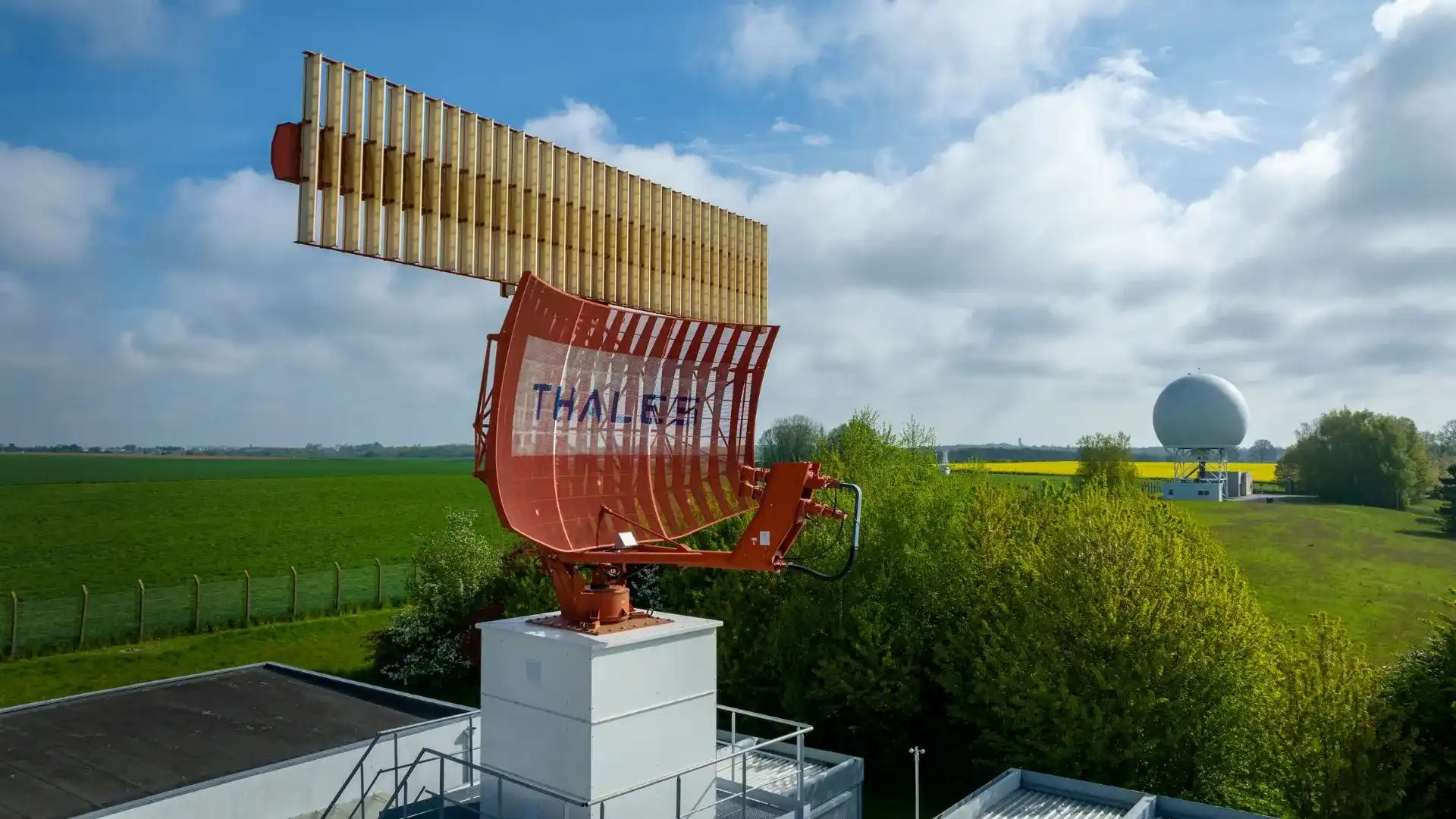
Romania’s Ministry of National Defence (MoND) signed a contract on October 27, 2026, for four mobile precision approach and landing radar systems for the Romanian Air Force, awarding the work to a consortium of Thales Romania SRL and Thales LAS France SAS. The deal is valued at approximately 326.5 million Romanian lei (RON), excluding VAT, roughly €61 million or $69 million at current rates, with phased deliveries starting in 2028.
The award, placed through the General Directorate for Armaments, lands amid a broader Air Force recapitalization. Romania is fielding F-16AM/BM fighters drawn from 17 former Portuguese and 32 former Norwegian airframes, and approved the purchase of 32 F-35A fighters in November 2024, with the jets expected in the 2030s. In July 2026, Bucharest also signed for 12 Thales Ground Master 200 MM/A air surveillance radars, an order worth about €247 million funded under the European Union’s Security Action for Europe (SAFE) instrument. This contract is separate, and the ministry has not said whether SAFE funds are involved.
Thales Mobile Approach Radar Package: STAR NG, RSM NG and PAR
The ministry did not name the equipment, but Thales describes four deployable Ground Controlled Approach (GCA) systems combining primary surveillance, secondary surveillance and precision approach functions. Delivery to four Air Force locations will be complete by 2030, according to the company; the sites have not been identified.
The primary sensor is the STAR NG, an S-band approach control radar that Thales says provides coverage of up to 60 nautical miles (about 111 kilometers). Publicly available specifications indicate operation in the 2,700 to 2,900 MHz band, range resolution under 50 meters, and instrumented range options of 60, 80 or 100 nautical miles. The radar was designed for dual civil and military use, with anti-jamming functions, altimetry, and the ability to track slow, fast and small targets, including helicopters, fighters and unmanned aircraft. That matters for a service that must now separate its own traffic from low, slow intruders.
Each STAR NG is paired with an RSM NG secondary radar carrying identification friend or foe (IFF) functions. The sensor fuses NATO Mode 5 military IFF, Mode S civil secondary surveillance to EUROCONTROL standards, and Automatic Dependent Surveillance-Broadcast (ADS-B). One interrogator therefore handles cooperative military and civil traffic in a single picture, a prerequisite at airfields shared with civil aviation.
The final element is a Precision Approach Radar (PAR), with four units in the package. A PAR gives controllers azimuth and elevation data on an aircraft relative to the runway centerline and glide path, allowing a controller to talk a pilot down to minimums without a functioning instrument landing system (ILS). Thales has not named the PAR model selected for Romania. Thales says the systems are cyber-secured by design and meet current EUROCONTROL and International Civil Aviation Organization (ICAO) recommendations.
How Mobile GCA Radars Support Dispersed Romanian Air Force Operations
The ministry framed the requirement around resilience. The systems can serve military and civil aircraft day and night, including in difficult weather and hostile electromagnetic environments, and will feed data to national and NATO air command and control systems. Their mobility allows the Air Force to run approach control from alternative locations, reducing dependence on fixed air base infrastructure. Because the sets handle civil and military traffic alike, they could also cover shared or civil airfields if fixed approach services are lost. The sensor pairing has an allied precedent: France selected the same STAR NG and RSM NG combination in 2023 to renew approach radars at its air and naval bases.
That responds directly to the threat picture on NATO’s eastern flank. A fixed approach radar and its ILS are high-value, easily located targets, and losing them at a main operating base can halt the recovery of aircraft in instrument conditions. Satellite-based approaches offer no reliable fallback: European aviation safety authorities have flagged persistent global navigation satellite system (GNSS) interference around the Black Sea since 2022, and Romania has recorded repeated Russian drone incursions into its airspace since 2022. A ground-based, jam-resistant GCA set that can be moved to a secondary airfield restores an approach capability that depends neither on satellites nor on the main base surviving.
On the industrial side, Thales Romania will work with local partners on installation, integration and long-term availability, and the ministry cites know-how and technology transfer. Thales says its Bucharest Engineering Competence Centre, opened in 2019, employs nearly 1,000 engineers, keeping sustainment in country.
Analysis: Approach control rarely features in force-structure debates, yet it is an early chokepoint for any air force that intends to disperse. Romania’s F-16 squadrons and the F-35A fleet due in the 2030s are only as survivable as the airfields able to recover them in bad weather and under jamming. Pairing four relocatable GCA sets with the 12 Ground Master 200 MM/A surveillance radars ordered in July gives the Air Force a layered, largely single-vendor sensor architecture, which simplifies integration and training but concentrates supplier risk. At roughly €15 million per site package before VAT, the buy is modest; the ministry has not disclosed how much of that covers spares, training and sustainment.
Site locations, the PAR model, the funding source and delivery sequencing remain undisclosed. Deliveries run from 2028 to 2030. Whether the Air Force pairs the systems with a dispersal doctrine and regularly exercised alternate airfields will determine how much resilience the contract actually buys.