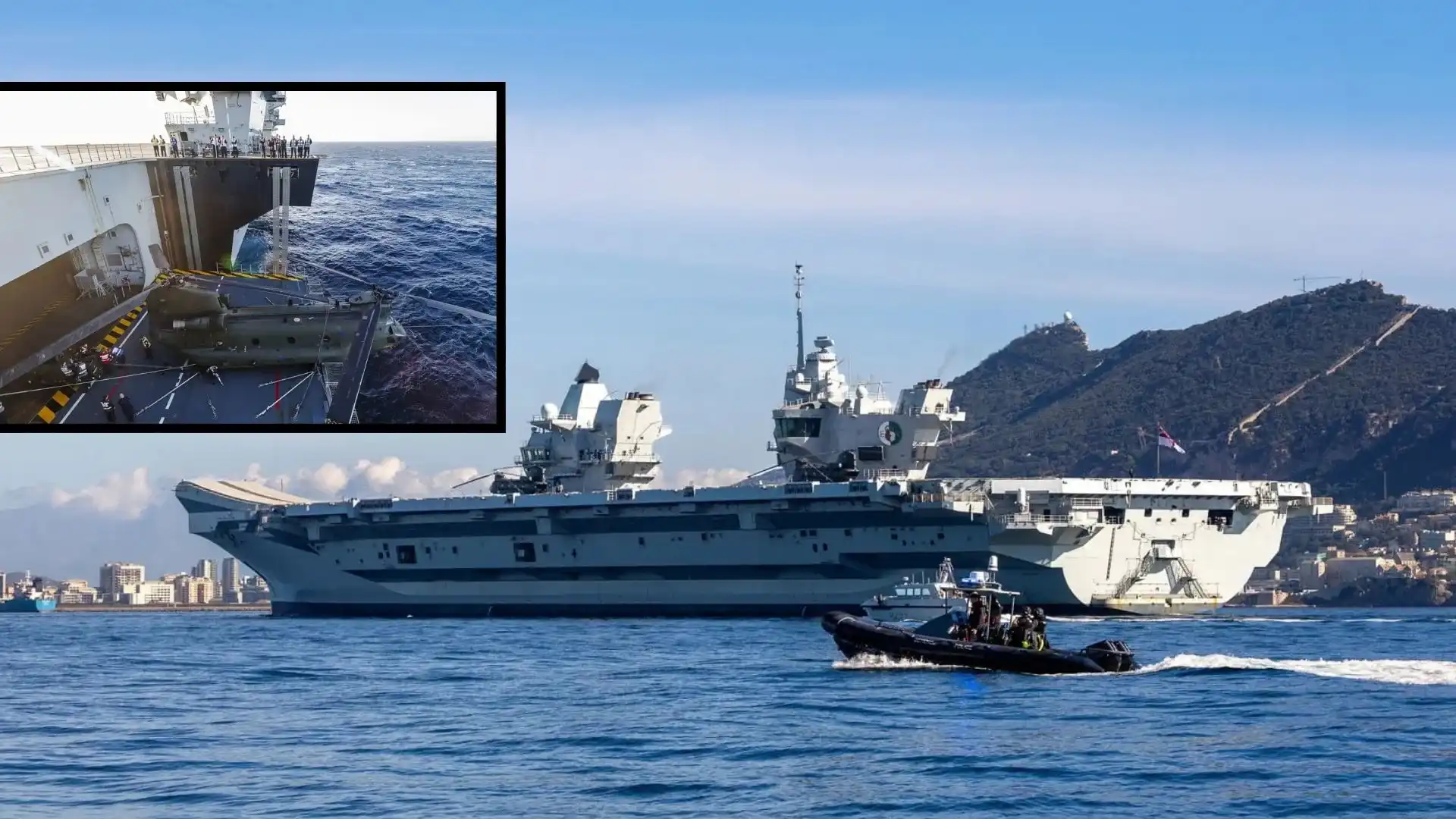
Royal Air Force CH-47 Chinook heavy-lift helicopters from 27 Squadron have completed a two-week embarkation workout aboard the aircraft carrier HMS Queen Elizabeth during Exercise Hathi Pol, the Royal Navy announced on October 28, 2026. The Chinooks were still on deck as the 65,000-tonne carrier arrived in Gibraltar for a week-long visit.
Hathi Pol, Hindi for ‘elephant gate’, is a long-running Royal Navy and RAF exercise designed to keep the RAF’s land-based heavy-lift fleet certified for operations at sea. The previous serial ran from February 24 to March 5, 2025, aboard sister ship HMS Prince of Wales. This iteration matters for HMS Queen Elizabeth, which is rebuilding her aviation handling skills after a dry-docking period at Rosyth that ran from August 2025 to March 2026 and covered her propulsion and stabilisation systems, followed by further maintenance in Portsmouth.
HMS Queen Elizabeth Chinook Embarkation: Lift, Hangar, and Deck Handling
The central technical task of Hathi Pol is moving a Chinook from the flight deck into the hangar, a precondition for any embarkation of meaningful length. Aircraft parked on deck are exposed to salt spray and heavy weather, and sustained operations require engineers to work on rotor heads, transmissions and engines under cover.
The Royal Navy described the transfer as a delicate evolution demanding careful planning. At 99 feet long with its tandem rotors spread, Chinook ZH777 only just fit on the carrier’s aircraft lift, its nose protruding over the edge of the platform. The lift took 60 seconds to lower the 12-tonne helicopter from the flight deck to the hangar deck, where handlers manoeuvred it inside for maintenance.
Publicly available specifications indicate the Queen Elizabeth-class carriers have two starboard-side aircraft lifts, each sized to raise two F-35B Lightning II jets at once and rated at roughly 70 tonnes. Weight is therefore not the constraint for the Chinook; footprint is. The 99-foot figure reflects the aircraft’s overall length with both 60-foot rotors spread, a geometry the lifts were not primarily designed around. That narrow margin is why the move remains a qualification event rather than routine deck work.
Hathi Pol exercises the full chain of personnel involved: RAF air crews, ground crews and engineers alongside the carrier’s aircraft handlers, Flying Control (Flyco), bridge team and operations room. The Royal Navy has not disclosed how many Chinooks embarked; two airframes, ZH777 and ZH896, appear in official imagery.
Why Carrier-Qualified Chinooks Matter for NEO and HADR Missions
For 27 Squadron, the objective is embarkation qualification: ensuring aircrew hold the certifications required to fly from a ship and are accustomed to the unfamiliar conditions of the seagoing environment. For HMS Queen Elizabeth, the exercise delivered a busy flight deck populated by aircraft her crew does not regularly operate, a demanding test after months of reduced flying.
The payoff is operational. According to the Royal Navy, qualified Chinooks can operate safely from either carrier for missions where heavy lift is required, specifically Humanitarian Assistance and Disaster Relief (HADR) and Non-Combatant Evacuation Operations (NEO). Each RAF Chinook can carry up to 55 troops or approximately 10 tonnes of mixed cargo, with a crew of two pilots and two crewmen. The current fleet comprises HC5, HC6 and HC6A variants built to a common digital glass cockpit standard. Publicly available specifications indicate RAF Chinooks are powered by two Honeywell T55 turboshafts in the 4,700 to 4,800 shaft horsepower class.
UK Ministry of Defence data from April 2023 counted 59 Chinooks in the fleet, 39 of them in service. That inventory will be reshaped by the purchase of 14 Boeing H-47 Extended Range (ER) Chinooks, announced on March 14, 2024, at a cost the Defence Secretary then put at about 2 billion pounds. The H-47(ER) matches the current payload of 55 troops or 10 tonnes but, according to the MoD, offers roughly double the approximately 740-kilometre range of today’s aircraft. Under the 2021 Defence Command Paper, the 14 oldest Chinooks are to be retired as the new airframes arrive. Deliveries were scheduled to begin in 2027; the Royal Navy did not say whether the extended-range variant will feature in future Hathi Pol serials.
Analysis: Since the Royal Navy retired the helicopter carrier HMS Ocean in 2018, the two Queen Elizabeth-class carriers have had to absorb the heavy-lift and amphibious aviation role alongside their F-35B strike mission. Hathi Pol is the mechanism that keeps that dual role credible. Qualifications lapse, deck crews rotate, and HMS Queen Elizabeth returned from Rosyth with a ship’s company in which more than a quarter of personnel were going to sea for the first time, according to the Royal Navy. Regenerating the ability to strike down a 12-tonne helicopter in 60 seconds determines whether the UK can surge a carrier into a NEO or disaster-relief tasking with heavy lift embarked rather than depending on land bases that may not be available.
Hathi Pol concluded as HMS Queen Elizabeth entered Gibraltar, joined for her arrival by Chief Minister Fabian Picardo, Deputy Governor Marc Holland and Commander British Forces Commodore Tim Davey. The carrier hosted 150 local guests for a capability demonstration and opened her gangway to 1,000 Gibraltarians on Sunday. The Royal Navy has not published the carrier’s programme after Gibraltar. The next markers are the following Hathi Pol serial and whether the RAF qualifies the H-47(ER) at sea once it enters service.