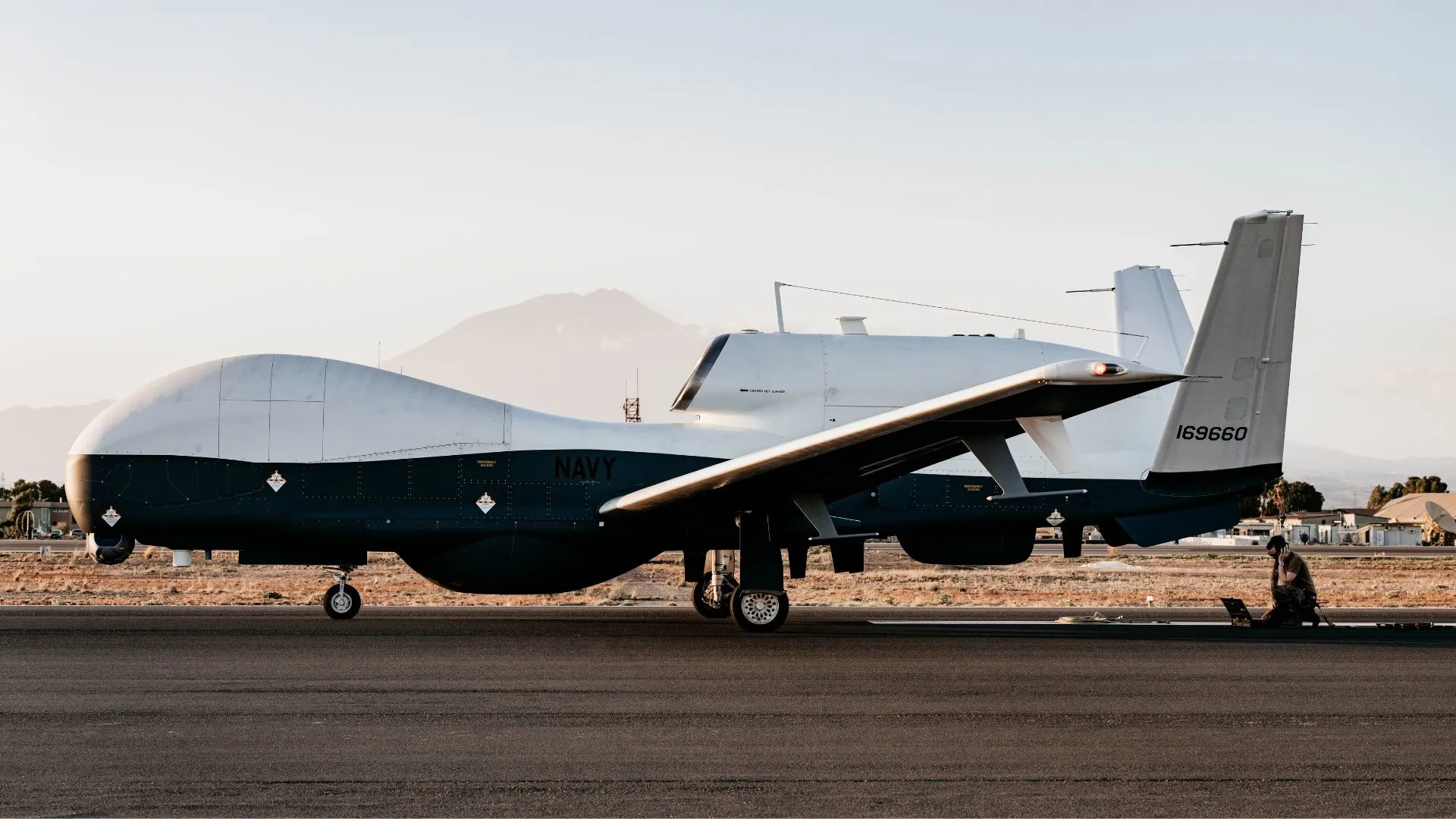
Naval Air Systems Command (NAVAIR) has awarded Northrop Grumman Systems Corp. a $55,986,538 firm-fixed-price contract modification to install the B7 Retrofit Material Kit on a single MQ-4C Triton air vehicle, according to Pentagon contract announcements published October 29, 2026. The modification, P00003, was awarded October 28 against delivery order N0001926F1093 under basic ordering agreement N0001925G0003. The full amount comes from fiscal 2027 Navy aircraft procurement funds and was obligated at award. Work will be performed in Palmdale, California (64%), San Diego, California (34%), and other continental U.S. locations (2%), with completion expected in May 2030. The award was not competitively procured.
The designation points to a specific airframe. B7 precedes B8, which Northrop Grumman delivered to the Navy in February 2022 as the first production Triton in the Integrated Functional Capability 4 (IFC-4) multi-intelligence (multi-INT) configuration. The announcement does not name the target configuration for B7 or itemize the kit’s contents. The award follows a $66.04 million firm-fixed-price order in early October 2026 covering 33 engineering change proposals, 17 for U.S. Navy and 16 for Royal Australian Air Force Tritons.
MQ-4C Triton Retrofit and the Shift to Multi-INT Missions
IFC-3 was the baseline configuration in which the first Tritons deployed to the U.S. 7th Fleet. IFC-4 adds low-band and high-band signals intelligence (SIGINT) receivers and is tied to the Navy’s Maritime Intelligence, Surveillance, Reconnaissance and Targeting (MISR&T) transition plan, under which Triton is to take on the airborne SIGINT role of the manned EP-3E Aries II.
Publicly available specifications indicate the Triton, derived from the RQ-4 Global Hawk, is powered by a single Rolls-Royce AE 3007H turbofan, spans 130.9 feet (39.9 meters), and has a maximum takeoff weight of about 32,250 pounds. NAVAIR lists a range of approximately 7,400 nautical miles and endurance beyond 24 hours at altitudes above 50,000 feet. The sensor suite centers on the AN/ZPY-3 Multi-Function Active Sensor, a 360-degree X-band active electronically scanned array radar, alongside an electro-optical/infrared turret, an Automatic Identification System receiver, and electronic support measures.
Adding SIGINT to that endurance profile is the operational point. NAVAIR places Triton in the Navy’s Maritime Patrol and Reconnaissance Force family of systems alongside the P-8A Poseidon, and a multi-INT orbit would combine radar and emitter collection without a manned SIGINT aircraft on station. Keeping any airframe in a separate configuration would also force distinct software baselines, maintenance procedures, and mission planning in a fleet with little spare capacity.
Triton Fleet Standardization, Retrofit Costs, and Testing Delays
The B7 award continues a retrofit campaign that has run in parallel with production. In August 2023, the Navy issued an $83.1 million cost-plus-fixed-fee order to bring two Tritons and one main operating base to IFC-4 for the U.S. Navy and Australia, with work scheduled to finish in June 2026. The Navy had procured 20 of 27 planned aircraft as of September 2025, according to the Defense Department Inspector General, and its fiscal 2027 budget request seeks no additional MQ-4Cs. Australian audit documents describe the Navy’s IFC-4 delivery as split into two increments, with Increment 2 adding upgraded capabilities and a sense-and-avoid function. The fleet also lost an aircraft in a Class A mishap in April 2026, an incident the Navy has not detailed publicly.
Oversight pressure persists. A September 2025 Defense Department Inspector General report found the Navy declared Initial Operational Capability in August 2023 before the Triton underwent initial operational test and evaluation (IOT&E), and warned that further retrofit spending would be needed to correct open deficiencies. The Navy told the Inspector General it expected validation of critical technology testing by November 2025. The Pentagon’s Director, Operational Test and Evaluation (DOT&E) stated in its fiscal 2025 annual report that IOT&E had not started because SIGINT deficiencies prevented operationally realistic testing, and that Triton’s effectiveness in its primary SIGINT missions remained unknown.
Analysis: Spending nearly $56 million on one airframe shows how scarce Tritons have become. The price is also well above the 2023 order, which brought two Tritons and a main operating base to IFC-4 for $83.1 million, less than $42 million per aircraft with ground infrastructure included, and the announcement does not explain the gap. With the program now centered on 27 aircraft rather than the 68 originally planned, and one lost in April 2026, each air vehicle represents a meaningful share of the force available to sustain maritime orbits, particularly as Triton takes on the EP-3E SIGINT role. The firm-fixed-price structure places cost risk on Northrop Grumman, a shift from the 2023 cost-plus order, while the sole-source award reflects the fact that the original manufacturer remains the only practical integrator for Triton hardware and software. The open test findings mean the value of any multi-INT upgrade still depends on the Navy proving the SIGINT payload in operational testing.
Milestones to watch include B7’s induction at Palmdale, the start of IOT&E, the Increment 2 schedule, delivery of the remaining production aircraft, and execution of the engineering change effort shared with Australia. The Navy has not disclosed when B7 will return to the fleet or how the installation will affect squadron availability.