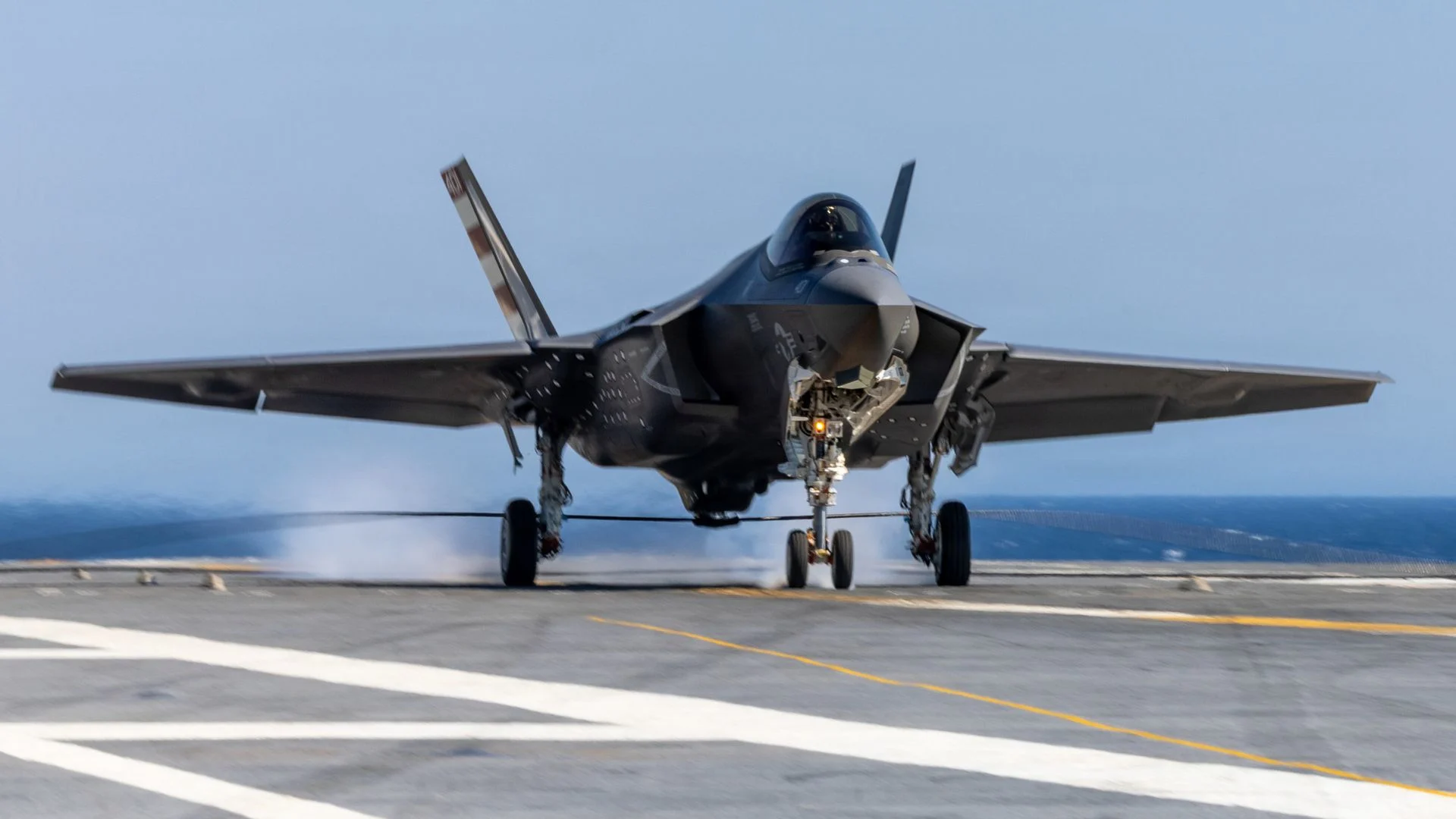
RTX’s Pratt & Whitney Military Engines has received a $32,181,162 cost-plus-incentive-fee contract modification to provide recurring F135 sustainment, including repair of repairables, for the engines powering the F-35A conventional takeoff and landing (CTOL) and F-35C carrier variant (CV) fleets, the Department of War announced October 29, 2026. The modification, P00009 to contract N0001926C0112, exercises an option on an existing award and runs through November 2027. Naval Air Systems Command (NAVAIR) at Patuxent River, Maryland, is the contracting activity, and the work was not competitively procured.
The award comes as the F-35 enterprise struggles to convert spending into availability. The Pentagon is targeting an 80% mission-capable rate for the F-35 fleet by 2030, and its fiscal 2027 budget request calls for more government depot capacity to repair the components that most affect aircraft availability. A June 2026 Government Accountability Office (GAO) report found persistent sustainment funding gaps and doubts that industry could meet parts demand even with more money. Repair of repairables, which returns failed modules to the spares pool instead of buying new hardware, sits at the center of that problem.
F135 Sustainment Option Spreads Work Across 12 Sites
East Hartford, Connecticut, takes 40% of the work. Oklahoma City follows at 21%, reflecting the F135 heavy maintenance center at Tinker Air Force Base, the program’s primary organic engine depot. Indianapolis, Indiana, accounts for 12%; West Palm Beach, Florida, and Windsor Locks, Connecticut, 6% each; and Fort Worth, Texas, 1%.
The remaining 14% is performed at partner locations: Brekstad, Norway, home of Ørland Air Station (4%); Leeuwarden, Netherlands (3%); Iwakuni, Japan (3%); Williamtown, Australia (2%); Cameri, Italy, site of the F-35 Final Assembly and Check Out facility (1%); and Marham, United Kingdom (1%).
The funding lines show who carries the bill. All $32,181,162 is obligated at award:
- Fiscal 2027 Air Force operations and maintenance: $16,453,791 (51.1%)
- Fiscal 2027 Navy operations and maintenance: $4,164,560 (12.9%)
- Fiscal 2027 Marine Corps operations and maintenance: $1,612,425 (5.0%)
- F-35 cooperative program partner funds: $5,738,624 (17.8%)
- Foreign Military Sales (FMS) customer funds: $4,211,762 (13.1%)
Marine Corps money supports its F-35C squadrons. Partners and FMS customers together fund 30.9% of the obligation.
The modification covers two engine models. The F135-PW-100 powers the F-35A, while the F135-PW-400 equips the F-35C and differs mainly in materials chosen for corrosion resistance at sea. Both are afterburning two-spool turbofans; publicly available specifications place the family in the 43,000 lbf thrust class with afterburner. The F-35B’s F135-PW-600, with its shaft-driven lift fan system, falls outside this action.
Depot Capacity, Readiness Targets, and the Engine Core Upgrade
Engine support has been the F-35’s most persistent sustainment weak point. A backlog of power module repairs at the Tinker depot earlier this decade left aircraft waiting on engines, and GAO warned that engine sustainment could be the program’s greatest risk over 10 years. The response combined faster depot turnaround, a second Department of Defense repair source at Fleet Readiness Center Southeast in Jacksonville, Florida, and regional depots in the Netherlands, Norway, and Australia.
Friction remains. The F-35 Selected Acquisition Report prepared for the fiscal 2027 budget describes material shifted from sustainment to production under the F135 performance-based logistics arrangement, delaying module repairs, and depot teams finding more damage than forecast during teardown. Recurring repair funding is the line that most directly attacks those turnaround times.
The same network will carry the next engine configuration. Pratt & Whitney announced on September 15, 2026, that it had completed the Risk Reduction Design Review for the F135 Engine Core Upgrade (ECU). The ECU is a drop-in core upgrade designed to deliver full engine life and add the power and thermal management capacity needed for Block 4 and later capabilities. It will be installed on new production engines or retrofitted at F135 depots, and GAO has projected ECU production beginning in 2031.
Analysis: At $32 million, this option is small next to the $1.6 billion undefinitized F135 sustainment action announced in December 2025, but its structure is telling. The cost-plus-incentive-fee format ties Pratt & Whitney’s fee to cost outcomes against a target, while nearly a third of the money comes from allies who depend on a single-source engine supply chain. With more than 1,500 production F135s delivered and the ECU still years from the fleet, readiness rests on repair throughput rather than new hardware. The 80% mission-capable goal will be won or lost at Oklahoma City, Jacksonville, and the partner sites named in this award.
Work runs to November 2027, into the first quarter of fiscal 2028. The milestones to watch are definitization of the broader F135 sustainment contract, the start of ECU ground testing, planned for late 2027, and whether Congress funds the added government depot capacity requested for fiscal 2027. The announcement did not disclose the base contract’s total value or the number of options remaining.