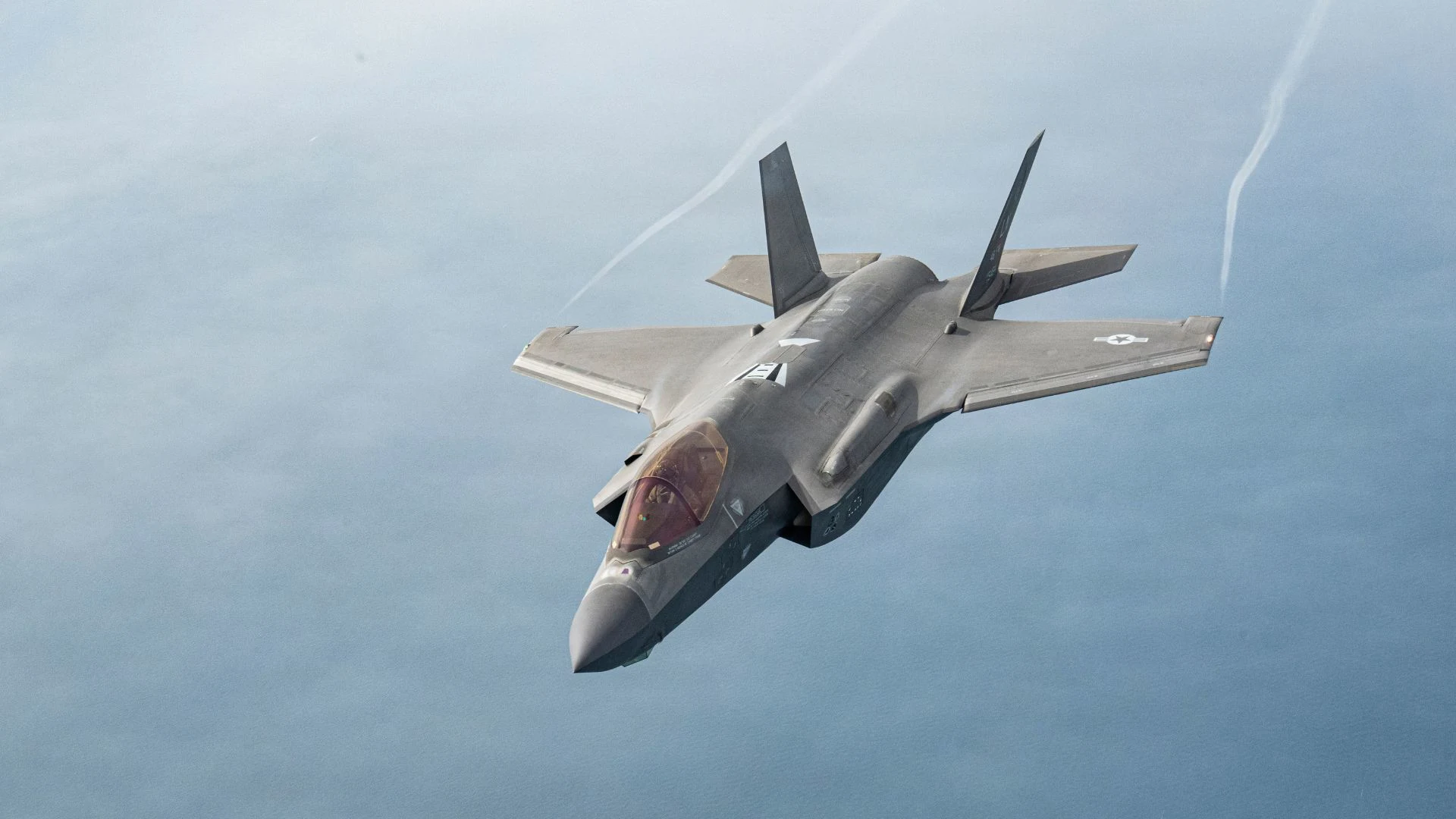
Lockheed Martin Aeronautics Co. of Fort Worth, Texas, received a $43,673,774 cost-plus-fixed-fee contract modification on October 28, 2026, to upgrade the operating systems of the F-35 Lightning II reprogramming laboratory facilities and systems it maintains for the US Air Force, Navy, Marine Corps, and the program’s international cooperative partners. Naval Air Systems Command (NAVAIR) at Patuxent River, Maryland, awarded the modification, P00025 under contract N0001922C0046, without competition.
The F-35 reprogramming labs sit at the center of the jet’s combat identification chain. They build the mission data files (MDFs) that give the aircraft’s sensors a reference library of hostile radars, surface-to-air missile systems, and aircraft for a given theater. Without current mission data, the jet’s sensor fusion cannot reliably classify what its electronic warfare and radar apertures detect. Because adversary emitters change constantly, the files must be rebuilt, verified, and reissued throughout the aircraft’s service life, and the laboratory hardware and software that generate them must keep pace with the jet itself.
F-35 Reprogramming Lab Upgrades and Mission Data File Production
The modification adds scope by establishing new contract line items dedicated to operating system upgrades. According to the Pentagon’s contract announcement, 80% of the work will take place at Eglin, Florida, and 20% at Fort Worth, Texas, with completion expected in April 2030.
Eglin Air Force Base hosts the core of the F-35 reprogramming enterprise. The US Reprogramming Laboratory produces mission data for American jets. Next to it, the Australia Canada United Kingdom Reprogramming Laboratory (ACURL) builds sovereign mission data for Australian, Canadian, and British F-35s, while the Norway Italy Reprogramming Laboratory serves those two partners. A third partner facility, the MDx Reprogramming Lab (XRL), supports all other F-35 customers.
The notice leaves several questions open. It does not identify which operating systems are being replaced, which individual laboratories receive upgrades, or how the work divides between them. It also does not tie the effort explicitly to Technology Refresh 3 (TR-3) or the Block 4 modernization program. The timing nonetheless aligns with the fleet’s computing transition. TR-3 introduces new integrated core processors, a panoramic cockpit display, and expanded memory, and it provides the hardware foundation for Block 4 sensor, weapons, and electronic warfare enhancements. Mission data built for that architecture requires laboratory test lines able to replicate it. The F-35 Joint Program Office and Fleet Readiness Center East began converting the first operational F-35Bs from TR-2 to TR-3 in early 2026.
Earlier laboratory investments followed the same model. A $106 million modification announced in March 2023 funded engineering, testing, maintenance, logistics, and material for Phase 2 upgrades of ACURL, along with verification and validation system hardware. That work carries the same 80/20 split between Eglin and Fort Worth and runs through December 2029.
Partner Funding Covers 68 Percent of the Eglin Upgrade
The funding breakdown is the most telling element of the award. All money was obligated at the time of award from three sources:
- Fiscal 2026 aircraft procurement (Air Force) funds: $6,988,754
- Fiscal 2026 aircraft procurement (Navy) funds, covering Navy and Marine Corps requirements: $6,988,754
- F-35 cooperative program partner funds: $29,696,266
Partner nations therefore carry roughly 68% of the cost, while the US services split the remaining 32% evenly. The cooperative partners include the United Kingdom, Italy, the Netherlands, Australia, Norway, Denmark, and Canada. The notice does not break down contributions by country. The ACURL model offers a reference point: Australia and the United Kingdom stood up that laboratory under a 50/50 financing arrangement, and Canada’s share since joining it has not been disclosed.
The services drew on aircraft procurement appropriations rather than operations and maintenance accounts, which suggests they classify the upgrade as investment in support equipment rather than routine sustainment. The sole-source award reflects Lockheed Martin’s position as prime contractor and holder of the design data underpinning the laboratories’ test lines.
Analysis: Mission data is where operational sovereignty over the F-35 actually resides. An F-35 with an outdated threat library flies with degraded combat identification, and its low-observable design delivers less survivability if the pilot cannot quickly classify the emitters searching for it. Partner funding of more than two-thirds of this upgrade shows allied air forces treat reprogramming capacity as a strategic asset rather than a program overhead. For European operators facing dense Russian integrated air defenses and for Australia in the Indo-Pacific, the speed at which a laboratory can turn new electronic intelligence into a validated file directly shapes force readiness. Laboratory infrastructure that lags the aircraft’s own computing upgrades would create a bottleneck no airframe modification can solve.
Work under the modification runs through April 2030. Key unknowns include the specific operating systems involved, how the work divides among the Eglin laboratories, and how the effort will synchronize with TR-3 operational testing and the phased fielding of Block 4 capabilities across US and partner fleets.