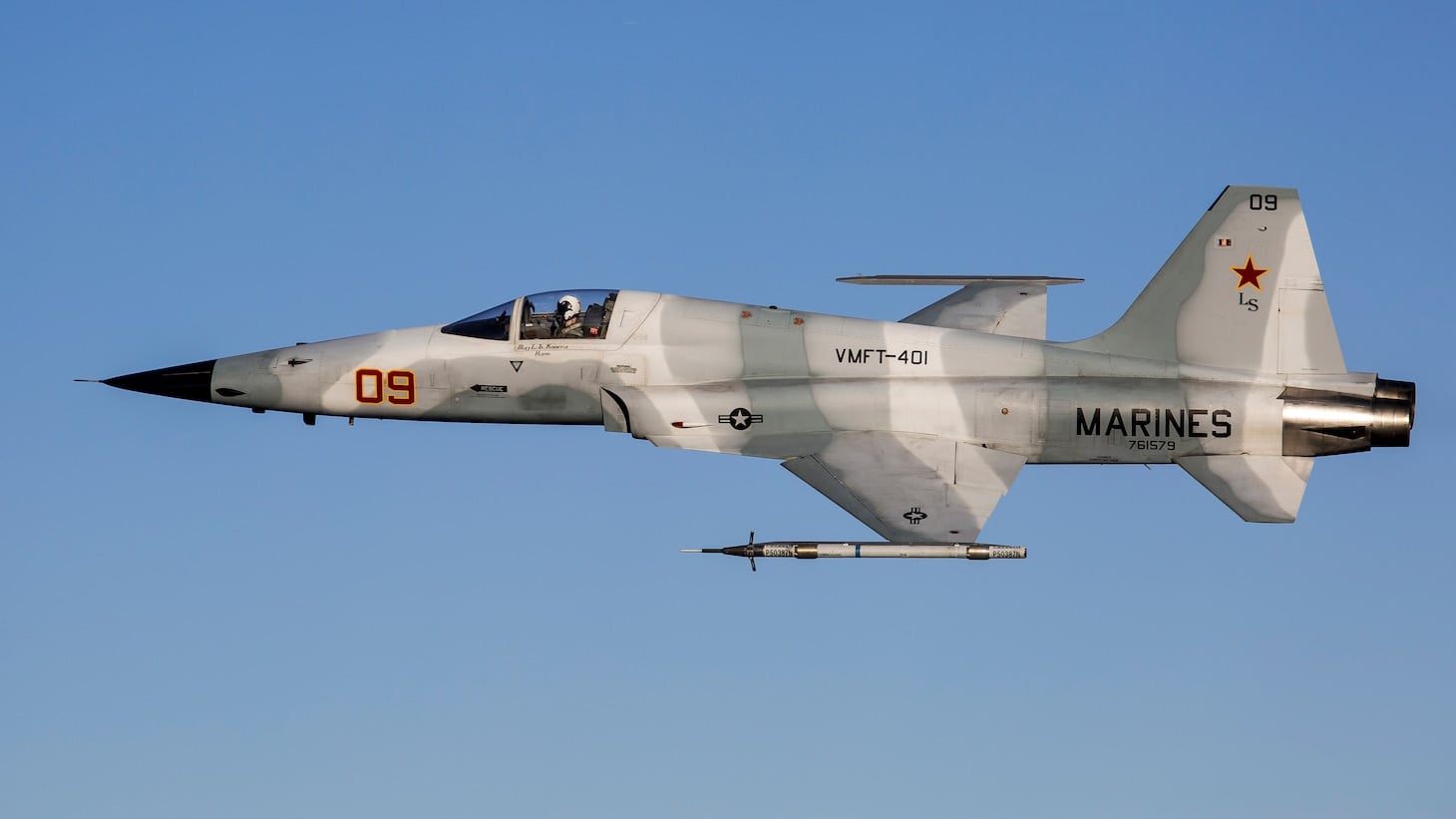
The Naval Air Systems Command (NAVAIR) is canvassing industry for a digital stability augmentation system and automatic flight control system (AFCS) to retrofit the F-5N/F Tiger II aggressor fleet, according to a sources sought notice published October 29, 2026. The Adversary and Specialized Aircraft Program Office (PMA-226) wants vendors to adapt the American Systems AS2100 Digital Stability Augmentation System (DSAS) flight computer to the F-5 and estimates a requirement for 20 units.
According to NAVAIR, the F-5 demands continuous pilot input to hold stable flight; left uncorrected, the aircraft tends to depart controlled flight and enter an inverted dive. The program office calls this a critical safety risk that raises workload and pulls pilots away from complex mission tasks. The F-5N/F remains a core red air platform for Navy and Marine Corps fighter training, flown by Fighter Squadron Composite 111 (VFC-111) at Naval Air Station Key West, Florida, and by Marine Fighter Training Squadrons 401 and 402 (VMFT-401 and VMFT-402) at Marine Corps Air Stations Yuma and Beaufort.
What NAVAIR Wants From a Digital Stability Augmentation Retrofit
The requirement is built around existing hardware. To hold down non-recurring engineering (NRE) cost, the solution must use the AS2100 part number and interface with the F-5’s existing mechanical flight control linkages and hydraulic actuators, with minimal modification to the airframe or baseline flight control hardware.
The adapted DSAS must process primary flight control inputs and command the actuators directly to improve aerodynamic stability. The AFCS adds automated flight profiles, with heading hold and altitude hold cited as examples, to reduce pilot task saturation in all phases of flight.
Failure behavior is the hard constraint. If DSAS or AFCS software or hardware fails, the system must immediately return primary unaugmented control to the pilot without violent aircraft transients. That defines an augmentation layer over the mechanical control path, not a fly-by-wire conversion.
For legacy F-5N/F aircraft, the vendor must also design a dedicated control and indication panel that fits current console space. The notice does not define “legacy”; one plausible reading is that jets already fitted with glass cockpits could host the interface differently, but NAVAIR has not said so. All hardware must respect the F-5’s space, weight, and electrical power generation limits, and the software must meet current DoD cybersecurity requirements for airborne systems, with respondents stating data rights and Modular Open Systems Approach (MOSA) compliance.
18-Month NRE Window and the American Systems AS2100 Pedigree
NAVAIR expects NRE to finish within 18 months of contract award. Airworthiness approval should take no more than six months from Government receipt of technical data and completion of a prototype or validation installation. The retrofit schedule remains to be determined.
Respondents must provide a rough order of magnitude (ROM) cost and notional schedule covering the solution’s pedigree, adaptation of commercial off-the-shelf equipment, qualification and test data, installation effort, lead time after receipt of order, and production throughput. The work falls under North American Industry Classification System code 334511, with a 1,350-employee size standard, and no set-aside has been determined.
The notice publishes no technical data for the AS2100, leaving its redundancy level, sensor architecture, and processing specifications unknown. American Systems, an employee-owned engineering firm founded in 1975 and headquartered in McLean, Virginia, has publicly described developing a dual-redundant autopilot for retrofit into existing military and commercial aircraft, and has worked with the Navy on augmenting legacy helicopter flight controls. A 2014 supplier announcement also said NASA had contracted American Systems to develop and supply the autopilot for the T-38 Talon fleet used for astronaut proficiency training, a relevant precedent given the T-38’s shared Northrop lineage with the F-5. Whether the AS2100 derives from that work is not confirmed.
How the F-5N/F Fits PMA-226’s Adversary Modernization Push
The Navy’s aggressors are largely ex-Swiss Air Force airframes. NAVAIR bought and refurbished 44 retired Swiss F-5s in a program launched in 2000, then acquired 22 more former Swiss F-5E/F aircraft in a follow-on purchase. Those 22 jets were slated for conversion under the Avionics Reconfiguration and Tactical Enhancement/Modernization for Inventory Standardization (ARTEMIS) program, which reached Milestone C on June 28, 2022, and adds a glass cockpit and digital avionics to create the F-5N+/F+ configuration.
Publicly available specifications indicate the Tiger II is powered by two General Electric J85-GE-21 afterburning turbojets rated at roughly 5,000 lbf each, with a top speed near Mach 1.6 and a maximum takeoff weight of about 24,700 lb. The F-5E first flew in 1972, and its small airframe, limited electrical generation, and mechanical control architecture explain why NAVAIR stresses size, weight, and power limits and favors reuse of an existing flight computer.
Analysis: By mandating the AS2100 part number, NAVAIR has largely fixed the hardware baseline, so any competition will turn on software adaptation, actuator integration, and airworthiness qualification rather than on the flight computer itself. That structure favors American Systems and firms prepared to team with it, and could steer the effort toward a limited-source award, although the notice does not say so.
More broadly, the Navy is paying to make a 1970s fighter safer rather than replace it, a measure of how dependent fleet training remains on the F-5. The Marine Corps’ 2022 aviation plan estimated an adversary requirement of nearly 15,000 sorties for that year, against up to 3,300 per year that VMFT-401 could generate. Removing the workload of holding the jet stable frees aggressor pilots to concentrate on replicating threat tactics.
Capability statements are due November 28, 2026, at 2:00 p.m. EDT, according to the notice text, although the listing header shows an October 28 response date that predates publication, a discrepancy respondents may want clarified. NAVAIR will use the responses to set its acquisition strategy, including any set-aside. Still unknown: which F-5N/F tails the 20 units will cover, the funding line, and when retrofits would begin.