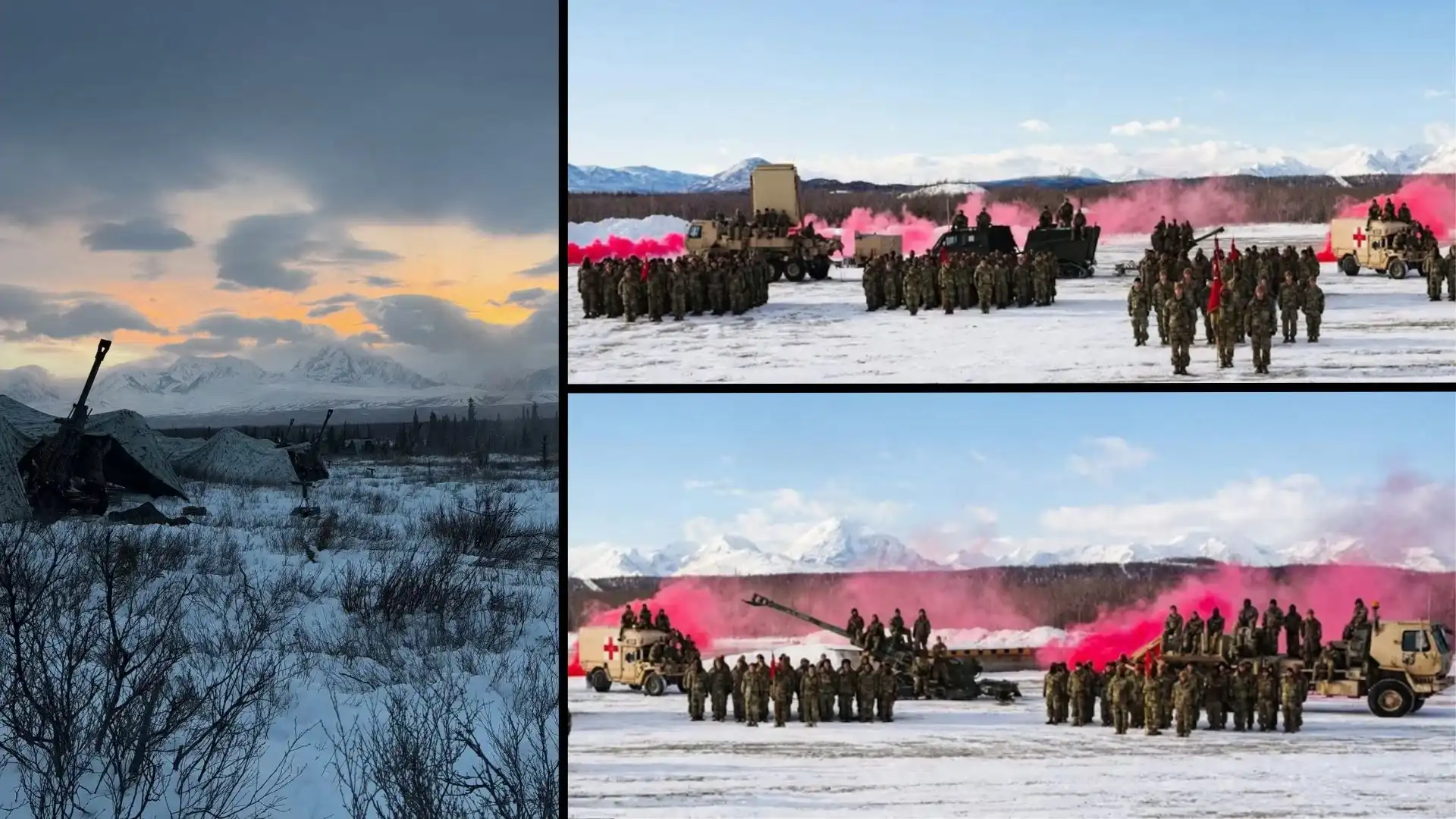
Paratroopers of the US Army’s 2nd Battalion, 377th Parachute Field Artillery Regiment (2-377 PFAR) completed the 11th Airborne Division’s first artillery battalion live-fire evaluation on October 29, 2026, at the Donnelly Training Area near Delta Junction, Alaska. More than 400 paratroopers fired over 600 rounds during the 16-day Artillery Table (AT) XVIII evaluation, which began October 13 and saw temperatures fall to zero degrees Fahrenheit.
The evaluation fills a gap in the division’s fires architecture. The 11th Airborne Division, reactivated on June 6, 2022, by reflagging two 25th Infantry Division brigades in Alaska, is the Army’s division focused on Arctic and extreme cold-weather operations. It still lacks a Division Artillery (DIVARTY) headquarters, the echelon that normally evaluates field artillery battalions. That headquarters is slated to stand up in 2027, and the October evaluation was built as the template until then.
How the 11th Airborne Division Certified Its First Artillery Battalion
Artillery Table XVIII is the battalion-level gate in the Army’s artillery qualification sequence. It validates a battalion’s ability to deliver direct, synchronized supporting fires to a mobile brigade combat team, in this case the 2nd Infantry Brigade Combat Team (Airborne), the division’s parachute brigade at Joint Base Elmendorf-Richardson (JBER).
The battalion moved more than 400 paratroopers and 100 tactical vehicles roughly 350 miles north from JBER to Donnelly. Before the battalion phase, each of its three firing batteries, Alpha (Falcon), Bravo (Eagle) and Charlie (Raven), had to pass Artillery Table XV battery live-fire evaluations, firing hundreds of live rounds to qualify. Because Table XVIII requires external evaluators, normally provided by a DIVARTY, the division’s Fire Support Element sourced them from I Corps at Joint Base Lewis-McChord, Washington, drawing on the 17th Field Artillery Brigade and artillerymen from the 7th Infantry Division.
“Executing the first-ever Table XVIII battalion live fire in the division is a monumental achievement for our paratroopers and the Division,” said Lt. Col. Ian P. Grundhauser, commander of 2-377 PFAR. “This exercise laid the groundwork and established the model for what battalion-level evaluations will look like for the 11th Airborne Division, and ultimately for our DIVARTY when it stands up next year.”
The Army has not specified which howitzers fired during the evaluation. According to Army releases, 2-377 PFAR fields the M119 105mm towed howitzer, and the division also operates the M777 155mm lightweight towed howitzer. Publicly available specifications indicate the M119A3, a digitized derivative of the British L119 light gun, weighs roughly 4,700 pounds (about 2,130 kg) and ranges roughly 11.5 kilometers with standard high-explosive rounds and about 19.5 kilometers with rocket-assisted projectiles. It can be sling-loaded under a UH-60 Black Hawk or airdropped with the force. The M777A2 weighs about 9,300 pounds (4,220 kg) and reaches approximately 24 kilometers unassisted, 30 kilometers with rocket assistance and 40 kilometers with the M982 Excalibur guided round. That mix gives the division a light gun that jumps with the infantry and a 155mm system with more than double its reach.
Arctic Artillery Under Counterfire: Massing Fires and Rapid Displacement
The final evaluation placed the battalion in a contested scenario. Opposing forces conducted hit-and-run direct-fire raids on gun positions, but the main threat was simulated enemy counterfire, which the Army describes as one of the greatest threats to modern artillery. To survive, the batteries had to mass fires by shooting simultaneously from dispersed, remote positions, then displace their howitzers to new firing points before the simulated enemy could retaliate.
The scenario mirrors lessons from Ukraine, where counter-battery radar and drone-cued strikes punish static gun lines. Dispersed firing points also demand reliable communications between separated batteries and the fire direction center across Alaska’s interior.
Over the 16 days, temperatures dropped to zero degrees Fahrenheit, winds reached 35 knots and 12 to 18 inches of snow accumulated. Cold of that order slows emplacement and displacement, drains batteries for digital fire control and radios, and shifts propellant temperature, which fire direction centers must correct for. The battalion still met all training objectives, according to the Army.
“This evaluation proved that we can mass fires, maintain tactical survivability against a modern threat, and deliver devastating, precise lethality in some of the most unforgiving, Arctic conditions on the planet,” Grundhauser said. “Our Arctic Angels are trained, qualified, and ready to support the maneuver fight.”
Analysis: The result is less a qualification box checked than a proof of concept for a division still assembling its enablers. An Arctic division without an organic DIVARTY depends on borrowed evaluators and brigade-level fires, which limits its ability to plan and synchronize deep fires at division scale. By codifying the Table XVIII model before that headquarters exists, the 11th Airborne Division shortens the ramp for its DIVARTY in 2027. Scenario design matters as much as round count: emphasis on dispersal and survivability under counterfire shows the Army training Arctic artillery against a peer adversary with mature counter-battery capabilities, a relevant shift as Russian military activity and Chinese interest in the high north continue to grow.
The next milestone is the activation of the division’s DIVARTY, which the Army says is slated for 2027. Key questions remain open: the final howitzer mix across the division’s field artillery battalions, whether the DIVARTY will receive long-range rocket fires such as the M142 High Mobility Artillery Rocket System (HIMARS), and when the field artillery battalion of the 1st Infantry Brigade Combat Team at Fort Wainwright will undergo its own Table XVIII.