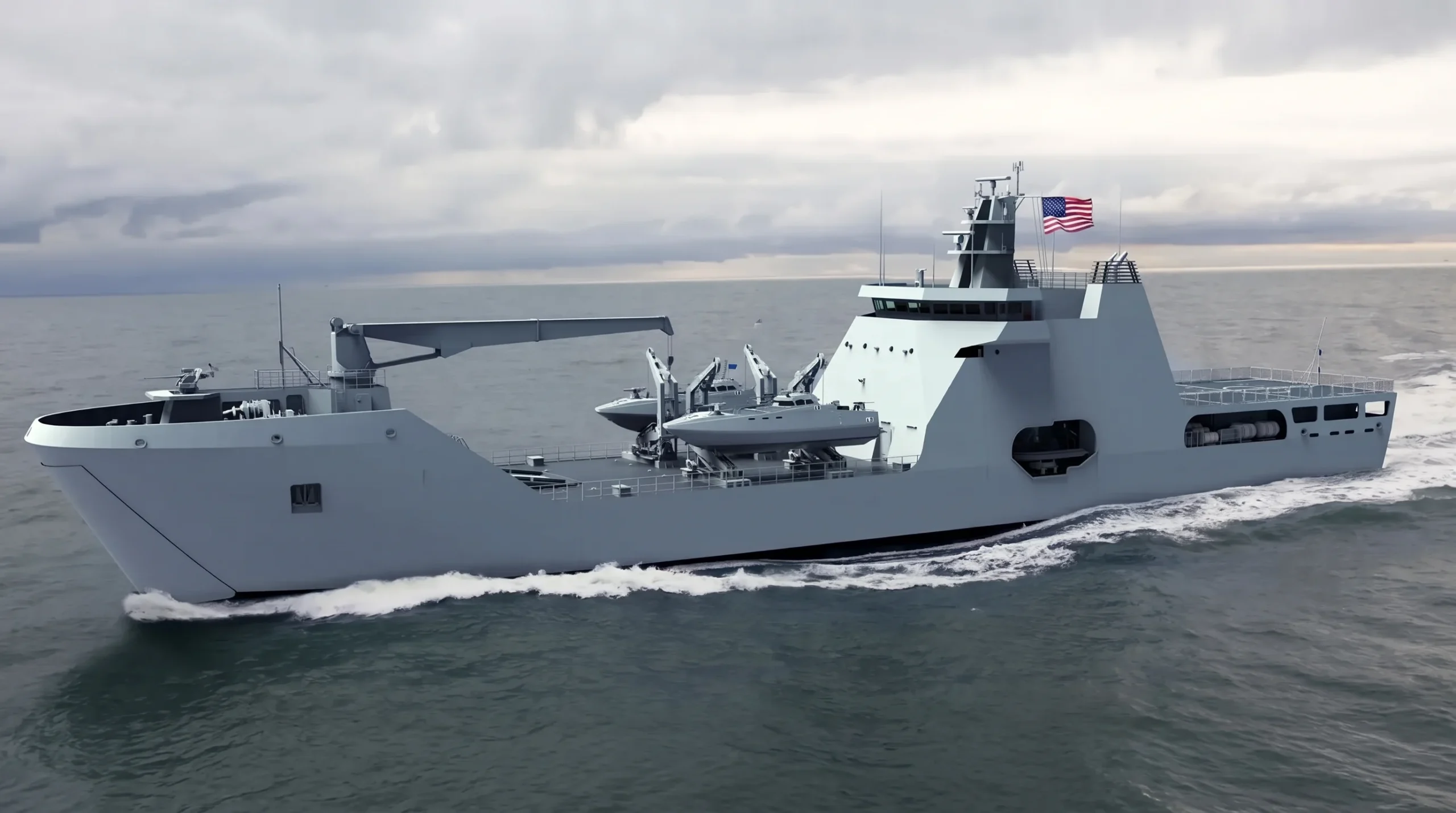
Hanwha Philly Shipyard will build a Landing Ship Medium (LSM) for the U.S. Navy and Marine Corps under a $269 million subcontract awarded by TOTE Services, the program’s vessel construction manager, Hanwha Defense USA (HDUSA) announced on October 29, 2026. The award covers one ship with options for three more, and it is the first contract for the South Korean-owned Philadelphia yard to build ships for the U.S. Navy.
The selection comes three and a half months after the Navy’s Portfolio Acquisition Executive for Maritime (PAE Maritime) awarded TOTE Services a $2.2 billion firm-fixed-price contract on July 13, 2026, to manage construction of up to eight McClung-class LSMs. The Navy is buying the ships to give the Marine Corps intra-theater mobility in the Western Pacific, where small units would move between islands and shorelines to set up expeditionary advanced bases and fire anti-ship missiles. LSM is the first Navy program run through a vessel construction manager (VCM), a model borrowed from commercial shipbuilding.
Hanwha Philly Shipyard Joins the LSM Vessel Construction Manager Model
Under the VCM structure, TOTE Services holds the prime contract with PAE Maritime and issues and manages subcontracts directly with shipyards. The Navy directed TOTE to place work with two yards: Gulf Coast-based Bollinger Shipyards for the lead ship, and Fincantieri Marinette Marine in Marinette, Wisconsin, for four hulls. Fincantieri received a $30 million contract in April 2026 for long-lead materials and production readiness on those four ships. TOTE kept discretion over the award strategy for up to three additional vessels in the initial batch and issued a request for proposals in July.
HDUSA is the first shipbuilder selected through that competition. According to TOTE, the decision rested on Hanwha’s “competitive pricing and acceptance of TOTE Services’ subcontract terms and conditions.” TOTE Services President Jeff Dixon said the build positions secured in the deal allow construction to start in the fourth quarter of 2027. The VCM contract carries a cumulative value of $2,605,075,850 if all options are exercised.
With five hulls already assigned to the directed yards, a firm Hanwha ship plus three options would exceed the eight-ship ceiling of TOTE’s current contract. Neither TOTE nor HDUSA has explained whether the options extend into a follow-on batch.
Hanwha brings direct experience with the model. The Philadelphia yard builds the Maritime Administration’s National Security Multi-Mission Vessel (NSMV) training ships under TOTE management, and HDUSA says four of the five vessels have been delivered. Hanwha acquired the yard in 2024. This week, HDUSA said it is acquiring a controlling stake in Hanwha Philly Shipyard, placing the facility under the Hanwha Aerospace subsidiary that leads the group’s U.S. defense business.
LST-100 Design Basis: Payload, Range, and Beaching Capability for EABO
The LSM derives from Damen Shipyards Group’s Landing Ship Transport 100 (LST-100), which Navy Secretary John Phelan announced as the design basis in December 2025 after years of requirements churn between the Navy and Marine Corps over the ship’s configuration and survivability. The Navy bought the design package for $17 million. Damen’s published specifications list a hull 100 meters (328 feet) long and 16 meters (52.5 feet) wide, a top speed of 15 knots and a range of 4,000 nautical miles for a ship of roughly 4,000 tons. The baseline design offers 1,020 square meters of roll-on/roll-off deck space, a core crew of 18, and an aft deck for helicopters and drones.
Those figures define the ship’s role. A 15-knot speed and modest displacement make the LSM a theater connector rather than an assault ship. It is built to shuttle Marine Littoral Regiment vehicles, rocket and missile launchers, fuel and ammunition between dispersed positions, then land them over a bow ramp onto austere beaches with no port infrastructure. That beaching capability is the operational core of Expeditionary Advanced Base Operations (EABO), which depends on repositioning small strike units faster than an adversary can target them.
The design is already in service with the Nigerian Navy, and Australia selected it for eight Landing Craft Heavy to be built by Austal in Western Australia. That record underpinned the Navy’s choice of a mature design over a new hull. U.S.-specific changes to the baseline, including combat systems, self-defense armament and survivability features, have not been publicly detailed.
Analysis: The Hanwha award tests two Navy bets at once. The first is the VCM promise of speed: TOTE moved from request for proposals to signed subcontract in roughly three months, a pace traditional Navy shipbuilding awards rarely match. The second is the entry of foreign-owned capacity into the naval industrial base. Hanwha’s yard adds a third LSM production line while established U.S. builders carry heavy submarine and surface combatant backlogs, and it gives Seoul a visible deliverable under the $150 billion U.S. shipbuilding investment pledge South Korea made in its 2025 trade deal with Washington. A single $269 million amphibious hull is a low-risk proving ground before Hanwha competes for larger Navy work.
The schedule now hinges on the directed yards. Bollinger’s lead ship sets the program’s critical path, and HDUSA states the first LSM is expected to deliver in 2030, later than the fall 2029 target the Navy cited in July. TOTE says subcontract discussions with Bollinger and Fincantieri are continuing. The next decision points are the exercise of Hanwha’s three options and the acquisition strategy for the remaining 27 ships of the planned 35-ship fleet.