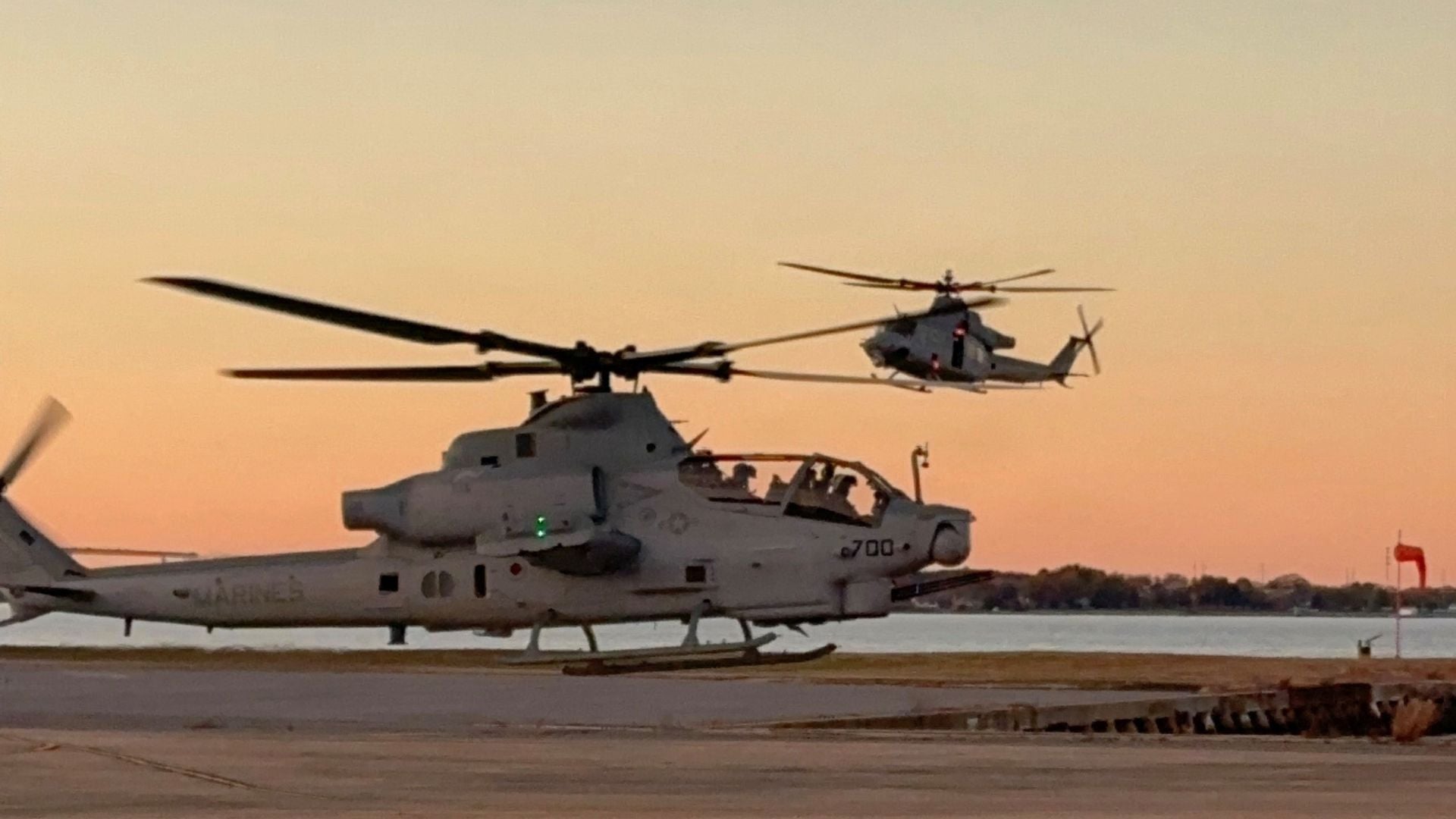
Naval Air Systems Command (NAVAIR) on October 30, 2026, awarded Bell Textron Inc. a $114,692,840 contract modification exercising an option under the H-1 Structural and Power Improvements for NextGen Effects (SPINE) Phase III effort. The award buys 15 A-kits, four mission kits and nine aircraft installations for the US Marine Corps AH-1Z Viper attack helicopter and UH-1Y Venom utility helicopter. The modification, P00001 to contract N0001926C0140, obligates the full amount in fiscal 2027 Navy aircraft procurement funds at award, with work scheduled for completion in June 2028.
The award is the first modification to the Phase III contract Bell announced on July 27, 2026, which the company valued at an estimated $300 million across a base period and three option years. That contract covers SPINE modifications to up to 49 aircraft, 28 AH-1Zs and 21 UH-1Ys, at Bell’s Amarillo Assembly Center in Texas, with inductions starting in mid-2027 and first redeliveries in 2028. Phase III follows the modification of one AH-1Z and one UH-1Y. Bell received the first AH-1Z at its Amarillo Assembly Center in March 2024, completed both upgrades in fall 2025 and transferred the two aircraft to Naval Air Station Patuxent River, Maryland, for flight testing. The program was previously designated the Structural Improvement Electrical Power Upgrade (SIEPU).
What the H-1 SPINE Upgrade Changes on the AH-1Z and UH-1Y
SPINE is an enabling modification rather than a new capability in itself. Bell says it provides greater electrical power capacity through an advanced, scalable architecture designed for rapid integration of current and future technologies, alongside structural improvements to the airframe. The company links SPINE to the Marine Corps’ Series A configuration, which it defines as improved defensive systems, digital interoperability and increased aircraft electrical power. Bell lists Series A content as more robust defensive systems, an advanced data bus, Link 16 and long-range, net-enabled weapons.
Neither NAVAIR nor Bell has disclosed the upgraded generation capacity in kilowatts or the weight the structural changes add.
The baseline aircraft are mature. Publicly available specifications indicate both types fly on two General Electric T700-GE-401C turboshafts rated at roughly 1,800 shaft horsepower each, driving a four-blade composite main rotor, and share 85% of their components, according to the Navy. The AH-1Z pairs its Target Sight System with AGM-114 Hellfire and AGM-179 Joint Air-to-Ground Missile loads, Advanced Precision Kill Weapon System rockets, AIM-9 Sidewinders and a three-barrel 20mm M197 cannon. Each new sensor, defensive suite or datalink added to that baseline draws on the same electrical system, whose overall capacity the H-1 program office (PMA-276) expects SPINE to increase significantly.
On the UH-1Y, Bell says SPINE also improves the fast-rope, hoist and litter kits used for personnel recovery. The contract announcement does not itemize the four mission kits in this award.
SPINE Phase III Kit Quantities, Funding and Supplier Footprint
The procurement mix is uneven. In aircraft modification programs, an A-kit comprises the permanent provisions built into the airframe, such as wiring, brackets and structural changes. Buying 15 A-kits against nine installations suggests NAVAIR is building kit inventory ahead of the induction rate, although the announcement does not explain the gap. The award also funds long-lead and time-critical components, an indication that the program office is protecting the mid-2027 induction schedule from supply chain delays.
The contract blends fixed-price-incentive, firm-fixed-price and cost-plus-fixed-fee line items. The modification was not competitively procured, consistent with Bell’s role as original equipment manufacturer.
Fort Worth, Texas, accounts for 38.1% of the work and Amarillo for 28.7%, followed by Tempe, Arizona (6.3%), Grand Rapids, Michigan (4.5%) and six smaller named sites, with 11% spread across other US locations and 1.1% performed outside the continental US. Amarillo’s share of less than a third, on an award that includes nine installations, suggests most of this money buys hardware rather than touch labor.
Analysis: SPINE is the gate through which every major H-1 capability insertion of the coming decade must pass. Marine aviation increasingly values the AH-1Z and UH-1Y for what they can sense, share and cue in a contested littoral fight, not only for what they carry on their pylons. Receiving off-board targeting over Link 16, employing longer-range munitions and surviving dense electronic warfare all depend on the additional electrical capacity SPINE is meant to provide. Buying kits ahead of aircraft suggests the Navy is front-loading hardware risk, which is where the program’s schedule exposure sits.
The next milestones are completion of flight testing at Patuxent River, the start of fleet inductions at Amarillo in mid-2027, first redeliveries in 2028 and exercise of the remaining options on N0001926C0140. Two questions remain open: how much of a fleet NAVAIR lists at 189 AH-1Zs and 160 UH-1Ys will eventually receive SPINE, and when the Series A content it is built to power will be funded.