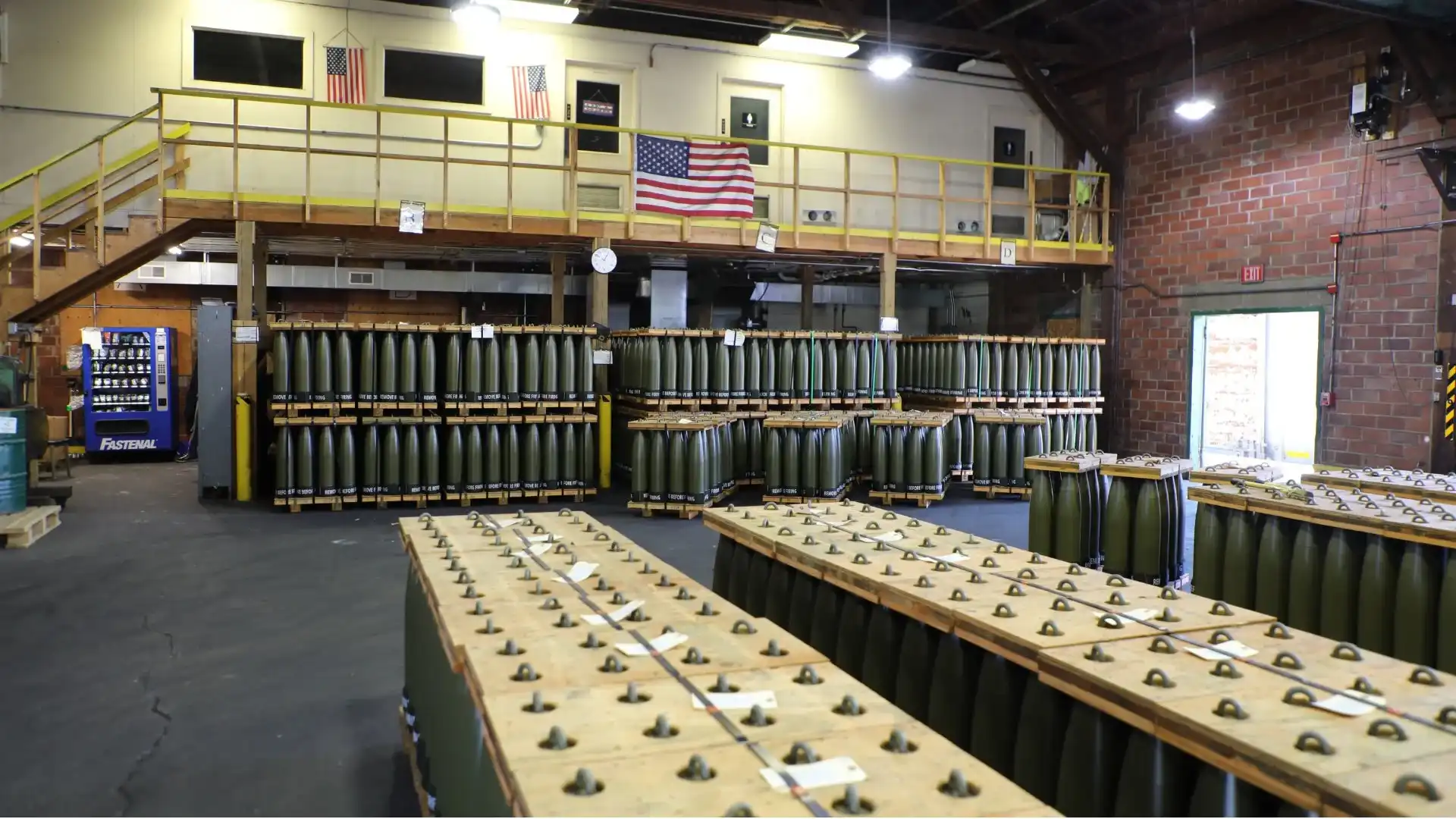
The U.S. Army has awarded a $4,171,491,000 firm-fixed-price multiple award task order contract to 11 companies to design, build, and commission new production capacity at its government-owned, contractor-operated (GOCO) ammunition plants, the Department of War announced on November 5, 2026. Army Contracting Command, Rock Island Arsenal, Illinois, is the contracting activity, and orders carry an estimated completion date of November 4, 2031.
The vehicle arrives as the Army works through a 15-year, roughly $16 billion plan to modernize its organic industrial base of 23 depots, arsenals, and ammunition plants. A July 9, 2026 evaluation by the Department of War Office of Inspector General found the Army producing about 36,000 155mm rounds per month as of March 2026, against a goal of 100,000, after a contractor-owned metal parts facility in Mesquite, Texas, failed to deliver projectile bodies that met specifications. Without that plant, the report concluded, the department can reach only 71,000 rounds per month.
Army Ammunition Plant Modernization Across Seven GOCO Sites
Solicitation documents issued for Project Lead Joint Services name seven plants in scope: Holston Army Ammunition Plant in Kingsport, Tennessee; Iowa Army Ammunition Plant in Middletown, Iowa; Lake City Army Ammunition Plant in Independence, Missouri; Milan Army Ammunition Plant in Milan, Tennessee; Scranton Army Ammunition Plant in Pennsylvania; Radford Army Ammunition Plant in Virginia; and the Quad City Cartridge Case Facility at Rock Island, Illinois.
Together they cover most of the ammunition production chain. Holston produces RDX- and HMX-based explosives and insensitive munitions explosives (IMX). Radford manufactures military propellants. Scranton forges 155mm projectile metal parts, Iowa loads, assembles, and packs artillery rounds, and Lake City, which has produced ammunition since 1941, is adding a 6.8mm facility for the Next Generation Squad Weapon. The Quad City facility produces deep-drawn steel and brass cartridge cases. Milan is an outlier: its production mission moved to Iowa in 2013, and the Army formally deactivated the plant in April 2025.
Task orders may cover energetic material lines for explosives and propellants, load, assemble, and pack lines, shell casing and metal parts lines, building upgrades, energy and environmental projects, and full commissioning to prove production capability and readiness. The Army can use design-build, design-bid-build, or progressive design-build delivery, and awardees must coordinate their work with each plant’s operating contractor.
How the $4.17 Billion MATOC Will Compete Each Task Order
The award follows a Request for Proposal released May 21, 2026, with the proposal deadline extended to July 6, 2026. The draft solicitation set out a Highest Technically Rated Offeror self-scoring evaluation. Eleven proposals were received, and the announcement lists 11 awardees, meaning every bidder secured a seat on the vehicle.
The bar for entry was high. The solicitation required bonding capacity of $200 million for a single project and $500 million in aggregate, Cybersecurity Maturity Model Certification Level 2 compliance, active Joint Certification Program status, and a safety Experience Modification Rate below 1.0. The ordering period runs five years, and task orders awarded before expiration may extend beyond it.
The $4.17 billion figure is a shared ceiling, not an obligation. The announcement states that work locations and funding will be determined with each order and lists no funds obligated at award. Minimum guarantees and first task order dates are undisclosed. The structure also gives the Army a standing, competed path for plant work. The Inspector General’s July report recorded that the Mesquite contract was not opened to competition and, according to Army Contracting Command officials, was issued as a task order under the Scranton property management contract rather than as a separate contract. Army Contracting Command-Rock Island maintains the work fell within that contract’s scope.
BAE Systems, MSM Group, and Nine Construction and Engineering Firms Win Seats
The pool leans toward heavy construction and engineering: Clark Construction Group, Burns & McDonnell Engineering, Hensel Phelps Construction, Alberici Constructors, J Kokolakis Contracting, M.C. Dean, Parsons Government Services, Bering-Weston JV, and Applied Research Associates sit alongside two firms with direct munitions experience.
BAE Systems Ordnance Systems, based in Kingsport, already operates two of the seven plants in scope. It has run Holston since 1999 under an operating contract renewed in December 2023 with an $8.8 billion ceiling and a 10-year base period, and it has operated Radford since 2012. The announcement does not address how the Army will manage potential organizational conflicts of interest if BAE competes for construction task orders at sites it operates.
MSM Group North America, of St. Petersburg, Florida, brings recent design-build experience inside the GOCO system. In August 2025, the Army awarded the company a $635 million fixed-price contract with economic price adjustment to design, build, and commission the Future Artillery Complex at Iowa Army Ammunition Plant. The firm is the U.S. arm of Slovakia’s MSM Group, part of the Czechoslovak Group (CSG), which broke ground on the complex in July 2026. General Dynamics Ordnance and Tactical Systems, which operates Scranton and built the Mesquite plant, does not appear among the awardees.
Analysis: The contract targets the capacity bottlenecks the 155mm shortfall exposed, but it is a delivery mechanism, not new production. Its value depends on how fast the Army funds task orders and whether builders can commission energetics and metal parts lines that work to specification. Mesquite shows the cost of commissioning risk: $469 million spent on a facility that, as of March 2026, had produced no compliant projectile bodies. Spreading future work across a pool that competes for each order gives the Army more leverage over cost and schedule than single-source arrangements tied to existing operating contracts. It also shifts integration risk onto the government, which must coordinate builders, operators, and program offices at every site.
The next indicators are the first task order awards, their locations, and their funding sources, which will show whether the Army prioritizes energetics at Holston and Radford, artillery capacity at Iowa and Scranton, or small-caliber lines at Lake City. Fiscal 2027 budget execution will determine how much of the $4.17 billion ceiling is actually used.