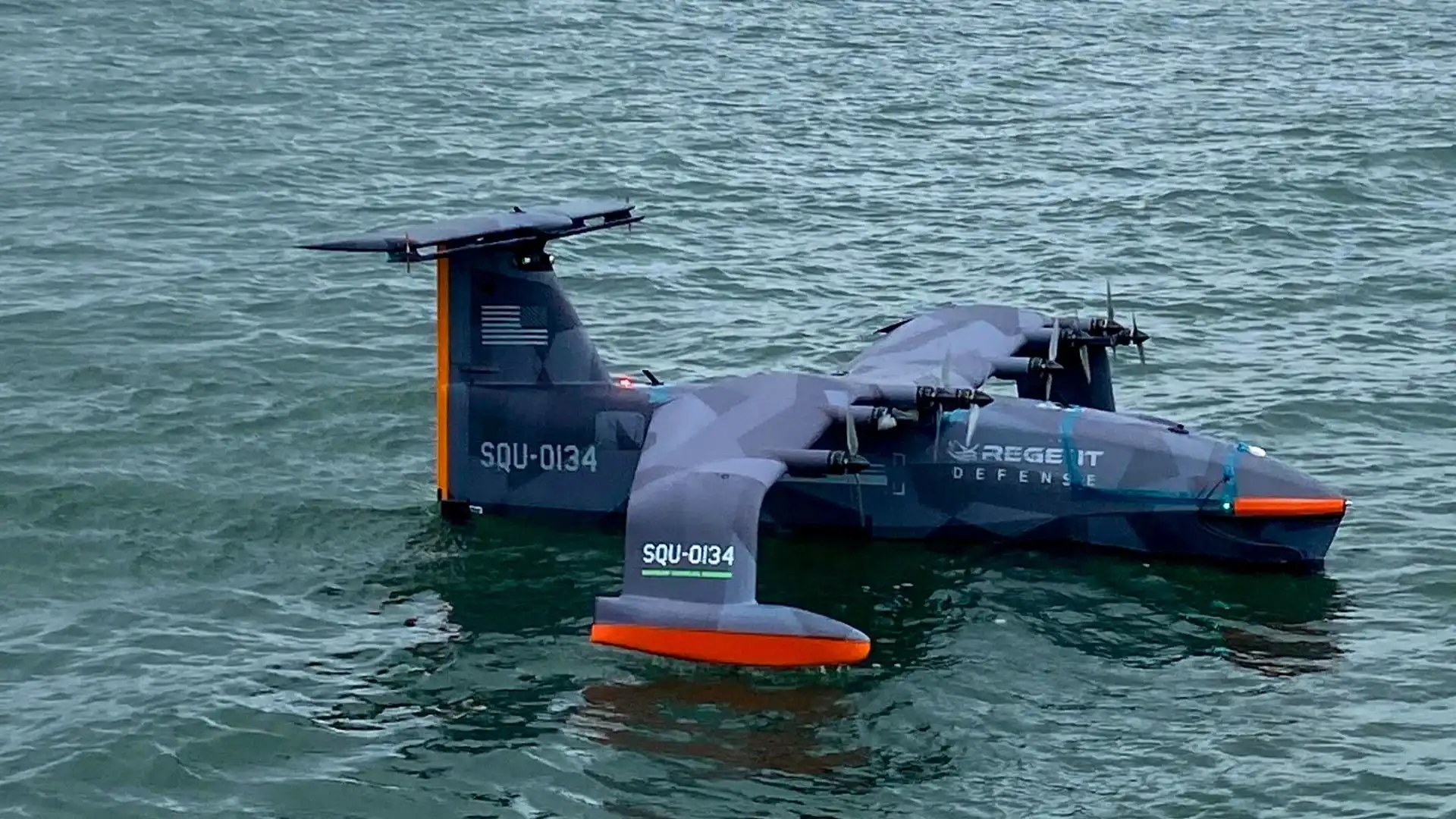
REGENT and NSI integrated REGENT’s Squire Seaglider drone with NSI’s Arowana unmanned undersea vehicle (UUV) during Maritime Big Play Pacific off San Clemente Island, California, using the wing-in-ground effect (WIG) craft to retask the UUV while it was underway and to pass control across a mixed fleet of uncrewed systems. The Rhode Island-based Seaglider developer announced the results on November 4, 2026.
Maritime Big Play is an AUKUS Pillar II experimentation series designed to integrate uncrewed maritime systems across the United States, the United Kingdom and Australia, and its 2026 Pacific iteration ran through October. The event was sponsored by the Office of the Under Secretary of War for Research and Engineering (OUSW(R&E)). The pairing targets an old problem: communicating with a submerged vehicle without forcing it to surface or abandon its mission.
How the Squire Seaglider Served as a Mobile Undersea Gateway
Squire is an autonomous Seaglider, a hydrofoiling WIG craft that REGENT classifies as an Unmanned Surface and Aerial Vehicle (USA-V). It flies within a wingspan of the water, below radar line of sight, at speeds up to 70 knots. REGENT cites a planned range of more than 100 nautical miles and a 50-pound configurable payload for intelligence, surveillance and reconnaissance (ISR), logistics, search and rescue, and anti-submarine warfare (ASW). The range figure remains a design target.
During the scenario, crews launched Arowana from a support vessel and sent it on a 2-mile transit toward a simulated high-value unit in the island’s leeward waters, with changing tides, visibility and weather built into the test conditions. While the UUV was underway, operators used Squire as a mobile gateway to update Arowana’s tasking in real time as new intelligence arrived, without recalling the vehicle or bringing it to the surface.
A UUV that must surface for new orders exposes itself and loses time; one that cannot be retasked keeps executing a plan that may already be obsolete.
The companies have not disclosed how the link between Squire and the submerged Arowana was established, whether by acoustic modem, buoy or another relay. Arowana’s dimensions, depth rating, endurance and sensor fit were not detailed either.
Fiber-Optic Guidance, TAK Integration and Beyond-Line-of-Sight Handoffs
The teams also guided Arowana over a fiber-optic tether, which keeps the control link intact where radio communication is limited; tether length was not disclosed.
On the aerial side, the combined team practiced beyond-line-of-sight handoffs from a short-range controller to a longer-range ground control station. It also verified line-of-sight radio links and Team Awareness Kit (TAK) integration across the uncrewed aerial systems on the range, giving operators a single common picture of every asset. According to the companies, tasking and control passed between systems during the mission rather than being reset between runs.
“Retasking an undersea vehicle mid-mission through a gateway vehicle is the kind of flexibility the fleet needs,” said Ed Rule, chief executive of NSI, a Lexington Park, Maryland, defense technology firm founded in 2004.
Analysis: The demonstration matters less for any single platform than for the architecture it points to. Undersea communications remain a binding constraint on distributed ASW and seabed operations. A fast, low-signature relay able to follow a UUV across a littoral operating area would let commanders treat undersea vehicles as dynamically tasked sensors rather than preprogrammed ones. TAK integration also lowers the cost of adding new vendors to a shared operating picture. The caveat is that a single scripted 2-mile transit in sheltered leeward waters says little about performance in open-ocean sea states or under electronic attack.
Neither company announced a contract tied to the demonstration. REGENT is moving Squire from prototype toward production at a 255,000-square-foot facility in North Kingstown, alongside its larger Viceroy Seaglider, for which it holds an expanded $20 million US Marine Corps contract. The next markers are disclosure of the Squire-Arowana link architecture, Squire endurance data from sustained testing, and whether a Navy or Marine Corps program office moves the gateway concept toward a funded requirement.