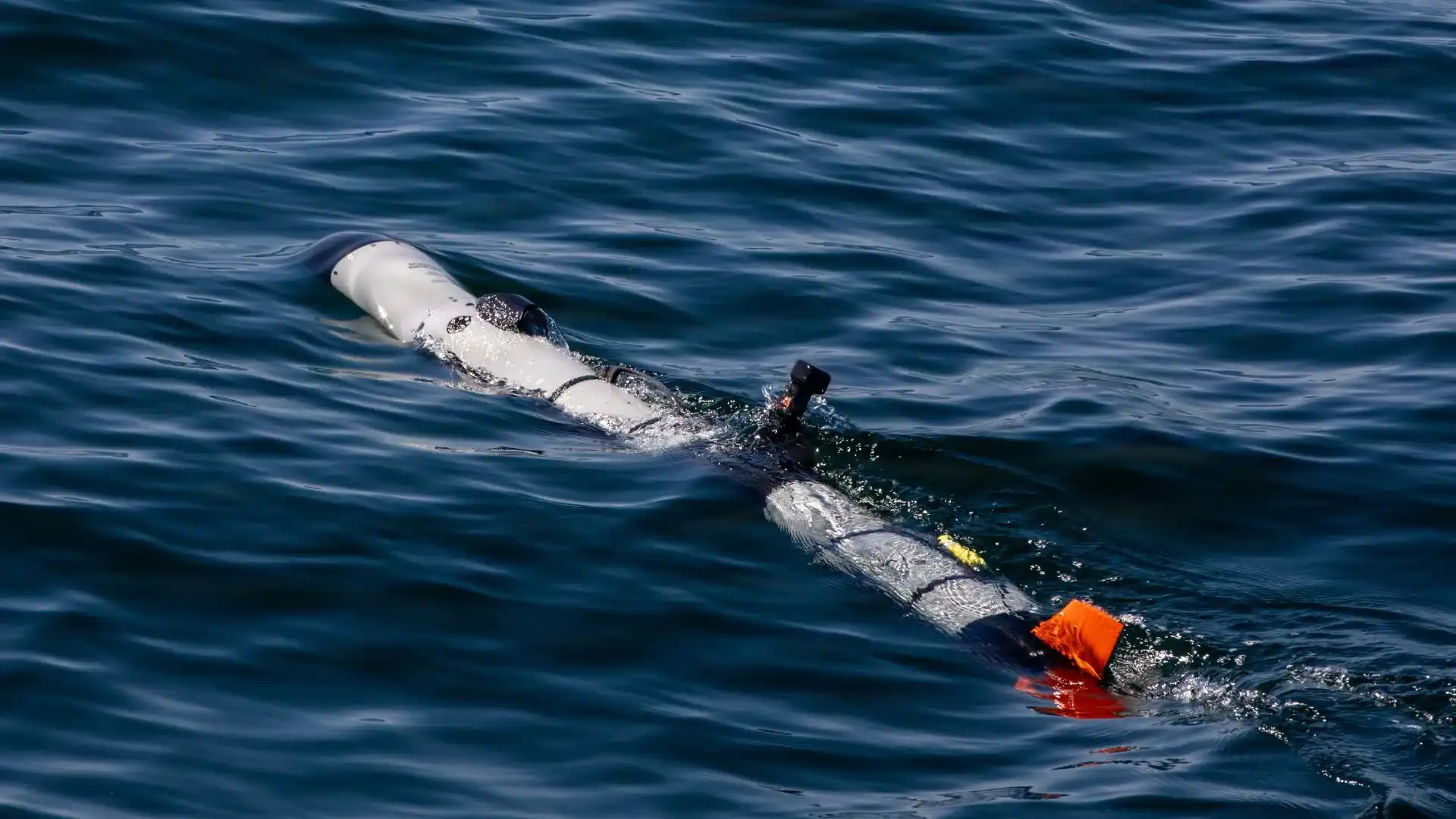
The Office of Naval Research (ONR) has exercised an $11,265,876 option on its contract with Integer Technologies LLC of Columbia, South Carolina, to continue the Operationalizing Marine Acoustics for Strategic Awareness effort, according to a Pentagon contract announcement dated November 5, 2026. The modification, P00002 to contract N0001426C2208, funds research into turning passive acoustic soundscape data into decision support for undersea warfare (USW) and seabed and subsea warfare (SSW).
The award extends a line of ONR-funded undersea autonomy work at the small business. In January 2026, ONR exercised a $10,657,183 option on a separate Integer contract, N0001425C2204, for the Intelligent Autonomous Systems for Seabed Warfare effort, with work running to January 2029. The new effort will be performed in Durham, New Hampshire, where Integer is establishing an office at the University of New Hampshire (UNH) under a five-year co-location agreement announced in June 2026 that pairs the company with the university’s Center for Acoustic Research and Education (UNH-CARE) for applied acoustics research. The value and award date of the base contract were not disclosed in the announcement.
How the Acoustic Soundscape Framework Supports Undersea Warfare
According to the announcement, Integer is developing a framework that combines physics-based models, machine learning models and novel acoustic soundscape models, deployable onboard both manned and unmanned platforms. The announcement also lists “super intelligence” models among the framework’s components without defining the term, and no technical description of that element has been made public.
The underlying premise mirrors terrain analysis on land. The ocean’s acoustic environment shifts with shipping traffic, marine life, sea state, temperature and salinity layering, and seabed composition. Those variables shape how far a sonar can detect a contact, how reliably an acoustic modem can pass data, and how detectable a platform’s own emissions are. The Navy’s stated aim is to give platforms an up-to-date picture of that environment so they can adapt how they maneuver, communicate, sense and act.
The program places heavy weight on automatic data processing and interpretation. The objective is for autonomous systems and their operators to understand the soundscape without manual analysis, producing actionable information for rapid execution and adaptation of USW and SSW missions. For unmanned underwater vehicles (UUVs) operating with minimal bandwidth to shore, onboard interpretation is a practical requirement, since raw acoustic data cannot be streamed back for analysis in real time.
Funding Profile and Integer’s Navy Seabed Warfare Portfolio
The option will be incrementally funded. ONR obligated $7,575,499 in fiscal 2026 research, development, test and evaluation (Navy) funds at the time of award, roughly 67 percent of the option value. Those funds expire at the end of the current fiscal year. Work is expected to be completed by October 2029.
Integer describes itself as a defense technology company that transforms raw data into decision advantage, with work spanning robotic and unmanned systems, sensors and perception, and cyber-physical systems. A $9.8 million Office of Naval Research award announced with Louisiana State University in July 2024 funded tools to improve how networks of maritime autonomous systems gather intelligence and make decisions, and the company supplies mission assurance software for Metron’s Lancet undersea vehicle. The Durham site gives the program access to UNH’s Judd Gregg Marine Research Complex, which supports work in the Great Bay Estuary and the Gulf of Maine.
Analysis: The award reflects a shift in how the Navy treats ocean acoustics, from an oceanographic product processed ashore to an operational layer that platforms consume in real time. That matters most for seabed and subsea warfare, where unmanned systems are expected to survey, patrol and protect undersea cables, pipelines and sensor fields for long periods with little human oversight. A UUV that can interpret its own acoustic surroundings can adjust depth, track and communications timing to preserve detection range and reduce its own signature. Routing the work through a small business tied to university acoustics labs also shortens the path from academic research to fielded autonomy.
The announcement does not name a transition sponsor, a target platform or a program of record for the framework, and it does not say whether at-sea demonstrations are planned before the October 2029 completion date. Further incremental funding actions against the option, and any follow-on award, will indicate whether the Navy intends to carry the capability beyond the science and technology phase.