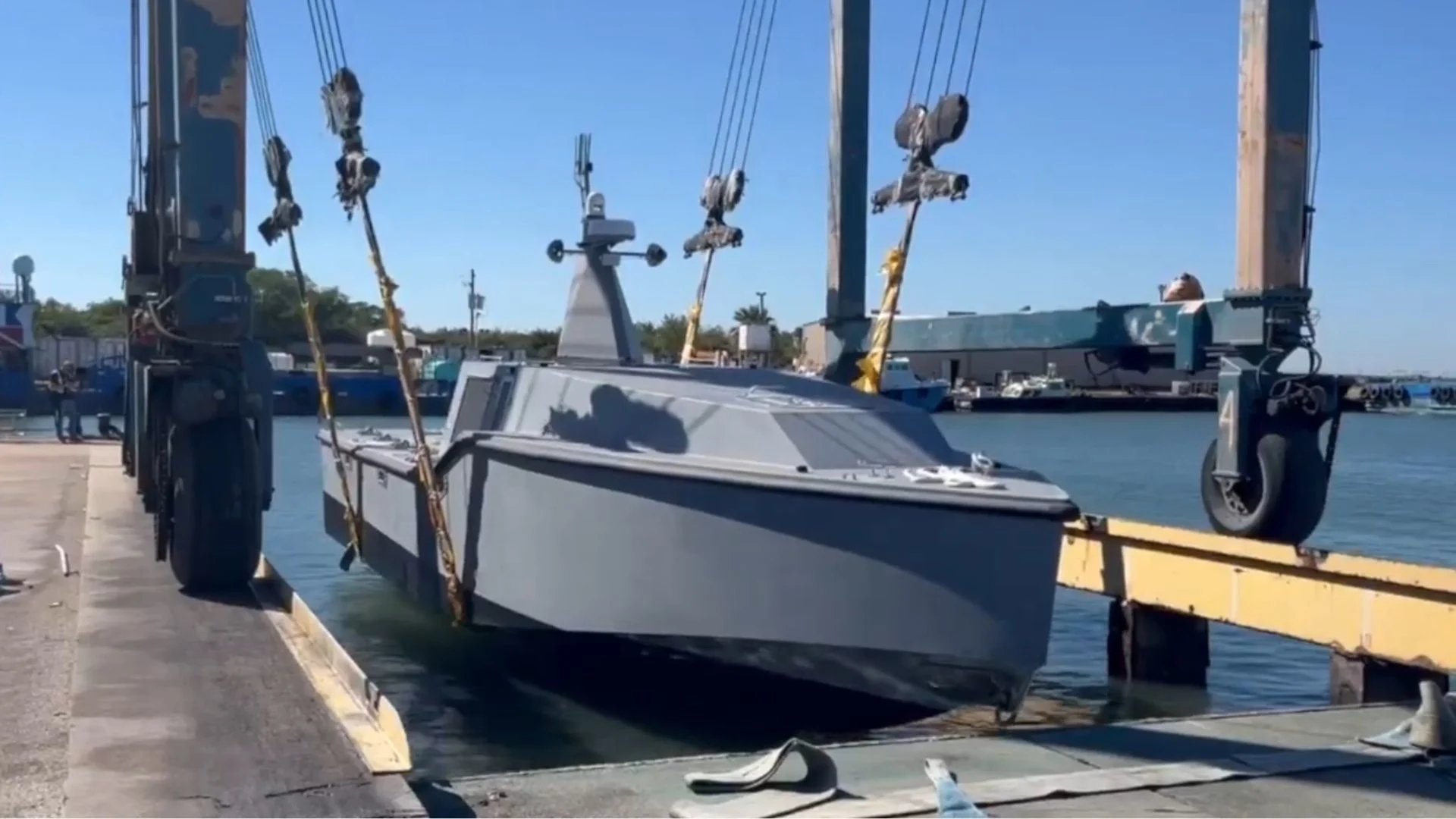
Saronic Technologies has launched another Mirage autonomous surface vessel (ASV), putting the 52-foot hull in the water at Galveston, Texas, this week after building it at the company’s Austin headquarters. Co-founder and CEO Dino Mavrookas announced the launch on X on November 6, 2026, describing Mirage as one of three Saronic platforms now in production alongside the 24-foot Corsair and the 180-foot Marauder.
The new hull follows the first Mirage, which entered the water at the same Galveston test site on July 2, 2026, to begin on-water trials. Saronic has not disclosed the new vessel’s hull number, trial schedule or intended customer, and no Mirage production contract has been made public. Mavrookas tied the launch to the industrial gap with China, citing 23 million gross tons of annual Chinese shipbuilding capacity against about 100,000 for the United States. Those figures match an Office of Naval Intelligence (ONI) estimate that first circulated in 2023.
Saronic Mirage Specifications: Range, Payload and Autonomy Stack
Company specifications describe Mirage as an aluminum-hulled, 52-foot (15.8-meter) ASV with a top speed above 35 knots, a range exceeding 2,500 nautical miles and a payload capacity of 3,500 pounds, roughly 1,590 kilograms. That is 3.5 times the 1,000-pound payload of the Corsair and 2.5 times its 1,000-nautical-mile range, placing Mirage between the Corsair’s short-cycle, attritable missions and the Marauder’s ocean-crossing logistics role.
The design grew during development. When Saronic unveiled Mirage in April 2025, it listed a 40-foot craft with more than 2,000 nautical miles of range and 2,000 pounds of payload. The production configuration added 12 feet of hull length, 500 nautical miles of range and 75 percent more payload, margin for heavier sensor, communications or effector packages.
Mirage operates fully autonomously or under remote human supervision through Echelon, Saronic’s mission planning and command-and-control software, and runs the same core autonomy stack as the rest of the fleet. That stack relies on passive perception for navigation, tracking and detection, backed by redundant communications links. Saronic lists maritime domain awareness, maritime security, and surface and aerial detection as baseline missions. Company imagery has also depicted Mirage fitted with a triple torpedo launcher, but no armed variant has been publicly contracted. Propulsion type, installed power, displacement and sensor fit remain undisclosed.
Corsair, Mirage and Marauder: Saronic’s Three-Tier Production Model
Mavrookas noted that the company’s first test platform, four years ago, was an $800 plastic fishing boat carrying $30,000 of cameras and batteries. The portfolio now spans three production tiers. The Corsair holds a $392 million Navy production agreement announced in December 2025, and Saronic says it had built more than 400 of them by September 2026. Naval Forces Central Command’s Task Force 59 began fielding the craft in March 2026. A Navy-operated Corsair recovered two Army AH-64 Apache crew members off Oman on June 8, and three Corsairs struck Iran’s Bandar Abbas naval base on July 12 in what US Central Command described as the first American combat use of sea drones.
At the top end, the Marauder medium unmanned surface vessel (MUSV), built in Franklin, Louisiana, reaches more than 25 knots and carries up to 150 metric tons in as many as four 40-foot ISO containers, with a published range of 5,400 nautical miles at a 25-ton load. On September 29, 2026, the Navy awarded production agreements for 10 MUSVs each to Saronic, HII and Galliano Marine Services, at a Navy-reported average cost of about $40 million per vessel.
Saronic says its Austin plant can build hundreds of Mirages and thousands of Corsairs a year; it has published no Mirage delivery figures.
Analysis: The ONI comparison counts gross tonnage, a metric driven by commercial hulls, so no volume of 52-foot drone boats will move it. What a Mirage line changes is the number of sensor and effector nodes the Navy can field without competing for drydock space: a hull built at an inland plant and moved overland to the coast bypasses the waterfront bottleneck constraining crewed warship output. The tonnage question falls instead to Port Alpha, Saronic’s planned shipyard in Brownsville, Texas, which the company says will open with 150,000 gross tons of annual capacity, more than the ONI estimate for the entire current US base. Mirage’s own exposure is demand: unlike Corsair and Marauder, it has no disclosed buyer.
Near-term markers sit across the portfolio: the first Marauder deliveries under the MUSV award and Port Alpha, where Saronic broke ground on September 30, 2026. The yard is slated to open in 2028, with Navy Landing Craft Utility (LCU) 1700 vessels among its first builds and deliveries expected from 2029. A Mirage production award before then would confirm that the middle tier has a customer as well as a production line.