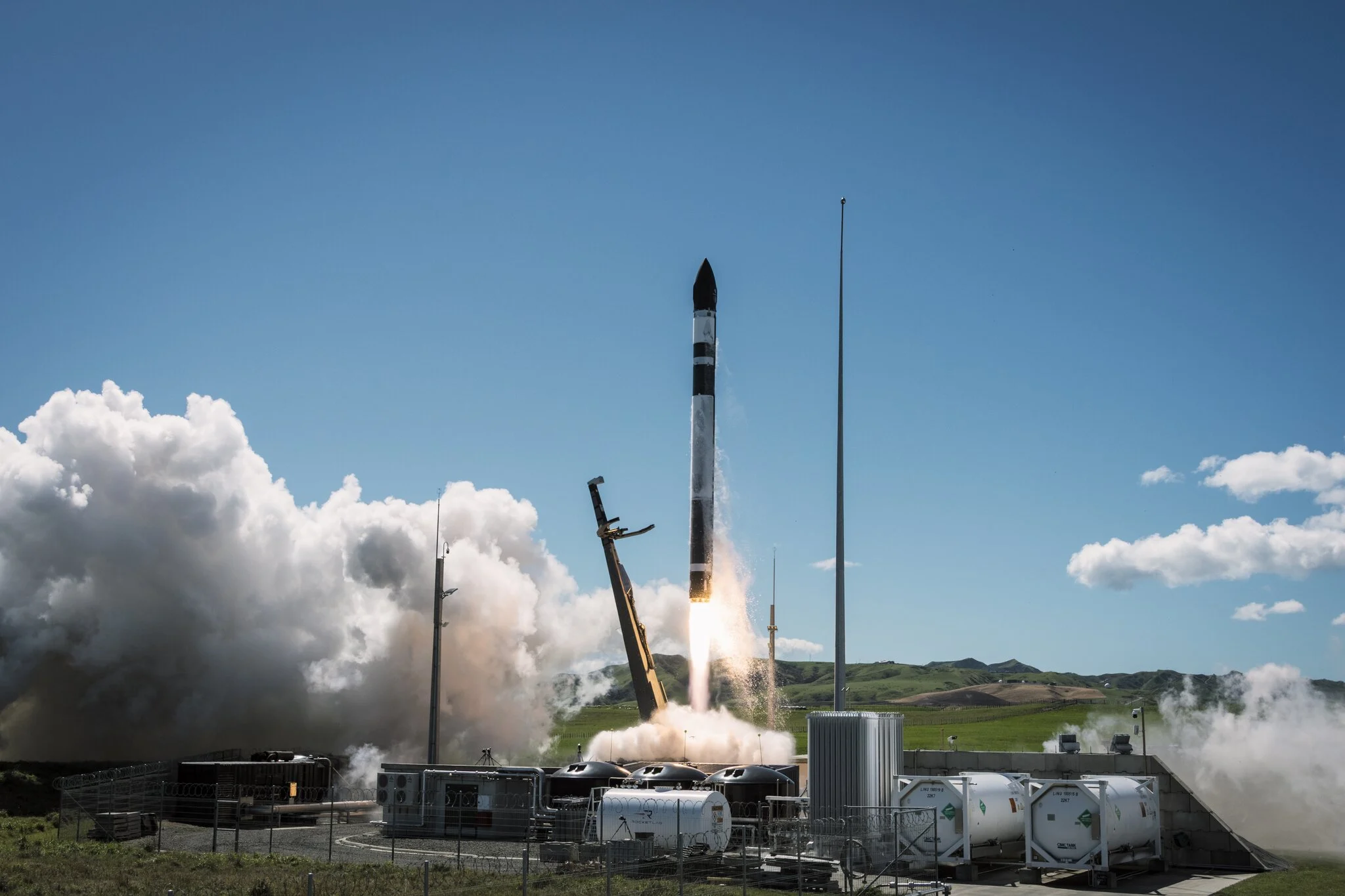
Rocket Lab signed a multi-year agreement on September 30, 2026, to fly 20 dedicated Electron missions for Tokyo-based synthetic aperture radar (SAR) operator Synspective, the largest commercial contract in Electron’s history. The launches will place 20 StriX satellites into sun-synchronous orbit (SSO) from Rocket Lab Launch Complex 1 on New Zealand’s Mahia Peninsula, with missions scheduled annually from 2028 through 2031. Financial terms were not disclosed.
The order lifts Synspective’s total Electron bookings to 47 missions, the most of any Rocket Lab customer. Electron has carried every StriX spacecraft since 2020, most recently on September 19, 2026, when the Owl By The Dozen mission delivered the 12th satellite on Electron’s 96th flight and 17th of the year. The deal also lands seven months after Synspective became an imagery supplier to the Japanese Ministry of Defense (MoD) Satellite Constellation Project, which runs through March 31, 2031.
Rocket Lab Synspective Contract Extends Electron Manifest to 2031
Each mission under the agreement carries a single StriX spacecraft, preserving the dedicated-launch model that lets Synspective set the orbital plane, altitude, and timing for every satellite. Rocket Lab has not released a year-by-year split; an even distribution would mean five launches per year for this customer alone.
The orbit choice marks a shift. Recent StriX missions, including the May 22, 2026, Viva La StriX launch, targeted a 572 km orbit inclined at 44.8 degrees, a mid-inclination geometry that concentrates revisits over Japan’s latitudes. The new block goes to SSO, a near-polar orbit that trades regional dwell time for global access, including high-latitude regions the current planes never overfly. That matches Synspective’s stated goal of imaging any point on Earth within hours, day or night and in any weather.
Per Rocket Lab’s published specifications, Electron is a two-stage carbon-composite vehicle that stands 18 m tall, measures 1.2 m in diameter, and weighs 13,000 kg fueled. Nine 3D-printed, electric-pump-fed Rutherford engines burning liquid oxygen and kerosene deliver 190 kN at liftoff and 224 kN at peak, while a single vacuum Rutherford rated at 25.8 kN powers the second stage. A Kick Stage performs final orbit insertion. Rated payload of 300 kg to low Earth orbit leaves wide margin for a 100 kg-class StriX, and Rocket Lab fields a custom fairing configuration sized to the satellite’s stowed envelope. Launch Complex 1 hosts two of Electron’s three pads, the third sitting at Wallops Island, Virginia. The company says the contract pushes its total launch backlog past 100 missions.
StriX X-Band SAR Design and Japan’s Defense Constellation Role
StriX traces to the Cabinet Office’s Impulsing Paradigm Change through Disruptive Technologies (ImPACT) program, which funded small SAR development with the University of Tokyo, the Tokyo Institute of Technology, and the Japan Aerospace Exploration Agency (JAXA) from fiscal 2015 to 2019. Synspective’s published specifications describe a 100 kg-class satellite stowed at 0.8 m by 1.0 m by 0.8 m that unfolds a seven-panel, parallel-plate slot array antenna measuring 5 m by 0.8 m. The X-band radar operates at 9.65 GHz with 1 kW of peak RF power, chirp bandwidth up to 600 MHz, VV polarization, left and right look capability, and a 15 to 45 degree off-nadir envelope. The satellite carries onboard propulsion and has a design life of roughly five years. Publicly reported figures cite 1 to 3 m ground resolution and 10 to 30 km swath widths.
Those parameters carry operational weight. X-band SAR images through cloud, rain, and darkness, which suits maritime surveillance along the Nansei island chain and in the East China Sea, where weather routinely degrades electro-optical collection. The five-year design life also means the earliest StriX satellites will need replacement inside the new contract window.
The defense link is now contractual. In February 2026, the MoD executed a 283.1 billion yen service contract, tax included, with Tri-Sat Constellation Co., a special purpose company formed by Mitsubishi Electric, SKY Perfect JSAT, and Mitsui & Co., to deliver persistent imagery intelligence through March 31, 2031. Synspective holds a 105.6 billion yen subcontract for small-SAR imagery, alongside partners Institute for Q-shu Pioneers of Space (iQPS), Axelspace, and Mitsui Bussan Aerospace. The constellation is tied to reconnaissance and stand-off defense requirements, where long-range strike depends on timely detection and tracking of targets beyond the horizon.
Analysis: The contract hardens a structural dependency in Japan’s emerging space intelligence, surveillance, and reconnaissance (ISR) architecture. Both small-SAR partners named in the MoD project rely on the same launcher: iQPS has booked 18 Electron missions, and Synspective now holds 47. A large share of Tokyo’s commercial radar reconnaissance capacity therefore flows through one US company’s rocket flying from a single New Zealand launch complex. That arrangement deepens allied industrial integration and secures guaranteed slots in a congested launch market, but it concentrates risk: an Electron stand-down would stall replenishment for two constellation suppliers at once. Proliferation is the counterweight. At roughly one-twentieth the cost of a conventional SAR satellite including launch, by Synspective’s estimate, StriX makes numbers, rather than individual hardening, the constellation’s primary survivability lever.
Fifteen StriX launches remain on the current manifest before the first mission under the new block in 2028. Open questions include the contract value, the annual launch split, whether the 2028 to 2031 satellites introduce a new StriX variant, and how a 47-mission total reconciles with Synspective’s stated 30-satellite constellation target, a gap that points to replacement of aging spacecraft, expansion, or both.